You know that feeling when your phone dies, the Wi-Fi is out, and suddenly the afternoon stretches endlessly in front of you? Our grandparents never had that problem. Long before screens existed, human beings played and the games they invented were so brilliantly simple, so deeply social, and so much fun that they survived for generations. This blog is covered by zainblogs. These are the 10 Traditional Games Everyone Should Know, and by the end of this guide, you will want to put down your phone and play every single one.
Whether you grew up in Lahore, London, Lagos, or Lima chances are at least one game on this list belongs to your childhood. This guide goes beyond just listing them. We tell you the history, how to play, why these games matter, and why keeping them alive is one of the most important things we can do for culture, connection, and community.
What You Will Find in This Guide
Why traditional games still matter in 2025
The 10 Traditional Games Everyone Should Know full rules, origins, and benefits
How traditional games compare to video games
How to introduce these games to children today
Efforts to preserve traditional games globally
Frequently Asked Questions
Why Traditional Games Still Matter
10 Traditional Games Everyone Should Know because play is the oldest universal language.
Before we dive into the list of 10 Traditional Games Everyone Should Know, let us ask: why does any of this matter in 2025?
The answer is more important than you might think. Traditional games are not just entertainment they are living archives of culture, geography, and social values. According to UNESCO’s work on Intangible Cultural Heritage, traditional games are recognised as expressions of cultural identity that must be actively preserved.
Here is what modern research tells us about the value of traditional play:
Cognitive development: traditional games requiring strategy (like Mancala or Chess) develop working memory, planning, and problem-solving
Social bonding: games that require physical proximity and verbal communication build empathy and cooperation far more effectively than digital alternatives
Physical fitness: most outdoor traditional games provide moderate-to-vigorous physical activity — exactly what health bodies recommend for children
Cultural identity: playing your ancestral games connects you to your community and your history
Mental health: unstructured outdoor play reduces anxiety and depression in children
The 10 Traditional Games Everyone Should Know
This list is global, inclusive, and carefully selected to represent different continents, skill types, and age groups. Each of these 10 Traditional Games Everyone Should Know can be played with zero technology and minimal equipment.
1. Kabaddi The Contact Sport of Ancient India
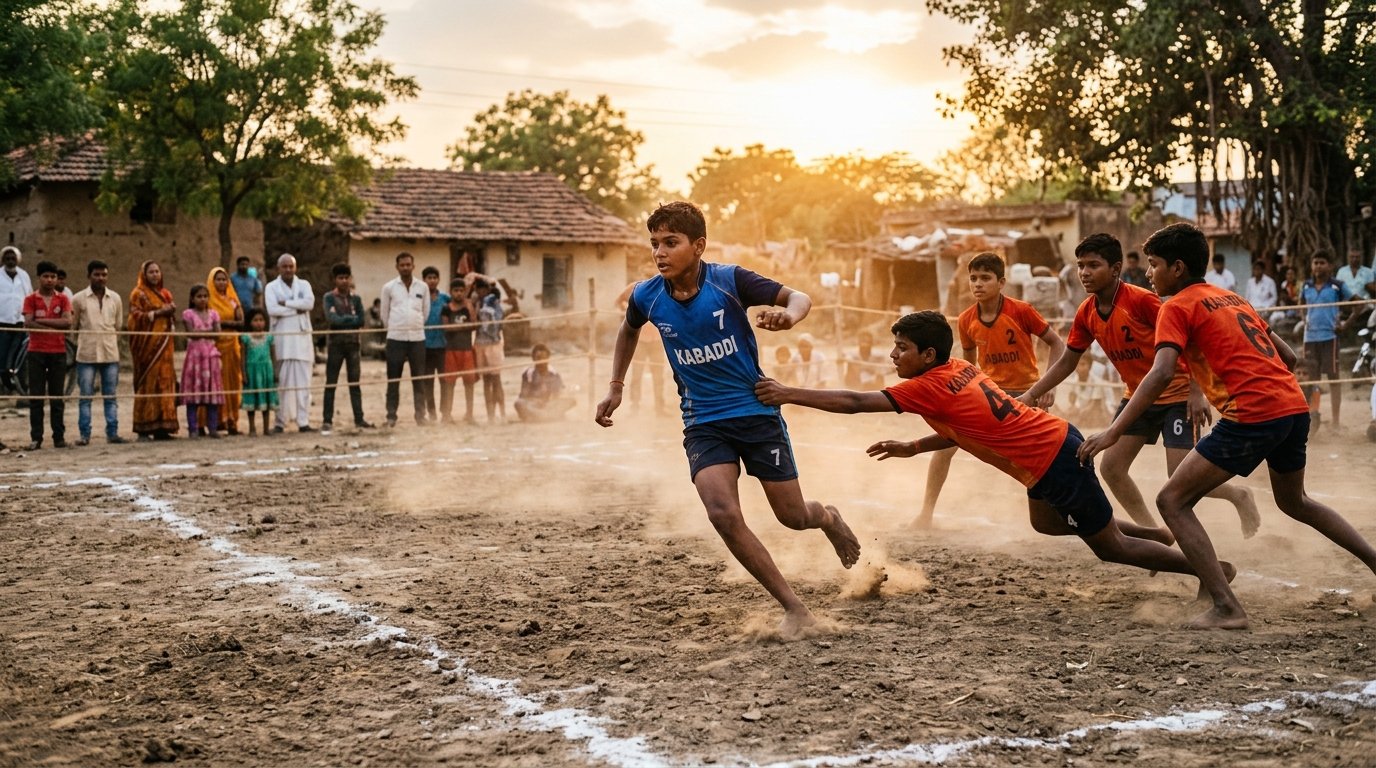
Kabaddi one of the 10 Traditional Games Everyone Should Know is a contact sport played for over 4,000 years.
If you have never seen Kabaddi, picture a sport where one player holds their breath, chants ‘kabaddi-kabaddi-kabaddi’, charges into enemy territory, tags opponents, and must return before exhaling. Sound wild? It is. And it is thousands of years old.
Origin: South Asia (India, Pakistan, Bangladesh, Sri Lanka). References appear in ancient Tamil literature dating back to 400 BC.
Players needed: 12 (two teams of 6, played on a court 12.5m x 10m for men)
How to play:
Two teams occupy opposite halves of the court
One player (the ‘raider’) crosses into the opponent’s half, chanting ‘kabaddi’ continuously without taking a breath
The raider tries to tag opponents and return safely
Tagged players are out opponents try to tackle the raider before they return
Points scored for successful raids and tackles
Why it belongs in 10 Traditional Games Everyone Should Know: Kabaddi was included in the Asian Games in 1990 and now has a thriving professional league.
Pro Kabaddi League). It is a rare traditional game that successfully transitioned to global professional sport.
Develops: explosive speed, breath control, body strength, tactical thinking
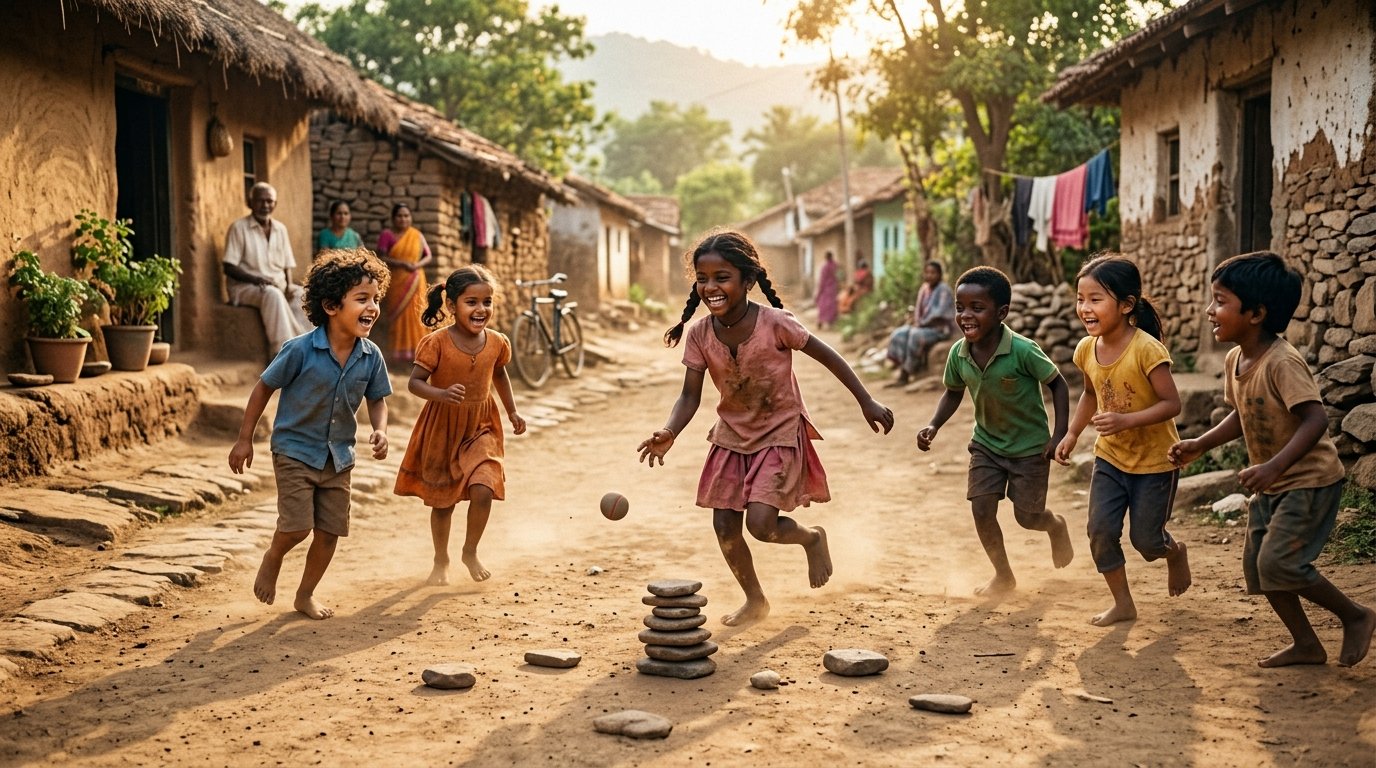
Pittu Garam known across South Asia as Saat Pathar, Lagori, or Seven Stones — is arguably the most nostalgic game on our list of 10 Traditional Games Everyone Should Know for anyone who grew up in Pakistan or India.
Origin: South Asia over 5,000 years old, with references in ancient texts
Players needed: 6–14 (two teams)
Equipment: 7 flat stones and a rubber ball
How to play:
Stack seven flat stones in a tower in the centre
One team throws the ball to knock the tower down
Once knocked, the throwers must rebuild the tower while the defenders try to hit them with the ball
If a rebuilder is hit, they are out. If the tower is rebuilt, the throwers win
Unique angle why this game is genius: Pittu Garam teaches simultaneous coordination between attack and defence, spatial awareness, and group strategy in a way that is almost impossible to replicate digitally.
Develops: throwing accuracy, team coordination, spatial awareness, agility
Best age: 7–16
Equipment cost: essentially zero
3. Mancala The World’s Oldest Board Game
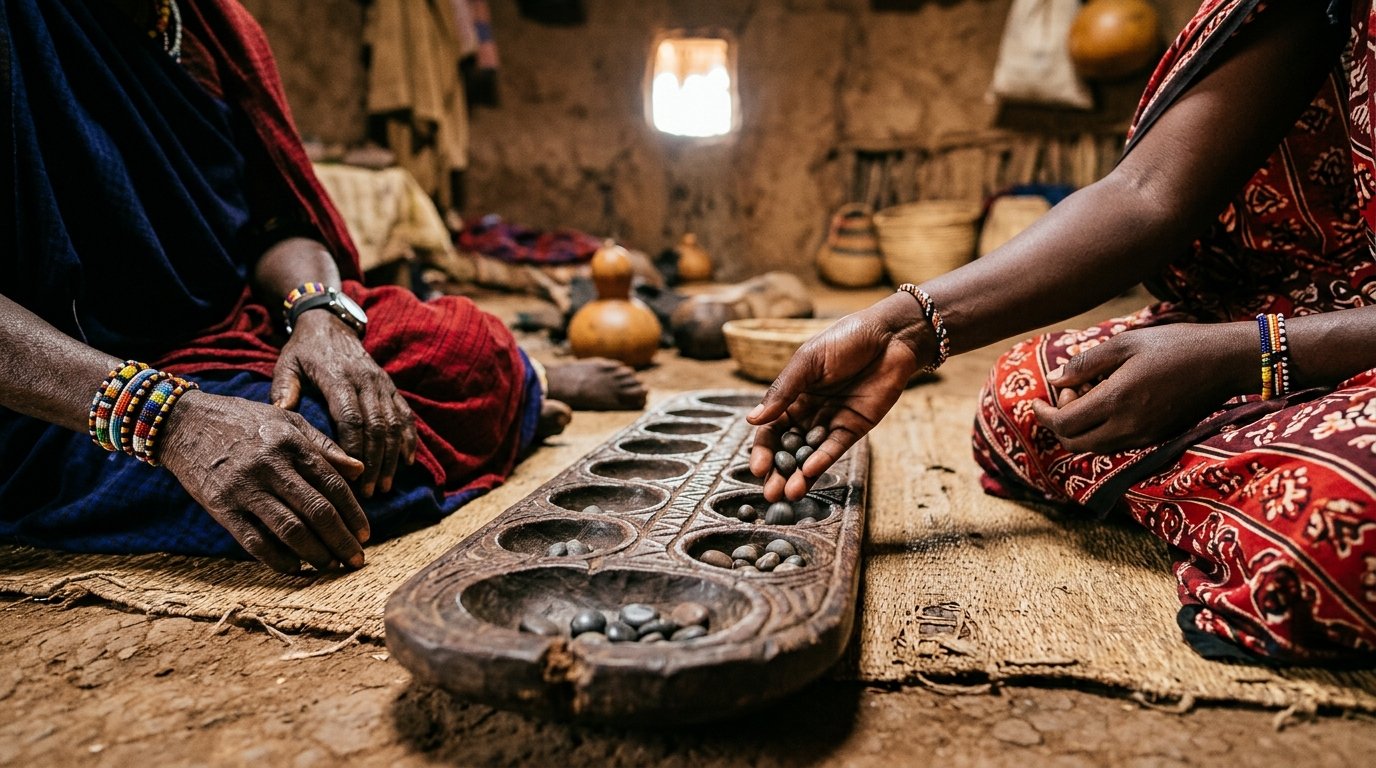
Mancala one of the 10 Traditional Games Everyone Should Know is believed to be the oldest board game in human history.
While the world debates Chess versus Go, Mancala sits quietly in the corner as quite possibly the oldest board game ever played by human beings. It is undoubtedly one of the 10 Traditional Games Everyone Should Know
Origin: Africa earliest evidence found in Ethiopia and Egypt, dating to approximately 700 AD, though some estimates go back to 1000 BC
Also known as: Bao (East Africa), Oware (Ghana), Congkak (Southeast Asia), Kalaha (Western adaptation)
Players needed: 2
Equipment: A Mancala board (12 small pits + 2 large stores) and 48 seeds or pebbles
How to play (basic Kalaha rules):
Each player has 6 small pits on their side and one large store (Mancala) on the right
Each pit starts with 4 seeds
On your turn, pick up all seeds from one pit and distribute them counterclockwise, one per pit
If your last seed lands in your Mancala, take another turn
If your last seed lands in an empty pit on your side, capture opponent’s seeds opposite
Game ends when one side is empty the player with most seeds wins
Long before cricket existed, South Asian children were playing Gilli-Danda a game so mechanically similar to cricket and baseball that historians debate which came first. As one of the 10 Traditional Games Everyone Should Know, Gilli-Danda deserves far more global recognition than it gets.
Origin: South Asia over 2,500 years old. Mentioned in ancient Indian epic texts
Equipment: Danda (a long stick, about 50cm) and Gilli (a small tapered oval piece of wood, about 7cm)
How to play:
Place the gilli across a small hole in the ground
Use the danda to flick the gilli into the air by hitting its tapered end
When the gilli is airborne, hit it as far as possible with the danda
Opponents try to catch the gilli if caught, the hitter is out
Distance is measured in danda lengths the further, the better
Equipment cost: Can be made from any sturdy sticks found outdoors
5. Kho-Kho The Chase Game That Never Gets Old
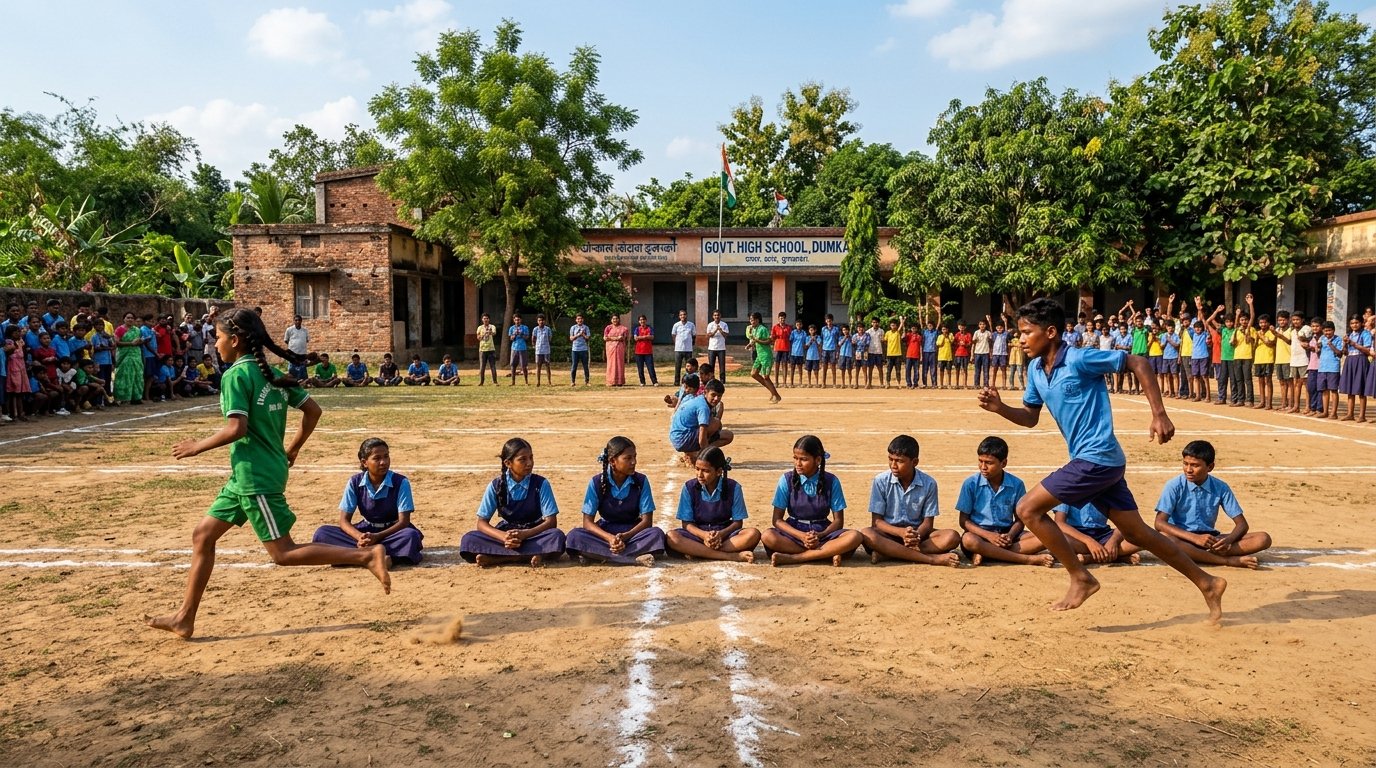
Kho-Kho demands explosive speed and tactical brilliance a must-have in any list of 10 Traditional Games Everyone Should Know.
Kho-Kho is one of those games that sounds impossibly simple until you actually play it then you realise it is a masterclass in speed, strategy, and spatial awareness. It absolutely belongs on the 10 Traditional Games Everyone Should Know list.
Origin: India over 1,000 years old, originally called Rathera
Players needed: 9 per team (18 total)
How to play:
9 players from one team sit cross-legged in a row, alternating directions they face
3 players from the opposing team are ‘chasers’ their job is to avoid being tagged
One designated chaser can tap a sitting player and shout ‘Kho!’ to swap that player becomes the new chaser
The chasers try to tag all runners in the shortest time
Of all the 10 Traditional Games Everyone Should Know, Hopscotch may be the most universally recognised. It has been independently invented by cultures on every continent and is still drawn on pavements by children worldwide today.
Origin: One of the earliest records comes from ancient Roman Britain soldiers reportedly used full-length courses exceeding 30 metres for military training
Equipment: Chalk or stones to mark the grid, a small stone or marker
How to play (standard version):
Draw numbered squares 1–10, usually in a pattern of singles and doubles
Throw your marker onto square 1
Hop through the course skipping the square your marker is on
Return and pick up your marker on the way back (without touching lines)
Advance to the next number each round miss your square or fall, and you lose your turn
Develops: balance, coordination, number recognition (great for young children), self-regulation
Best age: 4 and above
Equipment cost: A piece of chalk
7. Marbles Strategy in Your Pocket
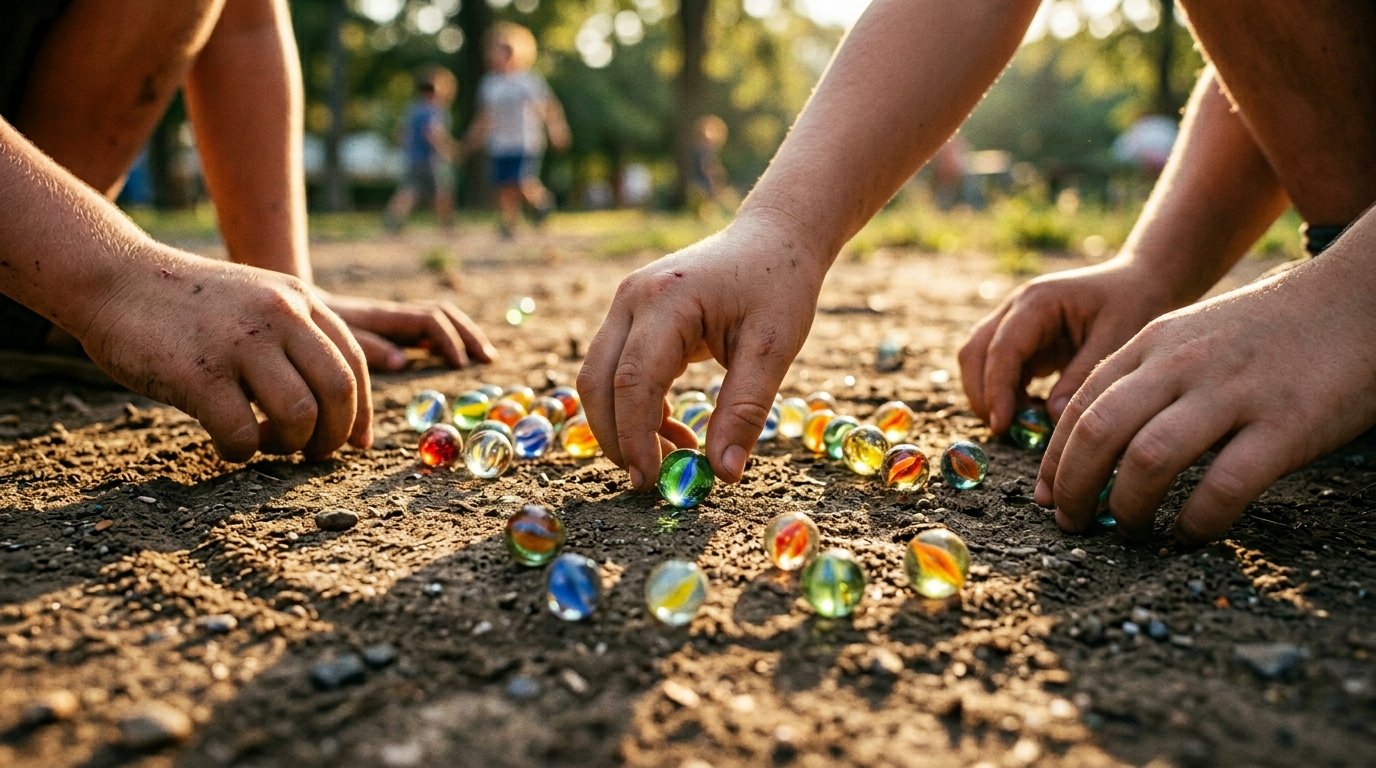
Marbles one of the 10 Traditional Games Everyone Should Know have been played in virtually every civilisation in recorded history.
Marbles appear in Egyptian archaeological sites from 4000 BC, Roman ruins, and virtually every ancient civilisation. They are tiny, beautiful, and pack a remarkable amount of strategic depth. They deserve their place in the 10 Traditional Games Everyone Should Know
Equipment: A collection of marbles typically a larger ‘shooter’ marble and smaller target marbles
How to play (Ring Taw most common version):
Draw a circle about 1 metre in diameter on the ground
Each player places an equal number of marbles inside the ring
Players take turns shooting their shooter marble from outside, trying to knock target marbles out of the ring
Any marble knocked out is kept by the shooter
Player with most marbles at the end wins
Marbles have even inspired competitive international play the British Marbles Board of Control has run the World Marbles Championship in Tinsley Green, England since 1932.
Develops: fine motor control, angle calculation, hand-eye coordination, strategy
Best age: 5 and above
8. Tug of War Strength, Unity, and Pure Tension
Tug of War is the ultimate test of collective strength and coordination. As one of the 10 Traditional Games Everyone Should Know, it has one of the most fascinating trajectories from ancient battlefields to Olympic stadiums to village fairs.
Origin: Ancient civilisations including Egypt, Greece, China, and India depicted in Egyptian murals from 2500 BC
Olympic history: Tug of War was an official Olympic event from 1900 to 1920. Great Britain won three gold medals in that era. There is an active campaign to have it reinstated.
Players needed: 2 teams of equal numbers can be played with as few as 2 per side
How to play:
Mark a centre line and two lines 4 metres either side
Both teams grip the rope from either end
On signal, pull. The team that pulls the other team’s marker past the centre line wins
Develops: teamwork, raw strength, coordination, willpower
Best age: 6 and above
Equipment: A strong rope and a field
9. Blind Man’s Buff Trust, Sound, and Giggles
Don’t let the simple premise fool you. Blind Man’s Buff is one of the oldest recorded games in human history, and it appears on our 10 Traditional Games Everyone Should Know list because of its extraordinary universal appeal across every culture and era.
Origin: Documented in ancient Greece over 2,000 years ago. Referenced in Chinese writings from the Han dynasty. Appeared in European illustrations from the 14th century onwards
Known as: Marco Polo (water version), Blind Man’s Bluff, Ankh Micholi (Pakistan/India)
How to play:
One player is blindfolded
Other players scatter in the playing area
The blindfolded player tries to catch someone using only sound and touch
Once caught, the blindfolded player tries to identify the caught person
Correct identification means the caught person becomes ‘it’
Beyond the fun, Blind Man’s Buff is a remarkable sensory development tool. Children playing it develop heightened spatial awareness, trust, and awareness of others around them.
Develops: sensory awareness, spatial thinking, trust, laughter the best medicine
Best age: 4 and above
10. Carrom The Finger-Flicking Champion
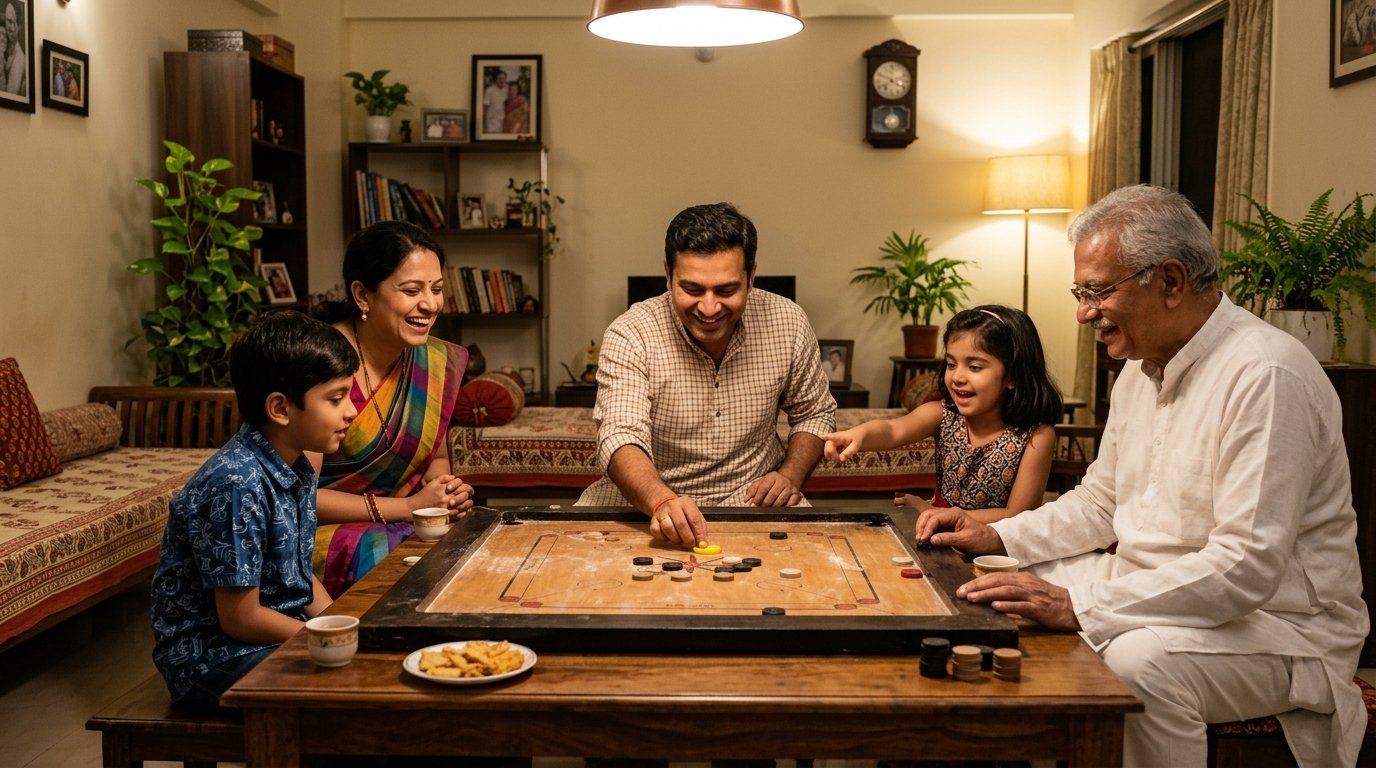
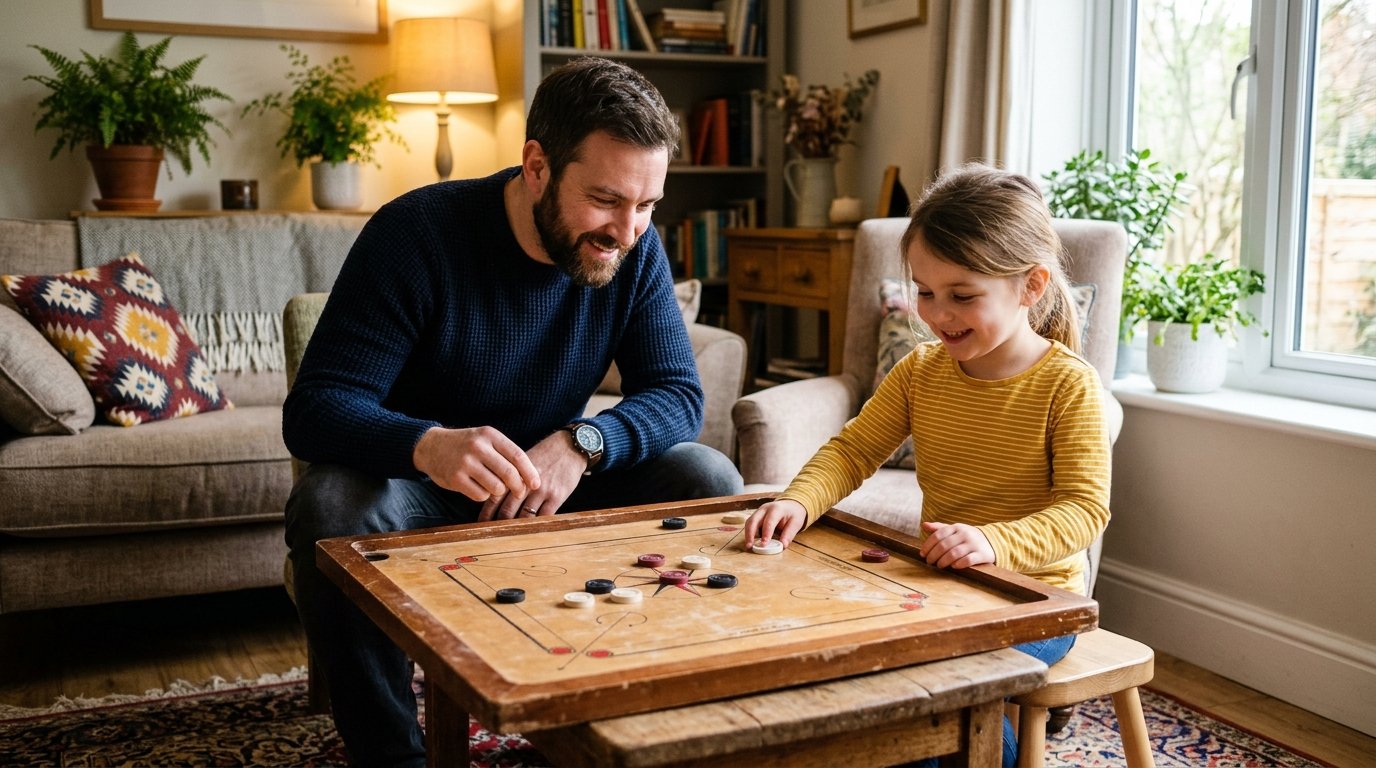
Carrom is the great family unifier one of the 10 Traditional Games Everyone Should Know for indoor play anywhere in the world.
Rounding out the 10 Traditional Games Everyone Should Know is Carrom perhaps the most skilful finger game ever invented. If you have visited any South Asian, Middle Eastern, or East African household, you have almost certainly seen this board.
Origin: Believed to have originated in India (possibly Myanmar) the first Carrom boards were made in the 19th century, though finger-billiards style games may be older
Also known as: Karrom, Karom, Finger billiards
Equipment: A square Carrom board (29 inches), 19 game pieces (9 white, 9 black, 1 red queen), 1 striker, powder
How to play (basic):
Players sit on each side of the board
The goal is to pocket your colour pieces (white or black) using the striker
The red queen must be pocketed and then ‘covered’ (pocket another piece immediately after)
Flick the striker with your finger from the base line to hit pieces into the corner pockets
Player who pockets all their pieces first wins the board
Carrom has a serious competitive scene. The International Carrom Federation oversees world championships. Pakistan’s carrom players have performed remarkably well internationally.
Develops: fine motor control, precision, geometry (angle calculation), patience
Best age: 6 and above
Equipment cost: A carrom board costs very little and lasts decades
Bonus: 5 More Traditional Games Worth Exploring
The 10 Traditional Games Everyone Should Know list above is the essential starter pack. But the world of traditional play is vast. Here are five more worth adding to your repertoire:
Gulli-Danda (Afghanistan/Pakistan): similar to Gilli-Danda but with regional rule variations
Oware (Ghana): the most strategic Mancala variant, requiring deep forward planning
Sepak Takraw (Southeast Asia): a kick volleyball using a rattan ball acrobatics meets football
Pallanguzhi (South India/Sri Lanka): a mathematically rich Mancala variant played on a 14-pit board
La Thuyée (France): a regional version of skittles predating bowling by centuries
Traditional Games vs Video Games: An Honest Comparison
Before anyone thinks this guide is anti-technology it isn’t. But understanding what the 10 Traditional Games Everyone Should Know offer versus digital entertainment helps us make smarter choices for children’s development.
Factor
Traditional Games
Video Games
Physical activity
High (outdoor games)
Very low
Social interaction
Face-to-face, real
Often online/digital
Cultural learning
Very high
Low
Equipment cost
Near zero
High (device + games)
Screen time
Zero
100%
Accessibility
Universal
Requires devices
Cognitive load
Moderate-high
Variable
Emotional regulation
Excellent
Mixed
The smart approach? A balance. The 10 Traditional Games Everyone Should Know should complement rather than replace modern entertainment. The WHO recommends less than 2 hours of recreational screen time per day for children traditional games fill that gap beautifully.
How to Introduce These Games to Children Today
Teaching children the 10 Traditional Games Everyone Should Know creates lasting memories and cross-generational bonds.
Knowing the 10 Traditional Games Everyone Should Know is one thing. Getting a screen-addicted generation to actually play them is another challenge entirely. Here’s what works:
Start with story: before teaching rules, tell the history. Children are fascinated to learn that a game they’re playing is 5,000 years old
Make it a family event: set a ‘screen-free Sunday’ where the family plays one traditional game together
Connect it to identity: if Carrom or Kabaddi is part of your cultural heritage, frame it as ‘this is where we come from’
School integration: advocate for traditional games in PE curricula many schools have dropped them in favour of Western sports exclusively
Games nights: Carrom and Mancala make perfect game night substitutes for Monopoly or Uno
Community tournaments: organise a neighbourhood Kho-Kho or Kabaddi match the social energy is electric
Global Efforts to Preserve Traditional Games
The 10 Traditional Games Everyone Should Know face genuine extinction risk in many regions. As urbanisation accelerates and screens consume more childhood hours, these games are disappearing from playgrounds, streets, and family gatherings.
Here are some organisations actively working to preserve them:
Khelo India Programme India’s government initiative reviving traditional and indigenous games at school level
Pakistan Sports Board increasingly promoting Kabaddi and Kho-Kho in national competitions
If you are a teacher, parent, or community leader, consider documenting and sharing local traditional games that aren’t on anyone’s radar yet. Every game preserved is a piece of culture saved.
Frequently Asked Questions 10 Traditional Games Everyone Should Know
Q1: What makes a game ‘traditional’?
A traditional game is one that has been passed down through generations within a specific culture, usually without a formal commercial origin. The 10 Traditional Games Everyone Should Know are examples of games that emerged organically from cultural practice, often with no known single inventor, and spread through oral tradition and community play.
Q2: Which of the 10 Traditional Games Everyone Should Know is best for very young children?
Hopscotch (from age 4), Blind Man’s Buff (from age 4), and Marbles (from age 5) are the most accessible starting points. They require minimal rules understanding and maximum physical fun perfect for children aged 4–7. As children grow, games like Kho-Kho, Kabaddi, and Carrom offer more complexity.
Q3: Are any of these 10 traditional games played professionally?
Several of the 10 Traditional Games Everyone Should Know have thriving professional scenes. Kabaddi has the Pro Kabaddi League with millions of viewers. Kho-Kho has Ultimate Kho Kho. Carrom has international championships. Tug of War was an Olympic sport and has an international governing body.
Q4: How can schools incorporate traditional games?
Schools can introduce the 10 Traditional Games Everyone Should Know through dedicated PE sessions, cultural awareness days, inter-school traditional sports tournaments, and after-school clubs. Low-cost games like Hopscotch, Kho-Kho, and Kabaddi require no budget beyond marking a court.
Q5: Do these games have health benefits?
Absolutely. The outdoor games in the 10 Traditional Games Everyone Should Know Kabaddi, Kho-Kho, Tug of War, Pittu Garam provide vigorous aerobic exercise. Indoor games like Carrom and Mancala develop fine motor skills and cognitive function. Together they provide a remarkably complete physical and mental health package.
Q6: Which traditional game is easiest to play in a small space?
Carrom, Mancala, and Marbles can all be played in a very small indoor space. Of the outdoor games in the 10 Traditional Games Everyone Should Know, Hopscotch needs only a pavement square and Blind Man’s Buff works in any room.
Q7: Are traditional games being lost?
Yes and it is a genuine cultural crisis. UNESCO reports that many traditional games are disappearing within 1–2 generations as children migrate to digital entertainment. That is exactly why knowing the 10 Traitional Games Everyone Should Know and actively playing them matters so much.
Q8: Can adults enjoy traditional games too?
Without question. Many of the 10 Traditional Games Everyone Should Know particularly Carrom, Mancala, Tug of War, and Kabaddi are played by adults at competitive levels worldwide. Traditional games are inter-generational by nature; they were designed to be played by families together.
Final Thoughts
The 10 Traditional Games Everyone Should Know are a bridge between generations, cultures, and the timeless human joy of play.
The 10 Traditional Games Everyone Should Know are not relics of the past. They are living, breathing expressions of human ingenuity games invented by people who had nothing but a stick, a stone, a piece of chalk, or a handful of seeds, and made something that brought whole communities together.
In a world that is increasingly digital, increasingly isolated, and increasingly sedentary, these games are not just nostalgic they are necessary. Every time a child shouts ‘Kho!’ or flicks a striker across a carrom board or stacks seven stones in a field, they are connecting with something ancient, communal, and irreplaceable.
So pick one. Learn it. Play it. Teach it to someone younger than you. That is how the 10 Traditional Games Everyone Should Know survive not in museums, but in the dust and laughter of actual play.