Pickleball Rules for Beginners 2026: The Only Guide You Need
Pickleball is one of the fastest-growing sports in America and honestly? It’s incredibly easy to pick up. Most beginners play their first real point within 20 minutes of learning the rules. But here’s what most guides don’t tell you: there are a handful of quirky rules that trip up nearly everyone in the first few sessions.
This guide covers every pickleball rule you need for 2026 explained in plain English, not rulebook jargon. No fluff. Just what you need to get on the court today.
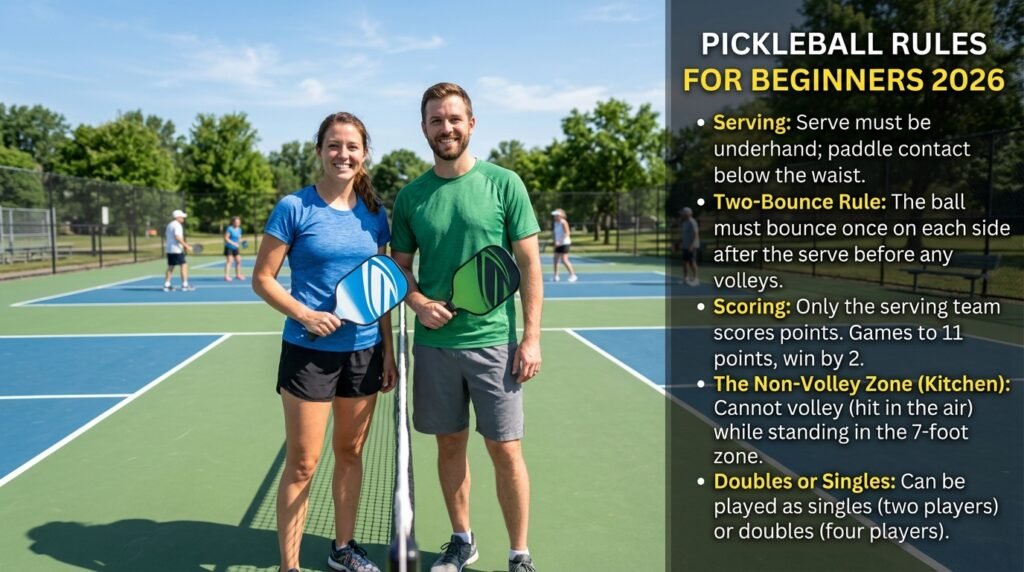
Quick Answer: Games go to 11 points (win by 2). Only the serving team scores. Serves are underhand. You can’t volley from the kitchen. The ball must bounce once on each side before volleying begins. That’s the core of pickleball.
What Is Pickleball? (60-Second Overview)
Pickleball blends elements of tennis, badminton, and ping-pong. You play on a small court (roughly badminton-sized) using solid paddles and a perforated plastic ball. It can be played as singles (1v1) or doubles (2v2) doubles being the most common.
The sport was invented in 1965 and is governed today by USA Pickleball (USAP), which publishes an updated official rulebook every year. The 2026 rulebook is the current standard for all official play.
Why is it so popular? The court is smaller, the ball is slower, and the rules are beginner-friendly. Yet the strategy runs deep making it addictive at every skill level.
Pickleball Court Layout: What You Need to Know
Pickleball Rules for Beginners 2026: The Only Guide You Need
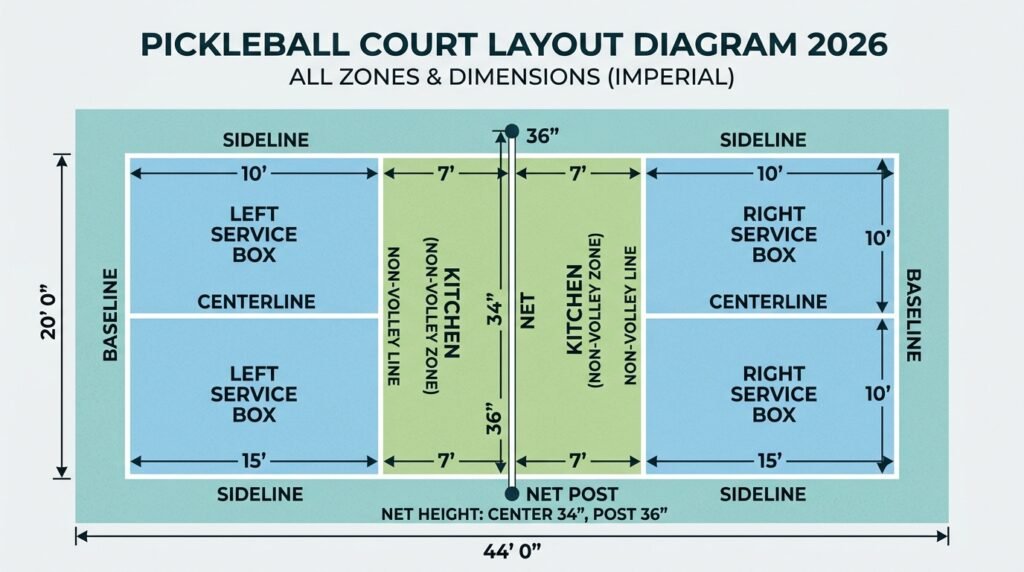
The pickleball court is 20 feet wide × 44 feet long the same size for both singles and doubles.
Court Feature
Measurement
Total Length
44 feet
Total Width
20 feet
Net Height (sides)
36 inches
Net Height (center)
34 inches
Kitchen (NVZ) Depth
7 feet on each side of net
The three zones you’ll hear about constantly:
• The Kitchen (Non-Volley Zone): 7-foot area on each side of the net. The most rule-heavy zone in pickleball.
• Service Boxes: Where serves must land diagonal from the server.
• Baseline & Sidelines: The outer boundaries. Out means fault.
Pickleball Serving Rules 2026 (The Complete Breakdown)
Serving is where most beginners accidentally break the rules. According to the official USA Pickleball rulebook, every legal serve must meet ALL of these requirements:
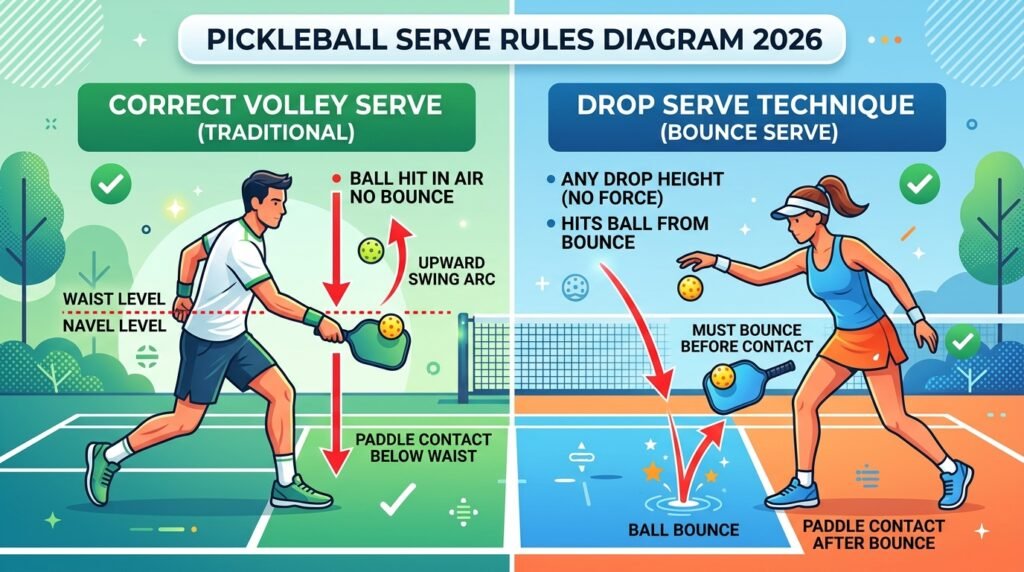
1. Underhand only: paddle must contact the ball below the server’s waist (navel level)
2. Paddle head below wrist: at the moment of contact
3. Diagonal landing: the serve must land in the opposite diagonal service box
4. Clear the kitchen: serve cannot land in the kitchen or on the kitchen line that’s a fault
5. Feet behind baseline: at least one foot must be on the ground behind the line when hitting
Volley Serve vs. Drop Serve
Volley Serve: Toss the ball and hit it before it bounces. This is the most common serve. Must meet all the rules above.
Drop Serve (great for beginners): Drop the ball from any natural height, let it bounce once, then hit it. No height restriction on contact point making it easier to learn.
You only get ONE serve attempt (no second serve like in tennis). Miss the service box = fault = lose the serve.
The Two-Bounce Rule: The Rule That Changes Everything
This is the most important rule to memorize. After the serve, each team must let the ball bounce once before volleying. Here’s the sequence:
6. Server hits the serve: it must bounce in the receiver’s service box
7. Receiver returns: it must bounce on the server’s side before they play it
8. After these two bounces: both teams can freely volley (hit out of the air)
This rule is why you’ll see experienced players rushing toward the kitchen line after those first two shots controlling the net is where points are won.
This rule was formerly called the “double bounce rule” same rule, different name. You may hear both.
How Pickleball Scoring Works (Explained Simply)
Pickleball Rules for Beginners 2026: The Only Guide You Need
The Basics
• Games go to 11 points, win by 2 (tournaments may use 15 or 21)
• Only the serving team can score points
• Winning a rally as the receiver = you get the serve, NOT a point
Doubles: The 3-Number Score Call
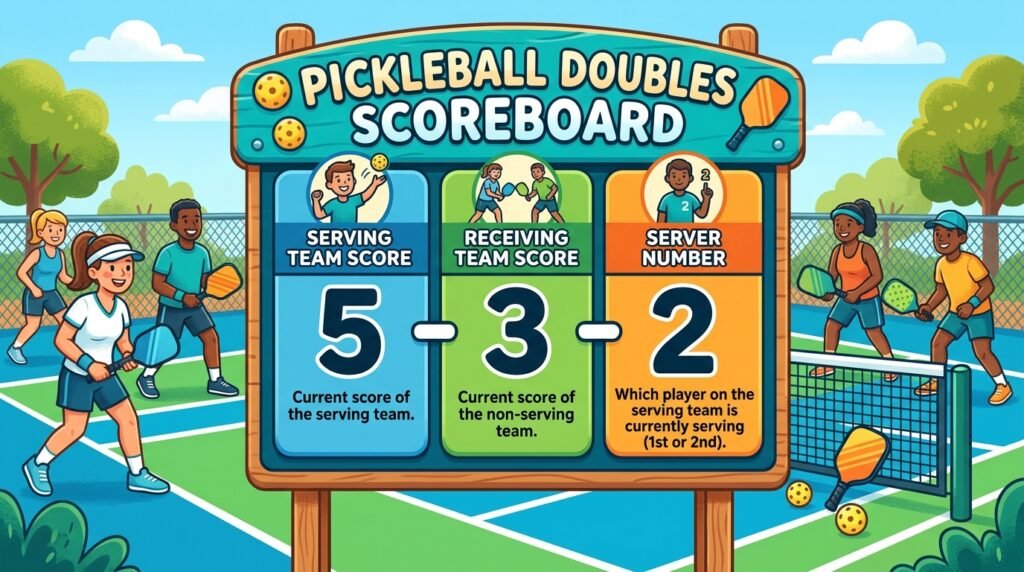
Before every serve in doubles, call three numbers: [Your Score] – [Their Score] – [Server Number]
Example: “5-3-2” = Your team has 5, they have 3, and this is your second server’s turn.
The trickiest part: at the very start of a game, the first serving team only gets ONE server (called the First Server Exception). After that, both players get a turn before a side-out.
Memory trick: Say the score out loud before every single serve. It prevents 90% of scoring disputes.
Singles Scoring
Call two numbers only: your score then their score. Serve from the right side when your score is even, left side when it’s odd.
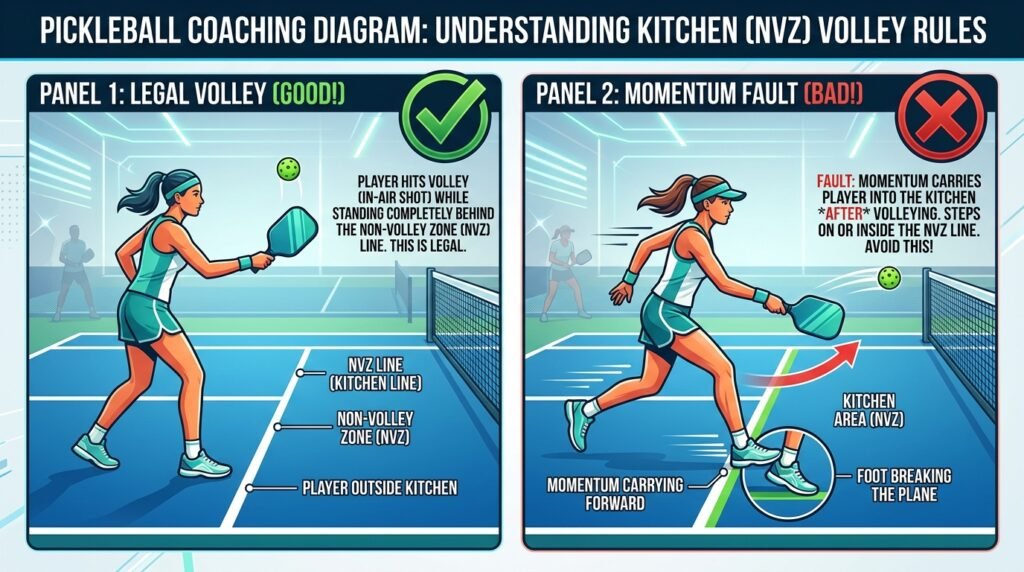
Kitchen Rules: The Non-Volley Zone Explained
The kitchen (Non-Volley Zone) is the 7-foot rectangular area on each side of the net. It causes more confusion than any other rule so let’s make it crystal clear.
You CANNOT: Volley (hit the ball out of the air) while standing in the kitchen or on the kitchen line.
You CAN: Step into the kitchen to play a ball that has already bounced. Completely legal.
The Momentum Rule (very important!): If you volley outside the kitchen but your forward momentum carries you INTO the kitchen even after the ball is gone it’s still a fault. Any part of you (feet, paddle, clothing) crossing into the kitchen counts.
The dink shot a soft, arcing ball that lands in the opponent’s kitchen exists precisely because of these rules. It’s one of the most powerful shots in pickleball strategy.
Pickleball Rules for Beginners 2026: The Only Guide You Need
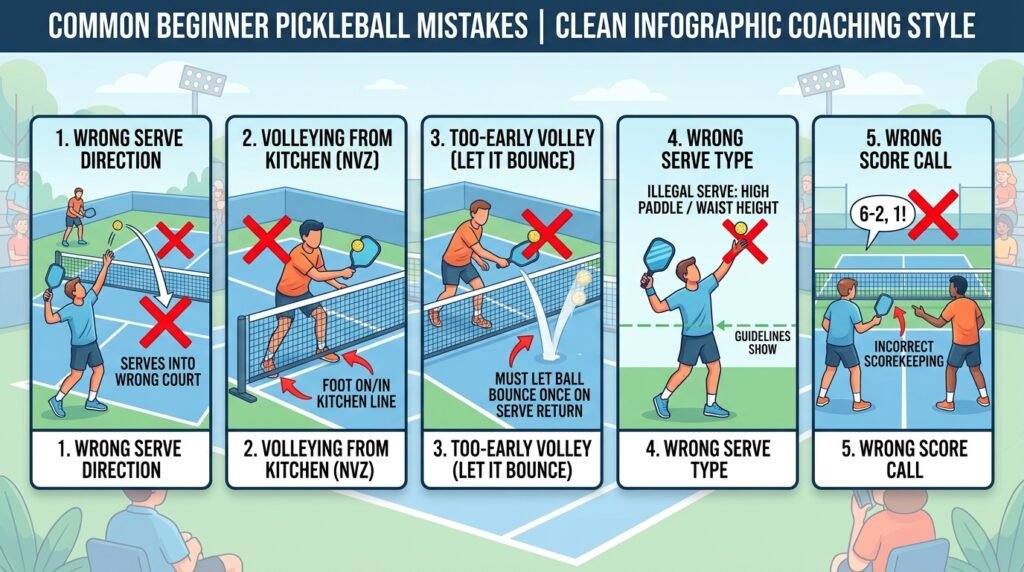
Common Pickleball Faults (And How to Avoid Them)
A fault ends the rally. Here are the ones beginners hit most often:
• Serve lands in the kitchen or on the kitchen line
• Volleying before both sides have had their mandatory bounce (two-bounce rule violation)
• Volleying while standing in the kitchen (NVZ fault)
• Momentum carrying you into the kitchen after a volley
• Ball bounces twice on your side before you hit it
• Ball lands out of bounds
• Touching the net or opponent’s court during a rally
About let serves: Since 2021, a serve that clips the net but lands in the correct service box is a LIVE ball not a replay. Many casual players still replay them out of habit. Clarify the local rule before you start.
2026 Rule Changes You Need to Know
USA Pickleball updates its rulebook every year. Here are the key 2026 updates from the official 2026 rulebook:
9. Spin serve banned: You cannot add deliberate spin to the ball with your non-paddle hand during a volley serve. Natural release is fine intentional spin is not.
10. Drop serve clarified: You can only drop the ball from a natural height. Adding downward force before the bounce is a fault.
11. Interference rules updated: Clearer rules on when outside interference (stray ball, loud noise) can be called for a replay.
12. Equipment timeouts clarified: Updated timelines for addressing broken paddles or equipment issues mid-match.
(Add FAQPage Schema in RankMath → Schema → FAQ for all questions below)
Q1: What is the kitchen rule in pickleball?
The kitchen (non-volley zone) is the 7-foot area on each side of the net. You cannot volley the ball while standing in it or while your momentum carries you into it after a volley. You can step in to play a bounced ball that’s perfectly fine.
Q2: How does scoring work in pickleball?
Only the serving team scores. Games go to 11 (win by 2). In doubles, call three numbers before each serve: your score, their score, and your server number (1 or 2). In singles, just call two numbers. The server stands right when their score is even, left when it’s odd.
Q3: What is the two-bounce rule?
After the serve, each side must let the ball bounce once before volleying. The receive must bounce, then the return must bounce only after those two bounces can either team hit the ball out of the air.
Q4: Can you serve overhand in pickleball?
No. All serves must be underhand, with the paddle below the waist and the paddle head below the wrist. The only exception is the drop serve, where after the ball bounces, you can contact it at any height.
Q5: What happens when the serve hits the net and goes in?
Under official 2026 USA Pickleball rules, it’s a live ball play continues. Many casual players still replay it as a habit, so check with your group before the game.
Q6: What are the 2026 pickleball rule changes?
The biggest change is the spin serve ban you can’t intentionally add spin with your non-paddle hand before a volley serve. The drop serve rules were also clarified, and interference and equipment timeout rules were updated.
Q7: Can you step into the kitchen in pickleball?
Yes! Stepping into the kitchen is 100% legal. You just cannot volley the ball while any part of you is in the kitchen or on the kitchen line.
Q8: What is a fault in pickleball?
A fault is any violation that ends the rally. Common faults: serve in the kitchen, volleying from the kitchen, breaking the two-bounce rule, hitting out of bounds, ball bouncing twice, and touching the net. Serving team faults = lose the serve. Receiving team faults = serving team gets a point.
Pickleball Rules for Beginners 2026: The Only Guide You Need
Ready to Play? Start Here
The best way to learn pickleball rules is to play. Find a court near you using Places2Play, grab a paddle, and go. Most parks have open play sessions where experienced players love helping newcomers.
For the complete official rulebook, always check usapickleball.org it’s updated annually and is the final word on any disputed rule.
Now stop reading and go play. You know enough to start.