If you’ve ever watched a basketball game with your kid and gotten the question “why is that player standing there?” you’re not alone. This blog is covered by zainblogs. Every team on the court is built around five positions, and understanding them is the fastest way to actually follow (and enjoy) the game. This guide is a complete 5 Basketball Positions Explained for Kids and Adults breakdown that works whether you’re 8 years old learning your first drill or an adult picking up the sport for the first time. We’ll cover what each position does, how the roles change between youth and adult basketball, and how modern “positionless” basketball has blurred the old rules.
What Are the 5 Basketball Positions? (Quick Answer)
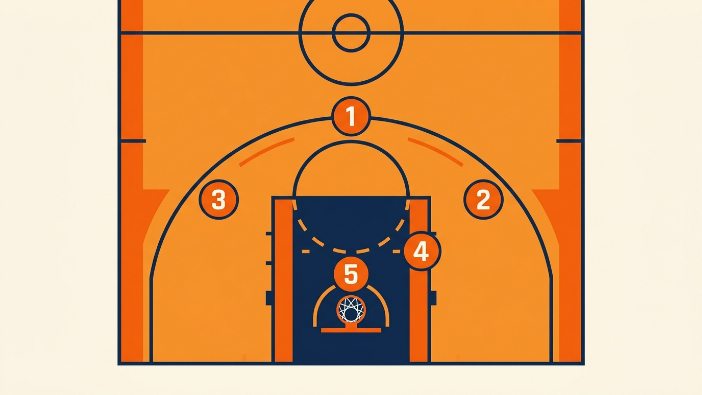
Basketball has five positions on the court at one time: point guard (1), shooting guard (2), small forward (3), power forward (4), and center (5). The two guards form the “backcourt” and typically play on the perimeter, while the two forwards and the center form the “frontcourt” and operate closer to the basket. Numbers 1 through 5 roughly track from smallest/quickest to tallest/strongest, which is why coaches use them as shorthand during games.
Some people search for “basketball positions” expecting a longer list because modern basketball also has hybrid roles like the stretch four or point forward layered on top of the five core positions. We cover those later in this guide too. The 5 Basketball Positions Explained for Kids and Adults make basketball easier to understand for everyone. https://jr.nba.com/
A Brief History of Basketball Positions
When basketball was invented in 1891, players weren’t assigned fixed positions at all early teams simply spread out and reacted to the ball. As the sport organized into leagues, coaches began separating players into “guards” (who defended the backcourt and brought the ball up) and “forwards” and “centers” (who played closer to the basket). Over decades, guards split into the point guard and shooting guard, and forwards split into small forward and power forward, giving us the five-position system used today. Understanding this history helps explain why the numbering runs from the perimeter (1) to the paint (5) it mirrors how the game itself evolved from a backcourt/frontcourt split into today’s more specialized roles.
The five basketball positions and where each one lines up on the court.
The 5 Basketball Positions at a Glance
Before diving into each role individually, here’s a side-by-side reference table you can bookmark.
#
Position
Also Called
Court Zone
Primary Job
1
Point Guard (PG)
The Floor General
Perimeter / top of the key
Runs the offense, passes, controls tempo
2
Shooting Guard (SG)
The Perimeter Scorer
Wings / perimeter
Scores from mid-range and three-point range
3
Small Forward (SF)
The Swiss Army Knife
Wing / mid-post
Versatile scoring, rebounding, and defense
4
Power Forward (PF)
The Paint Enforcer
Low post / elbow
Rebounds, screens, scores near the basket
5
Center (C)
The Rim Protector
Low post / paint
Blocks shots, rebounds, scores close to the rim
Each Basketball Position Explained in Detail
1. Point Guard (PG) The Floor General(5 Basketball Positions Explained for Kids and Adults)
The point guard brings the ball up the court and starts every offensive play. Coaches often call this player the “coach on the floor” because they read the defense in real time and decide whether to pass, drive, or pull up for a shot. Good point guards are rarely the tallest players on the team quickness, court vision, and calm decision-making matter far more than height. On defense, the point guard usually guards the opposing team’s primary ball-handler and looks to create turnovers.
Key skill: ball-handling and passing under pressure
Common nickname: the 1, or the floor general
Famous example (adult level): a pass-first guard who controls tempo rather than chasing points
2. Shooting Guard (SG) The Perimeter Scorer(5 Basketball Positions Explained for Kids and Adults)
The shooting guard’s main job is scoring, especially from mid-range and three-point range. This player is constantly moving without the ball, using screens set by teammates to get open for a jump shot. When the point guard is trapped by the defense, the shooting guard often steps in as a secondary ball-handler. On defense, shooting guards chase the opposing team’s best perimeter scorer through screens and rotations.
Key skill: shooting off the catch and off the dribble
Common nickname: the 2, or the sniper
Works best for: kids and adults who love shooting drills and off-ball movement
3. Small Forward (SF) The Swiss Army Knife(5 Basketball Positions Explained for Kids and Adults)
Small forwards are the most versatile players on the floor, which is why this position is nicknamed the “Swiss army knife” of basketball. They’re expected to score from the inside and outside, rebound, defend multiple positions, and occasionally handle playmaking duties. Because the role demands a bit of everything, it’s a great starting point for young players who haven’t found a specialty yet.
Key skill: overall athleticism and adaptability
Common nickname: the 3, or the wing
Works best for: well-rounded players who don’t want to be locked into one job
4. Power Forward (PF) The Paint Enforcer(5 Basketball Positions Explained for Kids and Adults)
The power forward battles for rebounds, sets screens, and scores close to the basket, usually working the area between the free-throw line and the low block. Traditionally a physical, back-to-the-basket player, the modern power forward increasingly adds mid-range or three-point shooting to stretch the defense a hybrid role sometimes called the “stretch four,” which we explain further down.
Key skill: strength, rebounding, and footwork in tight spaces
Common nickname: the 4
Works best for: physically strong players who like contact and rebounding battles
5. Center (C) The Rim Protector(5 Basketball Positions Explained for Kids and Adults)
Centers are usually the tallest players on the team and anchor the defense from the paint, blocking shots and controlling the boards on both ends. On offense, the center scores close to the rim, sets screens, and can pass out of double-teams when defenses collapse around them. At the youth level, height matters less than it seems footwork and timing can make a smaller center just as effective.
Key skill: shot-blocking, rebounding, and footwork near the basket
Common nickname: the 5, or the anchor
Works best for: taller or naturally strong players but don’t limit them to only this position early on
Five positions, five different roles but every one of them matters equally on the court.
Why This 5 Basketball Positions Explained for Kids and Adults Guide Covers Both Age Groups
Most guides pick a lane: either they explain positions to kids using cartoon analogies, or they go deep into adult and competitive strategy with no beginner framing at all. That split leaves parents coaching a 9-year-old and adult beginners joining a rec league with two completely different and mostly unhelpful sets of resources. This guide is built to work for both, because the five positions are fundamentally the same; only the coaching emphasis changes.
Basketball Positions for Kids: Keeping It Simple
For younger players, the goal isn’t to lock a child into one position it’s to help them understand the game’s five roles while they develop every skill. A simple way to introduce the positions to kids is through everyday comparisons:
Point guard = the team captain who decides where everyone goes
Shooting guard = the sharpshooter aiming for the basket
Small forward = the all-rounder who can do a bit of everything
Power forward = the strong player who battles for every rebound
Center = the tall protector guarding the hoop
Youth coaching organizations generally recommend rotating kids through every position rather than assigning one permanently especially before age 12, when height and body type can change dramatically. A tall 10-year-old parked permanently at center may never develop the ball-handling skills they’ll need as an average-height adult. Every beginner should know the 5 Basketball Positions Explained for Kids and Adults to play with confidence.
Basketball Positions for Adults and Competitive Players
Once players reach high school, college, or competitive adult leagues, positions become more clearly defined but the modern game has also introduced hybrid roles that blend two traditional positions. Understanding these matters if you’re watching or playing at a higher level:
Point Forward a forward with point-guard passing ability who can initiate offense from the wing
Combo Guard a player who can run the offense or play off the ball as a scorer
Stretch Four a power forward who shoots from three-point range instead of staying in the post
Stretch Five a center who steps beyond the arc to shoot, pulling opposing centers away from the rim
This shift toward “positionless basketball” means adult and competitive players are increasingly expected to handle, pass, shoot, and defend regardless of their listed position but the five core positions remain the foundation everyone still learns first. Improve your basketball IQ with the 5 Basketball Positions Explained for Kids and Adults. Understand the 5 Basketball Positions Explained for Kids and Adults with clear descriptions of each player’s responsibilities.
Kids vs. Adults: Basketball Positions Comparison Table
Position
Best For (Youth 8–12)
Best For (Teens/Adults)
Key Skill to Practice
Point Guard
The natural organizer who loves to pass
The primary decision-maker and tempo-setter
Ball-handling under pressure
Shooting Guard
The kid who always wants to shoot
Off-ball movement and catch-and-shoot range
Shooting off screens
Small Forward
Any well-rounded, active player
Two-way wings who can guard multiple spots
All-around conditioning
Power Forward
Bigger, physical kids who rebound well
Interior scorers who can also step outside
Boxing out and footwork
Center
Taller kids, but rotate them elsewhere too
Rim protectors and post scorers
Post moves and shot-blocking timing
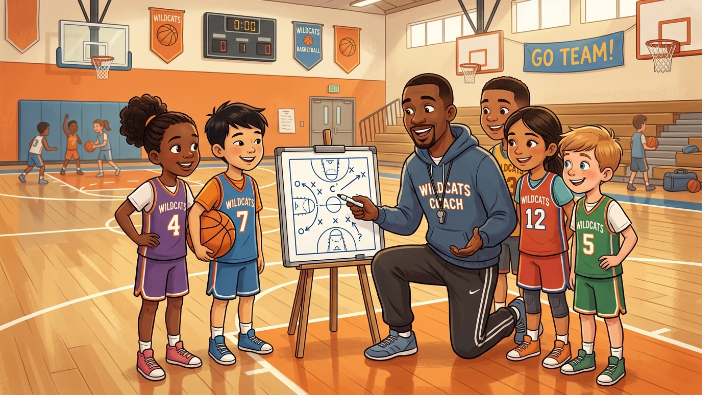
Rotating young players through every position early on helps them develop a complete skill set.
How to Choose the Right Basketball Position
Whether you’re a parent guiding a child or an adult beginner sizing up your own game, the same three factors from this 5 Basketball Positions Explained for Kids and Adults framework apply, roughly in this order:
Physical profile: height and speed create a natural starting point, but they don’t have to be permanent
Skill set: strong shooters lean shooting guard, natural passers lean point guard, rebounders lean forward or center
Team need: sometimes the best position is simply the one your team is missing
For beginners of any age, small forward is often the easiest entry point since the role rewards general athleticism over one narrow specialty. From there, most players naturally gravitate toward a position as their skills develop. Read the 5 Basketball Positions Explained for Kids and Adults and discover how every position contributes to team success.
Adult beginners joining a rec league for the first time often overthink this step. Coaches watching a new player for the first few sessions are usually looking at just two things: how comfortable you are handling the ball under light pressure, and how you naturally move without it. If you find yourself constantly drawn to the perimeter and enjoy setting up teammates, guard positions are worth trying first.
If you gravitate toward the basket and don’t mind physical contact, the forward and center positions will feel more natural. Most recreational leagues are also happy to let you rotate through a few positions across your first several games before settling into a regular role take advantage of that instead of guessing from the sideline. Start learning with the 5 Basketball Positions Explained for Kids and Adults and improve your understanding of the game today.
Why Basketball Positions Matter for Team Strategy
Positions aren’t just labels they’re the backbone of how a team runs plays. When a coach calls a “1-5 pick and roll,” every player on the floor instantly knows the point guard and center are about to work together near the top of the key. This shared vocabulary is why youth coaches introduce positions early, even while encouraging kids to rotate through all of them: understanding the roles makes it far easier to understand spacing, screens, and rotations once a player starts running actual plays.
At the adult and competitive level, positional balance also determines how a team defends. A lineup with two true post players (power forward and center) can dominate rebounding but may struggle to defend faster, smaller lineups on the perimeter. A “small ball” lineup that replaces the center with a stretch four or wing player trades some rebounding for speed and outside shooting. Recognizing these trade-offs is part of what separates casual fans from people who can really read a game.
Common Mistakes When Assigning Basketball Positions
Locking a tall child into center permanently before their growth has leveled off
Ignoring point guard development for shorter kids because a taller teammate “looks” more athletic
Treating position as fixed instead of a starting point that can change as skills grow
Skipping ball-handling and shooting fundamentals for post players, which limits them as the game evolves
Getting this right matters more than it might seem: research on youth sports has linked early specialization in a single position or sport to a higher risk of overuse injury and burnout. A rotation-first approach used throughout this 5 Basketball Positions Explained for Kids and Adults guide gives young players a broader athletic foundation before they settle into a primary role. The 5 Basketball Positions Explained for Kids and Adults provide an easy way to learn basketball fundamentals for all ages.
Frequently Asked Questions
What are the 5 positions in basketball?
The five positions are point guard (1), shooting guard (2), small forward (3), power forward (4), and center (5). Guards typically play on the perimeter, forwards and the center play closer to the basket.
What position should my kid play in basketball?
At the youth level, it’s best not to fix a permanent position at all. Rotate kids through every position so they build ball-handling, shooting, and rebounding skills regardless of height or body type.
What is the hardest basketball position to play?
Many coaches consider point guard the toughest, since it requires ball-handling, decision-making under pressure, and leadership on every possession. Others argue center is hardest physically due to constant contact in the post.
What’s the difference between a guard and a forward?
Guards (point guard and shooting guard) are typically quicker, smaller players who operate on the perimeter and handle the ball. Forwards (small forward and power forward) are usually bigger and play closer to the basket, focusing more on rebounding and interior scoring.
Is there a 6th basketball position?
Not officially basketball has five on-court positions. However, teams often use a “sixth man,” which refers to the first substitute off the bench rather than a distinct court position.
What makes this 5 Basketball Positions Explained for Kids and Adults guide different from other guides?
Most articles online explain positions either for kids or for adults, not both. This guide covers the same five positions through both lenses, plus the modern hybrid roles that have changed how positions work at competitive levels.
Can a player switch positions during a game?
Yes. Many players are trained to play more than one position, and modern “positionless” basketball encourages switching based on matchups rather than sticking rigidly to one role.
Conclusion
Basketball only has five positions, but understanding what each one actually does changes how you watch and play the game whether you’re a kid picking a first position, a parent coaching a youth team, or an adult joining a weekend league. Keep this 5 Basketball Positions Explained for Kids and Adults breakdown handy, rotate young players through every role early, and let the position follow the skills rather than the other way around. From point guard to center, the 5 Basketball Positions Explained for Kids and Adults help every beginner learn faster.
5 Basketball Positions Explained for Kids and Adults helps beginners understand every player’s role. Learn the basics with 5 Basketball Positions Explained for Kids and Adults in simple language. 5 Basketball Positions Explained for Kids and Adults makes learning basketball positions quick and easy. Improve your game knowledge with 5 Basketball Positions Explained for Kids and Adults today. 5 Basketball Positions Explained for Kids and Adults is a great guide for new basketball players. Discover player responsibilities through 5 Basketball Positions Explained for Kids and Adults.
Learn the 5 Basketball Positions Explained for Kids and Adults with simple roles, easy examples, and beginner-friendly tips. Master the 5 Basketball Positions Explained for Kids and Adults to understand every player’s role on the court. Discover the 5 Basketball Positions Explained for Kids and Adults in an easy guide perfect for beginners and families. Explore the 5 Basketball Positions Explained for Kids and Adults to build basketball knowledge from the ground up. The 5 Basketball Positions Explained for Kids and Adults make learning the game simple, fun, and easy to remember.