It’s raining outside in 50 Indoor Games for Kids Without Equipment (No Toys Needed!). This blog is covered by zainblogs. Your child is circling the living room like a bored shark. The toys are everywhere and somehow none of them are interesting. Sound familiar?
Here’s the good news: the most memorable games kids ever play need zero equipment. No batteries, no board, no setup. Just space, imagination, and willing participants. Whether you’re a parent, teacher, babysitter, or just someone trying to survive a snow day, this guide has you covered.
In this article you’ll find 50 hand-picked indoor games for kids that require absolutely no equipment organized by age group, energy level, and group size so you can find the right game in seconds.
Pure joy, endless laughter, and no toys required! These two little adventurers are turning a cozy living room into a world of fun, proving that imagination is the best game of all.
Why No-Equipment Games Are Actually Better for Kids
Research from the American Academy of Pediatrics (AAP) consistently highlights that unstructured, imaginative play is one of the strongest drivers of childhood development building executive function, emotional regulation, language skills, and social competence.
No-equipment games in particular:
Encourage creative thinking because kids must use imagination instead of pre-set rules
Develop communication skills through negotiation, storytelling, and teamwork
Build physical literacy body awareness, balance, coordination with no gym needed
Are completely inclusive: no child feels left out due to missing toys or skills
Can start in 10 seconds perfect for bored kids who need engagement NOW
Quick-Reference Guide: Find Your Game in 10 Seconds
Game
Age
Players
Energy
Type
Simon Says
3+
3+
High
Active
Freeze Dance
3+
2+
High
Active
Floor is Lava
4+
1+
High
Active
Red Light Green Light
3+
3+
High
Active
Charades
6+
4+
Low
Creative
20 Questions
7+
2+
Low
Brain
Telephone
5+
4+
Low
Language
Human Knot
7+
6+
High
Team
Would You Rather
6+
2+
Low
Social
Storytelling Circle
5+
3+
Low
Creative
Mirror Mirror
4+
2
Med
Creative
Emotion Freeze Tag
4+
4+
High
Active
Classic Active Games (No Equipment Just Energy!)
These tried-and-true movement games have been played by generations of kids for good reason: they’re instantly fun, endlessly replay able, and work in any room with a bit of floor space.
Simon Says
Perfect for ages 3 and up, Simon Says is a listening and reaction game where one player gives commands but others only follow when the instruction starts with ‘Simon says.’ Anyone who moves on a command without ‘Simon say’ is out.
Why kids love it: Fast-paced, unpredictable, and hilarious when someone slips up.
Pro Tip: Swap ‘Simon’ for the child’s name ‘Ella says jump!’ to make them feel special.
Developmental Benefit: Strengthens listening skills, impulse control, and body awareness.
Red Light, Green Light
One player is the ‘traffic light’ and stands at one end of the room. When they call ‘Green light!’ everyone rushes forward; ‘Red light!’ means freeze instantly. Anyone still moving goes back to the start. First to reach the traffic light wins.
Variation: Add ‘Yellow light’ for slow-motion crawling hilarious for younger kids.
Developmental Benefit: Improves self-regulation, speed, and listening skills.
The Floor is Lava
Announce ‘The floor is lava!’ and give a 5-second countdown. Everyone must get off the floor by climbing onto furniture, cushions, or anything elevated. You can set rules: must stay 10 seconds, or must reach a specific destination without touching the ground.
Why it works: Zero setup, pure imagination, and kids absolutely love the dramatic premise.
For more creative movement games, check out resources from
Playworks.org a nonprofit dedicated to safe and healthy play for children.
Freeze Dance (No Music Needed!)
One person is the ‘DJ’ and claps, hums, or beatboxes. Everyone dances when they hear the beat and freezes completely when the sound stops. The DJ tries to catch people moving after the freeze.
No-music variation: The DJ says ‘FREEZE!’ instead works in any room, anytime.
Duck, Duck, Goose
Players sit in a circle. One child walks around tapping heads saying ‘duck, duck, duck…’ then suddenly says ‘GOOSE!’ The goose must jump up and chase the tapper around the circle before they steal the goose’s seat.
Ages: 3–8 years. Best with 5+ players.
Emotion Freeze Tag
A creative twist on classic freeze tag. When someone is tagged, instead of just freezing, they must strike an emotion pose happy, surprised, angry, sad. Other players can ‘unfreeze’ them by copying the same emotion pose.
Developmental Benefit: Builds emotional literacy and empathy children literally embody different feelings.
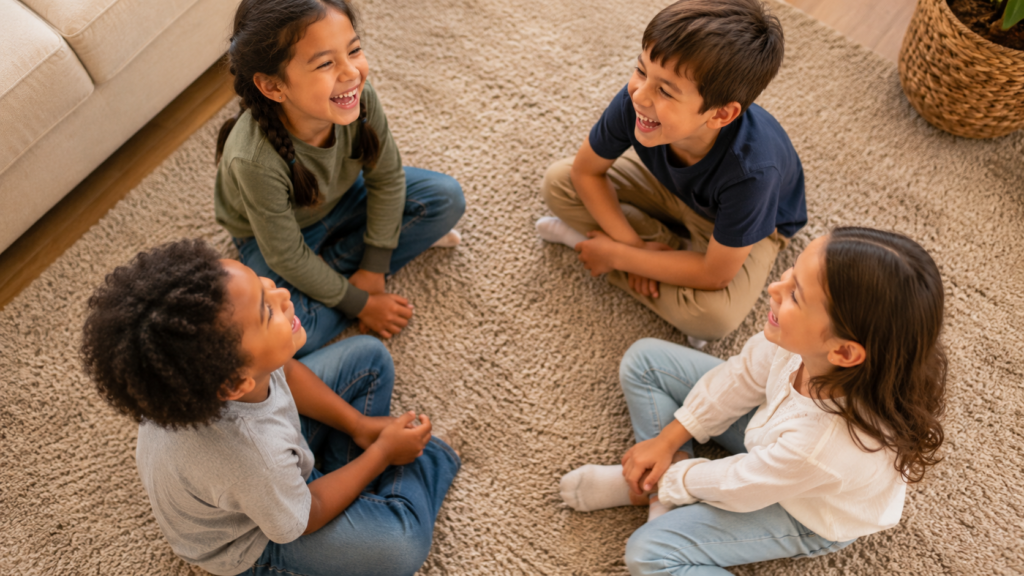
Laughter fills the room as friends gather in a circle, proving that the best games need nothing more than imagination and good company.
Brain Games & Word Games (No Equipment Required)
These quieter games build vocabulary, critical thinking, and creativity perfect for after-school wind-downs, car rides, or rainy afternoons when everyone needs a calmer activity.
20 Questions
One player thinks of a person, place, animal, or object. Everyone else asks up to 20 yes/no questions to figure out what it is. Great for teaching deductive reasoning kids must listen to previous answers and refine their guesses strategically.
Starter hint: Beginners should start with animals. Older kids can tackle fictional characters or abstract concepts.
Telephone (Chinese Whispers)
Players sit in a line or circle. The first player whispers a phrase to the next, who whispers it to the next and so on. The last player says the phrase out loud. What started as ‘The fluffy elephant ate a chocolate cake’ often ends as something hilariously unrecognizable.
Tip: Use longer, sillier sentences for maximum chaos.
Would You Rather?
One player poses two impossible choices: ‘Would you rather have spaghetti for hair or a waterfall coming out of your nose?’ Everyone must choose one and explain why. There are no wrong answers just endlessly entertaining discussions.
Why parents love it: Sparks genuine conversations and reveals kids’ personality and values in hilarious ways.
I Spy
The classic road trip game works just as well indoors. One player says ‘I spy with my little eye, something beginning with the letter B…’ and others guess objects in the room. For younger kids, use colors instead of letters: ‘I spy something red.’
Story Building Circle
Everyone sits in a circle. One person starts a story with one sentence. The next adds the next sentence, and so on taking the story wherever their imagination leads. Set a rule: the story must include a dragon, a bicycle, and a talking sandwich (or whatever wild elements the kids suggest).
Developmental Benefit: Builds narrative comprehension, creativity, and turn-taking skills.
Alphabet Categories
Choose a category (animals, food, countries, superheroes). Players take turns naming something in that category that starts with the next letter of the alphabet: Apple… Banana… Cherry… No repeats allowed. The player who can’t think of one is out.
Imaginative & Creative Games
These activities blur the line between game and storytelling they build language, emotional intelligence, and creative confidence in a way no screen ever could.
Charades
Divide into two teams. Players take turns acting out a word, phrase, movie title, or animal silently no speaking, no sound effects. Teammates must guess correctly within a time limit (use counting to 30 instead of a timer).
Two players stand facing each other. One is the ‘mirror’ they must copy every movement the other person makes in real time, as accurately as possible. Swap roles every 2 minutes. For a challenge, try making the mirroring so seamless that a third person can’t tell who’s leading.
Developmental Benefit: Strengthens focus, observation, and non-verbal communication.
Statue Maker
One player is the ‘sculptor.’ They gently position other players into frozen poses (arms up, one leg raised, funny faces) creating a ‘sculpture garden.’ After 30 seconds, everyone holds their pose while the sculptor presents their artwork to an imaginary museum audience.Superpower Roleplay
Each child chooses a superpower (invisibility, super speed, the ability to talk to animals). They must then act out scenes using their powers saving the day, solving problems, or navigating ordinary situations in extraordinary ways.
Ages: 5–12 years. Works especially well with 3–6 players.Press Conference
One child becomes a famous character a historical figure, a movie villain, a talking dog and the others are journalists asking questions. The ‘celebrity’ must stay in character no matter how ridiculous the questions get.
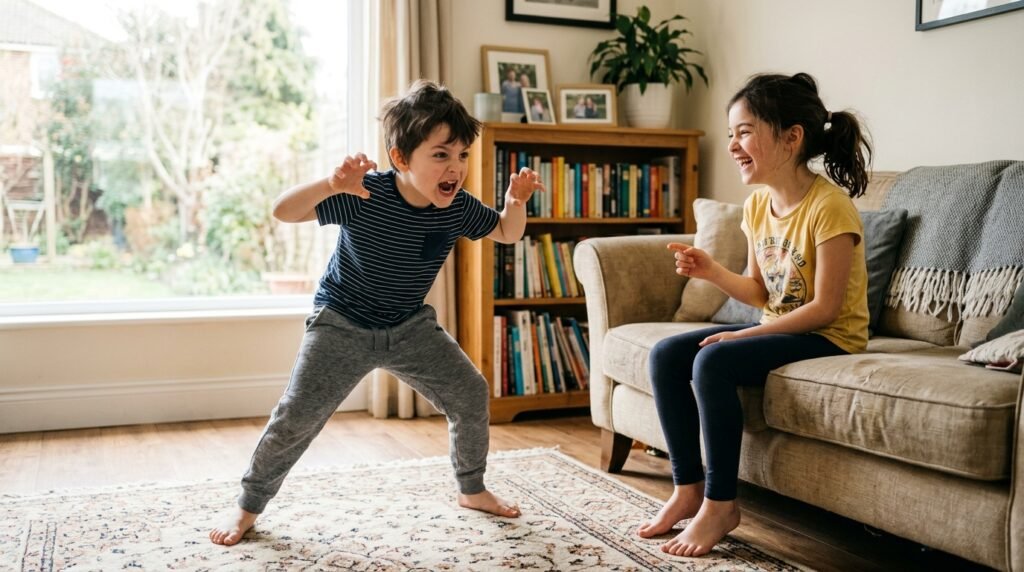
Charades, giggles, and endless fun! These siblings are turning imagination into the best game of the day no toys needed, just laughter and creativity.
Team & Group Games (Best for 4+ Players)
These games shine when you have a larger group birthday parties, family gatherings, classroom breaks, or playdates with multiple kids.
Human Knot
6 or more players stand in a circle. Everyone reaches across and grabs two different people’s hands (not the hands of the person directly next to them). Now the group must untangle themselves stepping over and under arms without letting go, until the knot unravels into a circle again.
Tip: If the group gets completely stuck, allow one ‘cheat’ release one handhold and reconnect. Works for ages 7+.
This game is a favorite at schools the team at
Playworks.org notes it as one of the most effective cooperation games requiring zero materials.
Charades Relay
A team-based twist on charades. Two teams compete simultaneously. Each team has a ‘clue giver’ acting out the same word. Whichever team guesses first wins that round. First team to win 5 rounds takes the game.
All Tangled Up
Similar to Human Knot but with a twist: players start in a line, hold hands with the person next to them, and the line twists into increasingly complex configurations as the leader winds everyone around. The group must untangle on command.Captain Says (Advanced Simon Says)
A more complex version of Simon Says where the ‘captain’ can chain multiple commands quickly: ‘Captain says clap twice, hop three times, then freeze!’ Great for older kids ages 8+ who find classic Simon Says too easy.
Wink Murder
Designate one player secretly as the ‘murderer’ by having everyone close their eyes while one person is tapped. The murderer ‘kills’ others by winking at them victims count to three and dramatically ‘die.’ The rest try to identify the murderer before everyone is eliminated.
Ages: 7+. Minimum 6 players for best experience.
Calm-Down & Quiet Games (Perfect Before Bed or Quiet Time)
Not every indoor moment calls for running and shrieking. These gentle games are perfect for winding down energy, transitioning to quieter activities, or managing mixed-age groups.
Sleeping Lions
All players lie completely still on the floor with eyes closed pretending to be sleeping lions. One or two ‘hunters’ walk around trying to make the lions move, laugh, or open their eyes (without touching them). Any lion that moves becomes a hunter. Last lion sleeping wins.
Ages: 3–10 years. Parents’ secret weapon for pre-nap calm.
Slow Motion Race
Players race across the room but ONLY in slow motion. The first person to reach the finish line while moving in convincing slow motion wins. Anyone who speeds up is disqualified. Much harder (and funnier) than it sounds.
Guided Imagination Journey
Everyone lies on the floor with eyes closed. One person narrates a slow, vivid journey: ‘You’re floating on a cloud above the ocean. You can feel the warm breeze… below you a whale surfaces…’ the imagery gets more creative as it goes.
Developmental Benefit: Builds mindfulness, listening, and descriptive language skills.
Memory Chain
Start with: ‘I went to the market and I bought an apple.’ The next player repeats everything and adds one item. Continue until someone forgets the order. Great for working memory and builds naturally into language play.
A cozy story, warm light, and little imaginations at work. Sometimes the simplest moments create the most magical memories.
Games by Age Group
Best Indoor Games for Toddlers (Ages 2–4)
Duck, Duck, Goose simple rules, lots of giggles
Simon Says builds following instructions
I Spy (colors version) perfect attention span
Freeze Dance clap-based version
Sleeping Lions great for wind-down
Best Indoor Games for Young Kids (Ages 5–7)
Floor is Lava
Red Light, Green Light
Telephone
Story Building Circle
Emotion Freeze Tag
Best Indoor Games for Older Kids (Ages 8–12)
Human Knot
Charades and Charades Relay
20 Questions
Wink Murder
Would You Rather (deeper edition)
Press Conference
20 More Quick Games — The Full List (Games 27–50)
Here are 24 more no-equipment games you can pull out on demand. Each one is battle-tested and kid-approved.
27. Running Through the Forest imagine and narrate dodging obstacles as you ‘run’ in place
28. Alphabet Animals name an animal for every letter of the alphabet, racing clockwise
29. Rock Paper Scissors Tournament elimination bracket style
30. Categories Sprint shout names in a category as fast as possible
31. Eye Spy Story combine I Spy with story building
32. Ninja everyone strikes a ninja pose, take turns trying to tag each other’s hands in one fluid motion
33. Heads Down, Thumbs Up classic classroom game
34. Who Am I? famous person written on forehead (or just imagined), ask yes/no questions
35. Zip Zap Zop
pass an imaginary energy bolt around the circle with eye contact
36. Fortunately / Unfortunately storytelling where each sentence alternates good/bad news
37. One Word Story each player adds only ONE word to a growing story
38. Mafia (simplified) roles of villager and detective; deduce the traitor
39. Group Counting group tries to count to 20 without two people saying the same number simultaneously; restart on overlap
40. Liars Dice (no dice) bluffing game where players hold up fingers for dice rolls
41. Guess the Emotion act out an emotion, others guess
42. Animal Relay everyone must walk like a different animal named by the group
43. Back Writing trace letters or numbers on each other’s backs to guess
44. Yes And… improve game where every response starts with Yes And
45. Opposites Game say the opposite of whatever the leader says
46. Tongue Twister Battle who can say Peter Piper fastest
47. Shape Freeze freeze in the shape of letters or objects called out
48. Ha Ha Ha lie down head-on-stomach in a chain; first person says HA, next says HA HA, etc.
49. Grandmother’s Footsteps sneak up on the ‘grandmother’ who turns around randomly
50. The Listening Game eyes closed, identify sounds the leader makes with hands, feet, and voice
Big laughs, creative minds, and endless energy! These kids are proving that the best games come from imagination, not equipment.
Developmental Benefits of No-Equipment Play
It’s worth knowing WHY these games matter beyond just keeping kids busy. Child development experts and pediatric organizations agree that free imaginative play is foundational:
Physical Development: Active games improve gross motor skills, balance, and coordination. According to the CDC’s developmental milestones guidelines, active unstructured play supports healthy physical growth throughout childhood.
Cognitive Development: Games like 20 Questions, Memory Chain, and Alphabet Categories directly build working memory, attention span, and problem-solving — skills that transfer directly to academic performance.
Social & Emotional Development: Negotiating rules, handling wins and losses, taking turns, and reading social cues are all practiced in every group game on this list. The American Academy of Pediatrics emphasizes that peer play is irreplaceable for emotional regulation.
Language Development: Word games, storytelling, and telephone build vocabulary, narrative structure, and phonological awareness foundations of literacy.
Tips for Making Indoor Games a Success
Match the game to the energy level don’t start Human Knot right before bedtime
Mix ages deliberately older kids love teaching younger ones and it builds patience
Let kids invent their own rules ownership increases engagement dramatically
Have 3 games in your mental ‘back pocket’ so there’s no dead time when one game ends
If a game fails, pivot fast ‘Okay that didn’t work, who wants to try Floor is Lava?’
For very young children (under 4), keep rules to one sentence maximum
Rotate who gets to be ‘It’ or the leader so no child dominates every round
Indoor Games Without Equipment for School & Classroom
Teachers and recess supervisors face a unique challenge: keeping large groups of children engaged with zero materials, in limited space, following safety rules. Here are the top 10 classroom-tested games that work brilliantly in school settings:
Simon Says easy to manage for large groups
Heads Down, Thumbs Up a classic that requires complete silence
Zip Zap Zop brilliant for focus and eye contact
Group Counting (count to 20 without clashing) builds group listening
One Word Story fantastic creative writing warm-up
Emotion Freeze Tag doubles as SEL (Social Emotional Learning)
Telephone language arts in disguise
Would You Rather great for class discussions and debate practice
Ninja incredibly popular, zero equipment, high movement
For educator resources, the Playworks Indoor Game Library offers free, printable game guides specifically designed for schools and after-school programs.
Learning is even better when laughter fills the room! A fun classroom game brings students together, turning education into an exciting adventure.
Rainy Day Games for Kids — No Prep Needed
Rainy days don’t have to be boring days. The beauty of no-equipment games is that they’re 100% weather-proof and prep-proof. Here’s a simple rainy day routine you can use:
10:00 AM Start with a high-energy active game (Floor is Lava, Freeze Dance)
10:20 AM Transition to a team game (Human Knot, Charades)
10:45 AM Cool down with a brain game (20 Questions, Story Circle)
11:00 AM Quiet time: Sleeping Lions or Guided Imagination Journey
This 60-minute loop can be repeated indefinitely. Swap games in and out using the Quick-Reference table near the top of this article.
Frequently Asked Questions
Q: What are the best indoor games for kids with no equipment?
A: The top no-equipment indoor games are Simon Says, Floor is Lava, Red Light Green Light, Freeze Dance, Charades, 20 Questions, Human Knot, and Telephone. These games work for ages 3–14, require no setup, and can start instantly in any room.
Q: What indoor games can kids play alone without any equipment?
A: Solo no-equipment games include: Guided Imagination Journey (self-directed visualization), Slow Motion Race (personal challenge), Alphabet Categories (brain game played solo), practicing animal walks, or inventing their own movement sequences. Speech Blubs (speechblubs.com) also offers language development games designed for solo play.
Q: What are good indoor games for kids at school or in a classroom?
A: Classroom-tested no-equipment games include: Heads Down Thumbs Up, Simon Says, Zip Zap Zop, Group Counting (count to 20 without two people saying the same number), One Word Story, Emotion Freeze Tag, and Ninja. All work with large groups and no materials.
Q: How do you keep kids entertained indoors on rainy days without toys?
A: The key is rotating games by energy level: start with something high-energy like Floor is Lava, move to a group game like Human Knot, then cool down with 20 Questions or a storytelling game. Having 3–4 game options ready prevents downtime and keeps energy managed throughout the day.
Q: Are no-equipment games actually good for child development?
A: Yes research from the American Academy of Pediatrics confirms that unstructured imaginative play is one of the most powerful drivers of childhood development. No equipment games build physical coordination, working memory, language skills, emotional regulation, and social competence simultaneously.
Q: What are fun indoor games for toddlers without equipment?
A: Toddler-friendly no-equipment games include: Duck Duck Goose, Simon Says (simple version), I Spy using colors instead of letters, Freeze Dance using clapping instead of music, and Sleeping Lions. Keep rules to a single sentence and make the game very physical and immediate.
Q: What games can a group of kids play inside without any props or toys?
A: For groups of 4 or more, the best no-prop games are Human Knot, Wink Murder, Heads Down Thumbs Up, Charades Relay, Ninja, and Zip Zap Zop. All scale well to larger groups and create strong social bonding.
Q: How do I get my kids off screens with no equipment games?
A: The trick is to make the alternative immediately irresistible. Start with a high-stakes, dramatic game like Floor is Lava and announce it loudly and excitedly. Once kids are engaged, they’ll naturally want to keep playing. Keep a mental list of 5 games you can suggest in under 10 seconds.
Ready to Play? You’ve Got Everything You Need
The next time you hear ‘I’m bored’ you have 50 answers. No trip to the toy store, no setup, no batteries required. Just games that have made children laugh for generations and will keep working as long as kids have imaginations.
Bookmark this page for the next rainy day, snow day, or boring Saturday afternoon. And remember: the best game is always the one that’s already starting.