How to Play Volleyball: A 12-Step Guide for Newbies is the perfect place to start if you want to learn the game from scratch with simple, easy-to-follow instructions. This blog is covered by zainblogs. If you’ve never touched a volleyball but want to walk onto a court and actually keep a rally alive, this How to Play Volleyball Step by Step Guide for Newbies breaks the game down into 12 sequential steps not scattered tips. You’ll learn the court, the rules, every core skill in the order you’ll actually use them, and a simple practice plan to go from “total beginner” to confident teammate in a few weeks.
Most beginner guides explain skills in isolation a section on serving here, a section on positions there without showing you how they connect during an actual game. This guide fixes that. We’ll walk through the game in the order you’ll experience it: gear, court, rules, skills, and your very first rally. To understand the official rules, court dimensions, scoring system, and player positions in more detail, visit the FIVB Basic Volleyball Rules for the latest guidance.
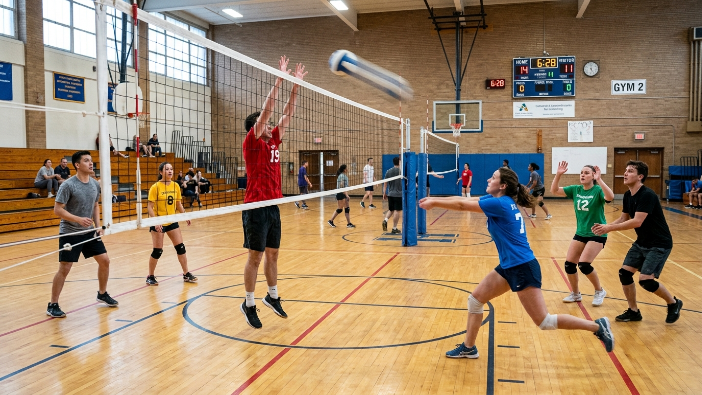
A beginner-friendly volleyball rally in action on an indoor court.
What Is Volleyball? A Quick Overview
Learn essential volleyball techniques with How to Play Volleyball: A 12-Step Guide for Newbies and play with confidence. Volleyball is a team sport played on a court divided by a net. Two teams of six (or two, in beach volleyball) hit a ball back and forth, trying to ground it on the opponent’s side while preventing it from touching their own floor. Each team gets a maximum of three touches before sending the ball back over the net. It’s fast, social, and one of the most accessible sports to start learning at any age. Start your volleyball adventure the right way with How to Play Volleyball: A 12-Step Guide for Newbies.
Volleyball Equipment You’ll Need Before You Start
You don’t need much to begin:
A regulation or beginner-friendly volleyball (softer, slightly lighter balls are easier for newbies)
A net and two poles, or access to a court that already has one set up
Knee pads (highly recommended you’ll be diving and hitting the floor more than you expect)
Comfortable athletic shoes with good lateral grip
Optional: ankle braces if you have a history of ankle rolls, since lateral movement is constant
Once you have the basics, you’re ready to learn the space you’ll be playing in.
Understanding the Volleyball Court and Net
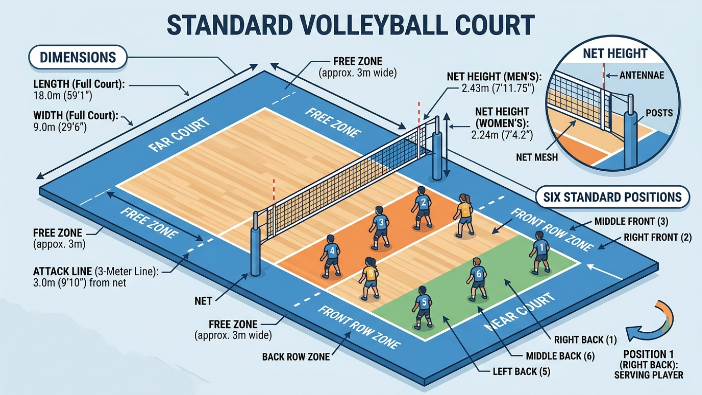
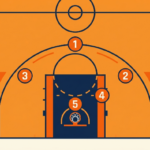
A standard indoor court measures 60 feet by 30 feet, split evenly by the net. The net sits at 7 feet 11⅝ inches for men’s play and 7 feet 4⅛ inches for women’s play. Each side has a front zone (attack line) and a back zone where you stand determines whether you’re primarily attacking or defending on that rotation.
Volleyball court dimensions and standard six-player positions.
How to Play Volleyball Step by Step: The Complete 12-Step Guide for Newbies
This is the core of the guide twelve steps, in order, from understanding the goal of the game to playing your first real rally.
Step 1: Learn the Object of the Game
The goal is simple: ground the ball on your opponent’s side of the court, or force them into a fault, while keeping the ball alive on your own side. Your team gets up to three contacts to organize a pass, a set, and an attack before the ball must cross the net.
Step 2: Learn the Six Positions
Indoor teams field six players: outside hitter, opposite hitter, middle blocker (x2), setter, and libero. The setter acts as the playmaker, the hitters attack near the net, and the libero identifiable by a different colored jersey specializes in back-row defense and passing. Knowing your assigned position tells you where to stand and what your first job is on any given play.
Step 3: Master the Underhand Serve First
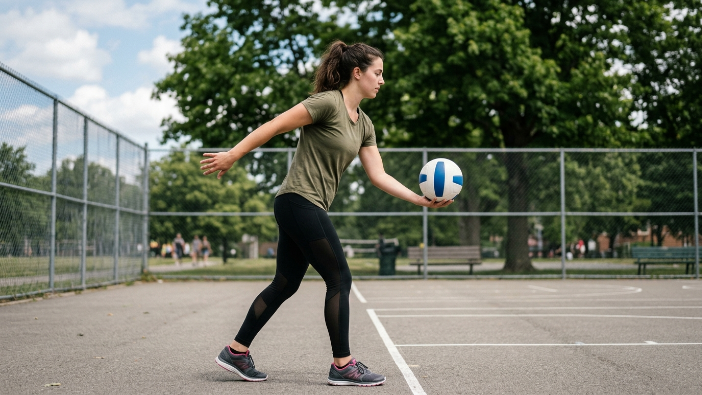
Every rally starts with a serve. As a newbie, start with the underhand serve: hold the ball out in front of your body at waist height, swing your hitting arm below your waist, and strike the ball with the heel of your hand up and over the net. It’s less powerful than an overhand serve but far more consistent while you’re learning and consistency wins beginner rallies.
Step 4: Learn to Pass (the Forearm Bump)
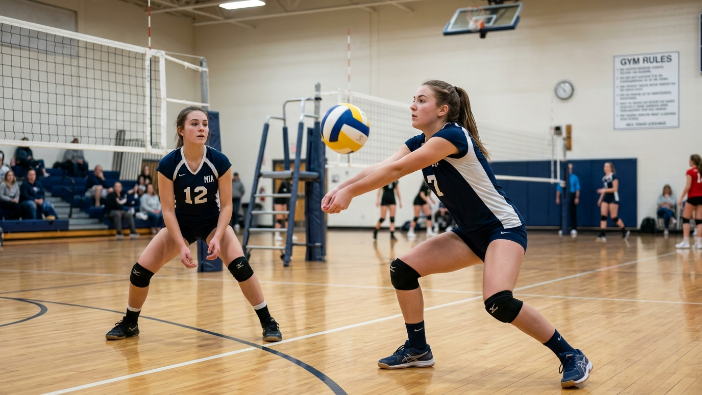
Passing is usually your team’s first response to a serve or attack. Clasp your hands together, keep your arms straight and angled toward your target, and let the ball contact your forearms don’t swing at it. Your goal is control, sending a soft, accurate pass to your setter rather than trying to power the ball anywhere.
Step 5: Learn to Set
Setting is the second touch, usually done with both hands above your forehead in a triangle shape formed by your thumbs and index fingers. Push the ball upward with your fingertips, placing it just above the net so an attacker can jump and hit it. Good footwork a small left-right shuffle into position makes setting far more consistent than trying to reach for the ball.
Step 6: Learn to Attack (Spike)
The attack is the third touch and the most exciting skill in the sport. Approach the net with a few quick steps, jump, and strike the ball with an open hand at its highest point, snapping your wrist to drive it down into the opponent’s court. As a newbie, focus on timing your approach to the set before worrying about power.
Step 7: Learn to Block
Blocking happens at the net, where front-row players jump to intercept an opponent’s attack before it crosses into their court. Keep your hands high and your fingers spread, reaching over the net only to follow through or contact the ball reaching over to attack a serve is a fault.
Step 8: Learn to Dig
Digging is your last line of defense preventing a hard-hit ball from touching your floor after an opponent’s attack. It often means low, quick reactions, extending your platform (forearms) toward the ball rather than swinging.
Step 9: Understand Rotation
Every time your team wins the serve back from the opponent, all six players rotate one position clockwise. This ensures everyone plays both front-row and back-row roles over the course of a game, and it’s one of the rules newbies forget most often early on.
Step 10: Understand the Scoring System
Modern volleyball uses rally scoring a point is awarded on every single rally, regardless of who served. Sets are played to 25 points (win by 2), and matches are best-of-five. If the match reaches a deciding fifth set, that set is only played to 15 points, still with a two-point winning margin required.
Step 11: Play Your First Practice Rally
Now put it together. Start with a simple three-contact rally with friends: serve underhand, pass to a target, set, and send it back over even without a hard spike. Beginners often start by simply catching and tossing the ball to get a feel for positioning and rules before adding real hits.
Step 12: Avoid Common Beginner Mistakes and Keep Progressing
The most common newbie mistakes are ball-watching instead of moving to the ball, double-contacting (touching the ball twice in a row), and crowding the setter instead of spreading across the court. Fix these early, and your rallies will get dramatically longer within just a few sessions.
How to execute a beginner-friendly underhand serve.
Indoor vs. Beach Volleyball: Quick Comparison
Curious how indoor and beach volleyball differ before you pick where to start? Here’s a side-by-side breakdown:
Feature
Indoor Volleyball
Beach Volleyball
Players per team
6
2
Court size
60 ft x 30 ft
52.5 ft x 26.25 ft (approx.)
Net height (men)
7’11⅝”
7’11⅝”
Net height (women)
7’4⅛”
7’4⅛”
Winning score
25 points, win by 2
21 points, win by 2
Match format
Best of 5 sets
Best of 3 sets
Substitutions
Limited, libero exempt
None allowed
Surface
Hardwood court
Sand
Volleyball for Kids vs. Adults: What Changes
For kids (roughly ages 6–12), coaches typically lower the net, use a lighter foam ball, and simplify scoring to keep rallies going and confidence high the focus stays on catching, tossing, and basic bumping rather than technical form. For teens and adults learning as newbies, the regulation net height, standard ball weight, and full rally-scoring rules apply from the start, with more emphasis placed on proper platform mechanics and approach timing for spiking. Either way, the same 12-step sequence above applies only the pace of introducing each step should adjust to the player’s age and coordination.
Sample 4-Week Beginner Practice Progression
Week 1: Foundations
Focus entirely on Steps 1–4 rules, positions, serving, and passing. Practice underhand serves against a wall and forearm passes with a partner for 20–30 minutes, three times this week.
Week 2: Building the Attack
Add Steps 5–6 setting and spiking. Drill the setting triangle shape and practice a simple three-step approach without a ball before adding it back in.
Week 3: Defense and Structure
Add Steps 7–9 blocking, digging, and rotation. Play small-sided games (3v3) to get repetitions on rotation without the complexity of a full six-player lineup.
Week 4: Full Game Play
Add Steps 10–12 scoring, full rallies, and correcting common mistakes. Play full 6v6 practice sets, applying rally scoring to 25 points.
How to execute a beginner-friendly underhand serve.
Common Beginner Mistakes to Avoid
Watching the ball instead of moving your feet into position early
Swinging at the ball while passing instead of using a stable platform
Standing still after serving instead of transitioning into your defensive position
Reaching over the net illegally when blocking a serve
Ignoring communication call the ball early to avoid collisions
Benefits of “How to Play Volleyball: A 12-Step Guide for Newbies”
Here are 20 unique short lines, each including the exact keyword “How to Play Volleyball: A 12-Step Guide for Newbies”:
How to Play Volleyball: A 12-Step Guide for Newbies makes learning fun and easy.
Start your journey with How to Play Volleyball: A 12-Step Guide for Newbies.
How to Play Volleyball: A 12-Step Guide for Newbies teaches every basic skill.
Learn serving, passing, and teamwork with How to Play Volleyball: A 12-Step Guide for Newbies.
How to Play Volleyball: A 12-Step Guide for Newbies is perfect for first-time players.
Improve your confidence using How to Play Volleyball: A 12-Step Guide for Newbies.
How to Play Volleyball: A 12-Step Guide for Newbies explains the rules step by step.
Build strong volleyball fundamentals with How to Play Volleyball: A 12-Step Guide for Newbies.
How to Play Volleyball: A 12-Step Guide for Newbies helps you master the basics quickly.
Enjoy learning with How to Play Volleyball: A 12-Step Guide for Newbies today.
How to Play Volleyball: A 12-Step Guide for Newbies makes practice simple.
Learn the correct techniques with How to Play Volleyball: A 12-Step Guide for Newbies.
How to Play Volleyball: A 12-Step Guide for Newbies is your complete beginner resource.
Practice smarter with How to Play Volleyball: A 12-Step Guide for Newbies.
How to Play Volleyball: A 12-Step Guide for Newbies helps improve your skills fast.
Discover easy volleyball tips in How to Play Volleyball: A 12-Step Guide for Newbies.
How to Play Volleyball: A 12-Step Guide for Newbies is ideal for kids and adults.
Learn each step clearly with How to Play Volleyball: A 12-Step Guide for Newbies.
How to Play Volleyball: A 12-Step Guide for Newbies builds confidence on the court.
Play better every match with How to Play Volleyball: A 12-Step Guide for Newbies.
Frequently Asked Questions
1. How many players are on a volleyball team?
Indoor volleyball uses six players per team on the court at once; beach volleyball uses two players per team.
2. What are the 6 positions in volleyball?
The six positions are outside hitter, opposite hitter, two middle blockers, setter, and libero, each rotating through front-row and back-row roles.
3. Is volleyball hard to learn as a complete beginner?
Not particularly most newbies can serve and pass with reasonable consistency within a few practice sessions by following a structured step-by-step guide for newbies rather than jumping straight into full games.
4. How do you win a point in volleyball?
Under rally scoring, a point is awarded every rally regardless of which team served either by grounding the ball in the opponent’s court or by the opposing team committing a fault.
5. What is the easiest serve for beginners to learn?
The underhand serve is easiest, since it’s swung below the waist with the heel of the hand and offers more consistency than the overhand serve while you’re still learning ball control.
6. How tall is a volleyball net?
Regulation net height is 7 feet 11⅝ inches for men’s play and 7 feet 4⅛ inches for women’s play.
7. What’s the difference between indoor and beach volleyball rules?
Indoor volleyball is played 6-a-side to 25 points with substitutions allowed, while beach volleyball is played 2-a-side to 21 points with no substitutions and a smaller sand court.
Final Thoughts
Learning volleyball doesn’t have to feel overwhelming. By following this how to play volleyball step by step guide for newbies from understanding positions through your very first practice rally you’ll build real skills in the correct order instead of guessing where to start. Grab a ball, find a wall or a partner, and begin with Step 1 today.