Most Sudoku guides either drown you in fifty micro-tips or skip straight to jargon like “ALS-XZ” before you’ve mastered the basics. This blog is covered by zainblogs. This breakdown of 15 Sudoku Strategies Every Player Should Know is deliberately curated to the techniques that actually cover the vast majority of puzzles you’ll ever face from your first easy grid to the hardest “evil” difficulty a puzzle app can throw at you. Nothing here is padding.
Each strategy below is organized by difficulty tier, so you can stop exactly where your current puzzles stop challenging you there’s no need to learn Forcing Chains if you’re still working through easy and medium grids. For advanced solving methods and expert techniques, explore Sudoku.com’s Sudoku Rules and Solving Strategies, which explains everything from beginner basics to advanced tactics.
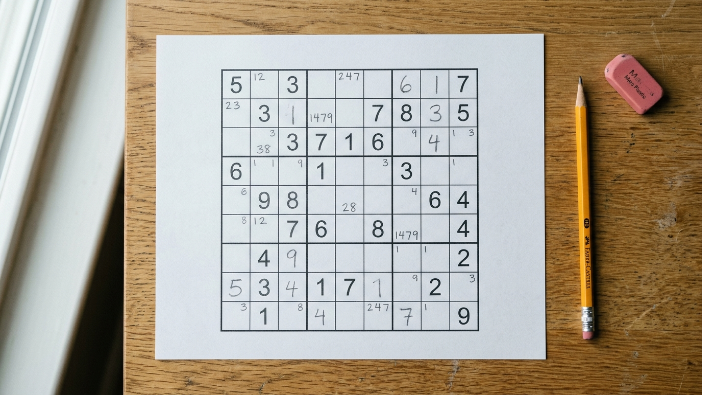
Pencil marks are the foundation every Sudoku strategy on this list builds on.
How These 15 Sudoku Strategies Are Organized
Sudoku strategies generally fall into four tiers of difficulty: Beginner, Intermediate, Advanced, and Expert. Easy and medium puzzles can almost always be solved with just the first four strategies on this list. Hard puzzles start requiring the intermediate techniques, while expert and “evil” difficulty grids typically need at least one of the advanced or expert strategies covered near the end.
What makes this particular breakdown of 15 Sudoku strategies every player should know different from a general technique dump is the ordering: each tier assumes you’ve already internalized everything above it, so you’re never asked to learn a pattern-matching technique like X-Wing before you’ve built the pencil-mark habits that make spotting it possible in the first place.
Quick Reference: All 15 Sudoku Strategies at a Glance
Before the full breakdown, here’s a fast-reference table showing where each strategy fits, and whether you’ll need pencil marks (candidate numbers) in place before you can use it.
#
Strategy
Difficulty
Best Used On
Needs Pencil Marks?
1
Scanning / Cross-Hatching
Beginner
Easy puzzles
No
2
Pencil Marks
Beginner
All puzzles
N/A
3
Naked Singles
Beginner
Easy–Medium
Yes
4
Hidden Singles
Beginner
Easy–Medium
Yes
5
Naked Pairs
Intermediate
Medium
Yes
6
Hidden Pairs
Intermediate
Medium
Yes
7
Pointing Pairs
Intermediate
Medium–Hard
Yes
8
Box/Line Reduction
Intermediate
Medium–Hard
Yes
9
Naked Triples
Intermediate
Hard
Yes
10
X-Wing
Advanced
Hard
Yes
11
Swordfish
Advanced
Hard–Expert
Yes
12
XY-Wing
Advanced
Expert
Yes
13
Unique Rectangle
Advanced
Expert
Yes
14
Simple Coloring
Expert
Expert–Evil
Yes
15
Forcing Chains
Expert
Evil
Yes
Beginner Sudoku Strategies
These four strategies solve the overwhelming majority of easy and medium Sudoku puzzles on their own. If you only learn four things from this list, learn these.
1. Scanning / Cross-Hatching (Beginner)
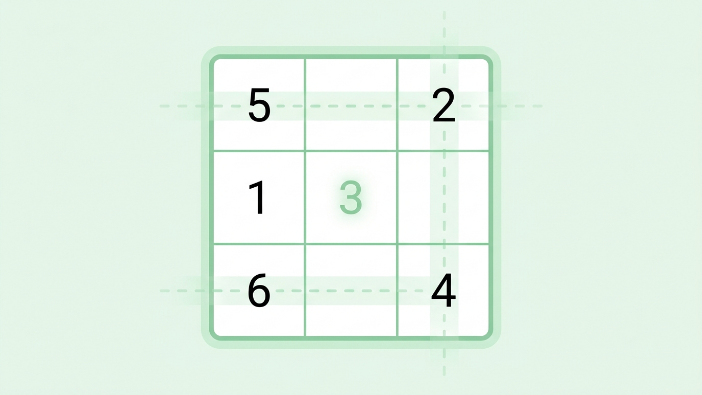
Cross-hatching is the most basic Sudoku strategy: pick a number, then draw imaginary lines through every row and column where that number already appears. Any cell touched by one of those lines can’t hold that number, which often narrows a box down to a single valid cell. It’s the first technique every solver learns, and it’s usually enough to make real progress on any easy puzzle. Most players eventually do this scan automatically without consciously thinking about it, but it’s worth practicing deliberately at first so the habit sticks.
Cross-hatching narrows down candidates by scanning rows and columns for a single number.
2. Pencil Marks (Candidate Notation) (Beginner)
Pencil marks are small numbers noted in the corner of each empty cell to track every value that could still go there. This single habit unlocks nearly every strategy further down this list without candidate notation in place, spotting pairs, triples, or X-Wing patterns is nearly impossible. Most digital Sudoku apps include a built-in candidate mode for this exact reason.
3. Naked Singles (Beginner)
A naked single is a cell that has exactly one possible candidate left after you’ve accounted for every number already placed in its row, column, and box. These are the easiest wins in the entire puzzle and should always be placed the moment you spot them, since filling them in often reveals new naked singles elsewhere on the grid.
4. Hidden Singles (Beginner)
A hidden single is a step trickier than a naked single: the cell itself may show several candidates, but one specific number can only physically fit in that one cell within its row, column, or box. Finding hidden singles means scanning by number rather than by cell pick a digit, then check where it can legally go across each unit.
Intermediate Sudoku Strategies
Once naked and hidden singles stop appearing, these five techniques are what carry you through medium and hard puzzles.
5. Naked Pairs (Intermediate)
A naked pair happens when two cells in the same row, column, or box contain exactly the same two candidates and nothing else. Since those two numbers have to occupy those two cells in some order, you can safely eliminate both candidates from every other cell in that unit.
Naked pairs let you eliminate candidates from an entire row, column, or box at once.
6. Hidden Pairs (Intermediate)
A hidden pair occurs when two candidates are restricted to just two cells within a unit, even though those two cells may still show other candidates as well. Once you spot the pair, every other candidate in those two cells can be eliminated, often revealing a naked single immediately after.
7. Pointing Pairs (Intermediate)
When a candidate number inside a 3×3 box is confined to a single row or column within that box, it can be eliminated from the rest of that row or column outside the box. This overlap between box and line constraints is one of the more satisfying “aha” strategies once it clicks.
8. Box/Line Reduction (Intermediate)
Box/Line Reduction is the mirror image of pointing pairs: when a candidate in a row or column is restricted to a single box, it can be eliminated from the rest of that box. Learning pointing pairs and box/line reduction together makes both easier to spot in practice.
9. Naked Triples (Intermediate)
A naked triple extends the naked pair idea to three cells sharing exactly three candidates between them, even if no single cell shows all three each cell might have only two of the three numbers. Once identified, those three numbers can be eliminated from every other cell in that same row, column, or box. Naked triples are easy to miss because they don’t require all three cells to look identical, only that together they contain no more than three distinct candidates.
Advanced Sudoku Strategies
These four strategies are where hard and expert puzzles stop yielding to basic elimination and start requiring genuine pattern recognition across the whole grid.
10. X-Wing (Advanced)
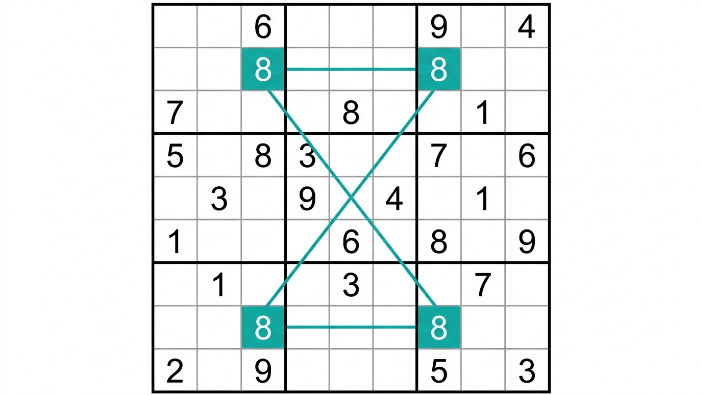
An X-Wing appears when a candidate number is restricted to exactly two cells in each of two different rows, and those cells line up in the same two columns (or the reverse, with columns and rows swapped). Because the candidate must occupy one of the two aligned cells in each row, it can be eliminated from every other cell in those two columns. Visually, the four cells form the corners of a rectangle, which is usually the fastest way to spot the pattern while scanning a puzzle.
The X-Wing pattern eliminates candidates across two rows and two columns simultaneously.
11. Swordfish (Advanced)
Swordfish extends the X-Wing concept from two rows and columns to three. If a candidate is restricted to two or three cells in each of three rows, and those cells collectively line up across exactly three columns, the candidate can be eliminated from every other cell in those columns. It’s harder to spot than an X-Wing simply because there are more cells to track at once, but the underlying elimination logic is identical.
12. XY-Wing (Advanced)
The XY-Wing strategy uses three bi-value cells a pivot cell holding candidates X and Y, and two pincer cells that each share one candidate with the pivot. If both pincer cells share a common candidate Z, that candidate can be eliminated from any cell that sees both pincers at once. It’s one of the more elegant advanced techniques once you get comfortable tracking which cells share a unit with which.
13. Unique Rectangle (Advanced)
Unique Rectangle strategies rely on the rule that every valid Sudoku puzzle has exactly one solution. If four cells spanning two rows, two columns, and two boxes all share the same two candidates, that configuration would create two possible solutions an impossible state in a valid puzzle which lets you eliminate the candidates that would cause it. There are several recognized sub-types of this pattern, but all of them lean on the same one-solution guarantee.
Expert Sudoku Strategies
These final two strategies are reserved for the hardest “expert” and “evil” puzzles, where every simpler technique has already been exhausted.
14. Simple Coloring (Expert)
Simple Coloring tracks a single candidate across a chain of cells where it appears exactly twice per row, column, or box, assigning alternating colors along the chain. When the same color appears twice in a single unit, that color represents an impossible chain and can be eliminated entirely. It takes practice to spot the full chain, but once you can trace conjugate pairs reliably, coloring becomes one of the faster expert-level techniques to apply.
15. Forcing Chains (Expert)
Forcing Chains work by testing what happens if each candidate in a starting cell turns out to be correct, then following the logical consequences forward through the grid. If both possible values eventually force the same outcome elsewhere on the grid, that outcome must be true regardless of which candidate was actually correct a powerful last-resort technique for the toughest puzzles. Because forcing chains rely on if-then logic rather than pattern recognition, they’re often the final tool solvers reach for once every other strategy on this list has been exhausted.
Mastering these 15 Sudoku strategies is enough to solve nearly any puzzle you’ll encounter.
A Quick Worked Example: Chaining Strategies Together
Here’s something most Sudoku strategy guides skip: puzzles are rarely solved with just one technique in isolation. A typical hard puzzle might open with a few naked singles, stall out, reveal a pointing pair that clears several candidates from one row, which in turn exposes a hidden pair in a neighboring box, which finally unlocks the naked single that gets you moving again. Learning these 15 Sudoku strategies individually matters less than learning to cycle through them in order singles first, then pairs and pointing patterns, and only then the advanced fish patterns every time you get stuck.
A harder, expert-level example follows a similar rhythm at a higher altitude: after singles, pairs, and pointing patterns are exhausted, an X-Wing might clear just enough candidates in two columns to expose a Naked Triple in a nearby box. That triple, in turn, can reveal the final Hidden Single needed to break the puzzle wide open. The pattern repeats at every difficulty level no single strategy usually finishes a hard puzzle alone, which is exactly why treating this list as fifteen isolated tricks rather than a connected toolkit undersells how they’re meant to be used.
How Many of These Sudoku Strategies Do You Actually Need?
If you mostly play easy and medium puzzles, the first four beginner strategies will solve almost everything you encounter. Hard puzzles typically require adding the five intermediate techniques. It’s only once you’re consistently attempting expert or “evil” difficulty that the four advanced and two expert strategies on this list become necessary. There’s no requirement to learn all 15 Sudoku strategies at once most players build up gradually, adding one new technique only when their current toolkit stops being enough.
A reasonable pace for most solvers is one new strategy every week or two of regular play, practiced deliberately on puzzles chosen specifically to require it. Trying to memorize all 15 Sudoku strategies every player should know in a single sitting tends to backfire the pattern recognition these techniques depend on only sticks after you’ve applied each one on real grids several times over.
Here are benefits of “15 Sudoku Strategies Every Player Should Know”
15 Sudoku Strategies Every Player Should Know helps you avoid common mistakes and solve puzzles with greater accuracy.
15 Sudoku Strategies Every Player Should Know improves your logical reasoning through proven solving methods.
15 Sudoku Strategies Every Player Should Know teaches efficient techniques that save time on difficult puzzles.
15 Sudoku Strategies Every Player Should Know enhances your ability to recognize number patterns quickly.
15 Sudoku Strategies Every Player Should Know strengthens your focus during every puzzle-solving session.
15 Sudoku Strategies Every Player Should Know makes challenging Sudoku puzzles easier to complete with confidence.
15 Sudoku Strategies Every Player Should Know encourages smarter thinking instead of random guessing.
15 Sudoku Strategies Every Player Should Know helps sharpen your mind with enjoyable daily practice.
15 Sudoku Strategies Every Player Should Know improves concentration by keeping your attention on every move.
15 Sudoku Strategies Every Player Should Know supports long-term brain health through regular mental exercise.
15 Sudoku Strategies Every Player Should Know helps beginners learn faster with simple yet effective techniques.
15 Sudoku Strategies Every Player Should Know develops critical thinking skills that benefit everyday decision-making.
15 Sudoku Strategies Every Player Should Know trains your brain to solve complex problems more efficiently.
15 Sudoku Strategies Every Player Should Know improves your puzzle-solving speed without sacrificing accuracy.
15 Sudoku Strategies Every Player Should Know provides a rewarding challenge that keeps your mind engaged.
15 Sudoku Strategies Every Player Should Know boosts confidence by helping you solve even advanced Sudoku grids.
15 Sudoku Strategies Every Player Should Know encourages consistent practice for continuous skill improvement.
15 Sudoku Strategies Every Player Should Know offers practical techniques that work for both beginners and experts.
15 Sudoku Strategies Every Player Should Know transforms every puzzle into an opportunity to strengthen your thinking skills.
15 Sudoku Strategies Every Player Should Know helps you enjoy Sudoku more by making each puzzle easier and more satisfying to solve.
Frequently Asked Questions
Which Sudoku strategy should I learn first?
Start with scanning and pencil marks, then move to Naked Singles and Hidden Singles. These four beginner strategies solve the majority of easy and medium puzzles on their own.
What is the easiest Sudoku strategy?
Naked Singles is generally considered the easiest strategy, since it only requires spotting a cell with exactly one remaining candidate after basic elimination.
How many Sudoku strategies do I actually need to know?
Most casual players only need the four beginner and five intermediate strategies from this list of 15 Sudoku strategies every player should know. The four advanced and two expert techniques are only necessary for expert and evil difficulty puzzles.
What’s the difference between naked singles and hidden singles?
A naked single is a cell with only one candidate left. A hidden single is a cell where a specific number can only fit in that one spot within its row, column, or box, even though the cell may still show other candidates.
Do I need to use pencil marks for every Sudoku strategy?
Yes, for nearly all strategies beyond basic scanning. Pencil marks (candidate notation) are what make it possible to spot pairs, triples, and pattern-based strategies like X-Wing and Swordfish.
What Sudoku strategy works best for hard puzzles?
Pointing Pairs, Box/Line Reduction, and Naked Triples typically unlock most hard puzzles once basic singles and pairs are exhausted.
Is X-Wing hard to learn?
X-Wing has a bit of a learning curve visually, but the underlying logic is straightforward once you’ve practiced spotting the rectangular pattern it relies on a few times.
What should I try if I’m completely stuck on a puzzle?
Recheck your pencil marks for errors first, then work through the 15 Sudoku strategies in order of difficulty rather than jumping straight to advanced techniques most sticking points resolve with a pair or pointing-pattern strategy you may have missed.
Final Thoughts
From cross-hatching your very first easy grid to chaining Forcing Chains on an evil-rated puzzle, this list of 15 Sudoku Strategies Every Player Should Know is meant to grow with you rather than overwhelm you on day one. Master the beginner tier fully before moving on, and you’ll find the intermediate and advanced strategies click into place far faster than trying to learn all fifteen strategies at once.
15 Sudoku Strategies Every Player Should Know helps improve logical thinking and decision-making skills. 15 Sudoku Strategies Every Player Should Know boosts memory by encouraging regular brain exercise. 15 Sudoku Strategies Every Player Should Know enhances concentration and attention to detail. 15 Sudoku Strategies Every Player Should Know helps you solve puzzles faster with smarter techniques. 15 Sudoku Strategies Every Player Should Know improves pattern recognition through consistent practice. 15 Sudoku Strategies Every Player Should Know strengthens problem-solving abilities in an enjoyable way.