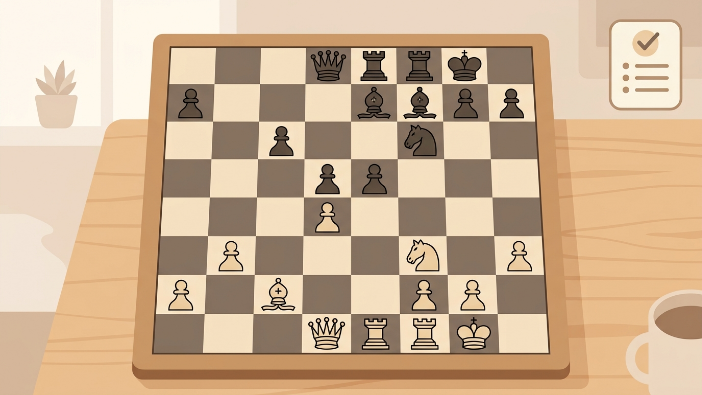
Discover 20 Ultimate Chess Tips to Improve Your Game Fast for better planning and execution. Most “how to improve at chess” guides give you either a random grab-bag of tips or a single player’s personal formula. Neither tells you which tips actually apply to your rating band, and few let you check your progress against a clear framework. This blog is covered by zainblogs. This guide covers 20 ultimate chess tips to improve your game fast, organized by skill area, so beginner, intermediate, and advanced players can each find what actually moves the needle for them.
Whether you’re a complete beginner stuck below 800, a club player plateaued around 1200-1500, or an intermediate grinder chasing 1800+, you’ll find tips mapped to where you actually are plus a comparison table, a fast-answer FAQ, and a study structure you can start using today. 20 Ultimate Chess Tips to Improve Your Game Fast with simple strategies anyone can learn. Official FIDE Chess Rules Learn the official rules of chess, tournament regulations, and gameplay standards from the International Chess Federation. https://handbook.fide.com/chapter/E012023
Quick-Answer Summary: How to Improve at Chess Fast
If you only have 60 seconds: play focused games at longer time controls, analyze every one of them (with and without an engine), solve tactics puzzles daily, learn one opening per color deeply instead of many shallowly, and study basic endgames before advanced theory. Consistency over months beats intensity over days. The 20 tips below turn this into a complete system.
A structured approach beats random studying the 20 tips below are organized by skill level.
Why Most Chess Improvement Lists Fall Short
Search “how to get better at chess” and two patterns repeat everywhere. The first is a personal-blog listicle: one player’s individual journey re-packaged as universal advice, light on structure and heavy on anecdote. The second is a single coach’s proprietary framework useful, but narrow, and often written to lead readers toward a paid course rather than fully answer the question on its own. Explore 20 Ultimate Chess Tips to Improve Your Game Fast and strengthen your opening play.
What’s consistently missing across these guides is a rating-based roadmap that tells you what to prioritize at your level, a direct side-by-side comparison of competing study methods, and a proper FAQ section addressing the specific questions players actually type into Google and ask AI assistants. Several widely-shared guides are also several years old and were written before free tactics trainers, engine-assisted analysis, and structured study apps became the norm so their advice skews toward slower, less efficient methods than what’s realistically available today. This guide is built to close all of these gaps at once.
Tips 1-7: Build Your Foundation
1. Analyze Every Game You Play
This is the single highest-leverage habit in chess improvement. After every serious game, go through it twice: once on your own without any engine, trying to identify where your plan broke down, and once with engine assistance to catch tactical errors you missed. Log recurring mistakes in a simple spreadsheet or notebook most players find the same three or four error types account for the majority of their lost points. 20 Ultimate Chess Tips to Improve Your Game Fast to develop winning habits.
2. Solve Tactical Puzzles Daily
Puzzles train pattern recognition, calculation, and visualization at the same time, and daily repetition is what makes patterns automatic under time pressure. Ten to fifteen focused minutes a day beats an hour once a week. Choose puzzles slightly above your comfort level rather than ones you solve instantly productive struggle is where the learning happens. Master 20 Ultimate Chess Tips to Improve Your Game Fast and outplay your opponents.
Daily tactics training builds the pattern recognition that separates improving players from those who plateau.
3. Learn One Reliable Opening Per Color
Chasing every trendy opening name spreads your study time too thin. Pick one opening system as White and one primary defense as Black, then go deep: learn the first 8-10 moves, the resulting middlegame plans, and two or three typical tactical traps within it. Depth in one system beats shallow familiarity with ten. 20 Ultimate Chess Tips to Improve Your Game Fast with practical advice for beginners.
4. Avoid Blitz and Bullet Until Fundamentals Are Solid
Fast time controls are fun but teach bad habits early they reward quick pattern-matching over the deliberate thinking that actually builds skill. Stick to games of at least 15 minutes plus increment while your fundamentals are still forming, and save blitz for warming up or testing openings once your base is stronger. Follow 20 Ultimate Chess Tips to Improve Your Game Fast to build a stronger game plan.
5. Study Basic Endgame Technique Early
Endgames come up in nearly every serious game, yet most beginners postpone studying them indefinitely. Prioritize king-and-pawn endings, the rule of the square, basic checkmates (king and queen vs. king, king and rook vs. king), and simple rook endgame technique like the Lucena and Philidor positions. These recur constantly and are quick to learn relative to their payoff. 20 Ultimate Chess Tips to Improve Your Game Fast and improve your decision-making skills.
6. Think in Plans, Not Just Individual Moves
A common beginner trap is moving piece by piece without an underlying idea. Before each move, ask what you’re trying to achieve over the next three to five moves improving a weak piece, targeting a specific pawn, preparing a break rather than just reacting to the position in front of you. Unlock 20 Ultimate Chess Tips to Improve Your Game Fast for consistent improvement.
7. Ask What Your Opponent Is Threatening Every Single Move
Even strong plans collapse if you ignore what the other side is doing. Before executing your own idea, scan the board for new threats your opponent’s last move created. This single habit eliminates a large share of blunders at every rating level below master. 20 Ultimate Chess Tips to Improve Your Game Fast and enhance your tactical awareness.
Tips 8-13: Sharpen Your Tactics and Calculation
8. Recognize Common Tactical Patterns by Sight
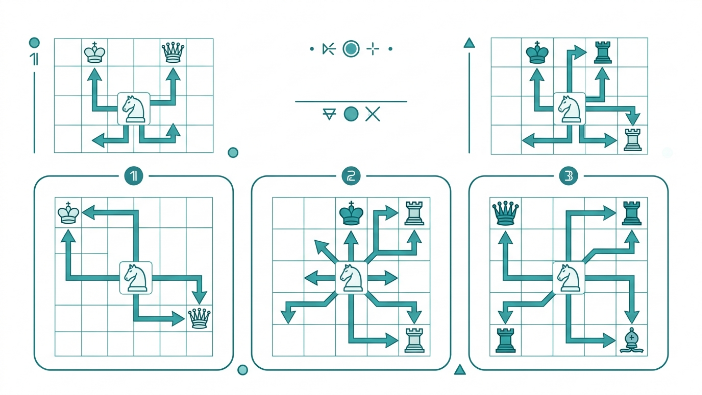
Forks, pins, skewers, discovered attacks, and back-rank weaknesses account for the overwhelming majority of tactical shots in amateur games. Study each pattern in isolation until you can spot the setup conditions instantly, not just solve them when a puzzle tells you one exists. Apply 20 Ultimate Chess Tips to Improve Your Game Fast to win more games with confidence.
9. Calculate Before You Move Slow Down
Rushed moves are the number one source of unforced errors below intermediate level. Before playing a move in a critical or unclear position, force yourself to calculate at least two or three candidate moves several moves deep, including your opponent’s most dangerous replies, before committing. 20 Ultimate Chess Tips to Improve Your Game Fast and master the fundamentals of chess.
Recognizing patterns like forks and pins by sight is faster than calculating them from scratch every time.
10. Watch for Weak Pawn Structures Yours and Theirs
Doubled, isolated, or backward pawns become long-term liabilities, especially as pieces come off the board. Learn to identify when a trade will damage your opponent’s structure (favorable for you) versus your own, and steer trades accordingly. Learn 20 Ultimate Chess Tips to Improve Your Game Fast to become a more confident player.
11. Don’t Trade Active Pieces for Passive Ones
Material value on paper doesn’t equal practical value on the board. A knight dominating the center is often worth more than a bishop boxed in by its own pawns, even though both are “worth three points.” Judge trades by activity and potential, not just piece type. 20 Ultimate Chess Tips to Improve Your Game Fast and take your chess skills to the next level. 20 Ultimate Chess Tips to Improve Your Game Fast and build a winning mindset.
12. Guard King Safety and Watch the Back Rank
Back-rank mates and exposed king positions cost games at every level, often out of nowhere. Make it a habit to check for luft (an escape square for your king) once your rank gets crowded, and stay alert to when your opponent’s king safety has quietly become the real target. Discover 20 Ultimate Chess Tips to Improve Your Game Fast with easy-to-follow strategies.
13. Spot Discovered and Double Attacks Before They Happen
A discovered attack where moving one piece unleashes an attack from another piece behind it is one of the most common ways games are decided at the club level. When a bishop, rook, or queen is aligned with an enemy piece through your own piece, treat that alignment as a live tactical risk even if the direct path looks blocked. 20 Ultimate Chess Tips to Improve Your Game Fast and strengthen every move you make. Learn 20 Ultimate Chess Tips to Improve Your Game Fast for smarter gameplay.
Tips 14-18: Train Like an Improving Player
14. Use a Structured Study Cycle: Study, Practice, Fix, Repeat
Random studying without a feedback loop wastes time. A simple and effective cycle is: study a concept, apply it in real games, review those games to find where the concept was misapplied or missed, then return to studying that specific gap. Repeating this loop consistently compounds faster than any single resource on its own. 20 Ultimate Chess Tips to Improve Your Game Fast and improve your tactical vision.
15. Review Annotated Master Games for Positional Understanding
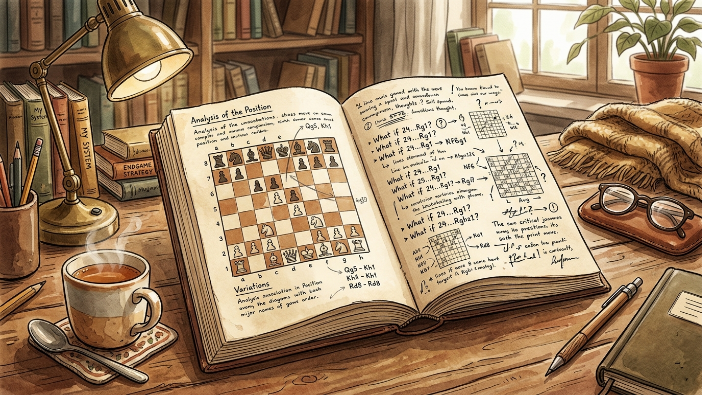
Tactics puzzles train sharp calculation, but annotated games from strong players teach the quieter skills piece placement, prophylaxis, and long-term planning that puzzles can’t capture. Pick a handful of well-annotated classic games and study the commentary, not just the moves. Master 20 Ultimate Chess Tips to Improve Your Game Fast to gain a competitive edge.
Studying annotated master games builds the positional intuition that tactics puzzles alone can’t teach.
16. Set SMART, Process-Based Goals Instead of Only Rating Targets
A goal like “reach 1600” gives you nothing to act on this week. Break it into process goals instead for example, “solve 10 tactics puzzles daily” or “analyze every rated game within 24 hours” that are specific, measurable, and within your control. Rating gains become a byproduct of consistent process, not a target you can directly control. 20 Ultimate Chess Tips to Improve Your Game Fast with practical examples for beginners.
17. Track Your Mistake Patterns Over Time
Keep a running log of the specific ways you lose games hanging pieces, missing tactics, poor time management, weak endgame technique and revisit it monthly. Most players are surprised to find one or two categories dominate their losses, which makes prioritizing study time far easier. Explore 20 Ultimate Chess Tips to Improve Your Game Fast and make better decisions.
18. Get Feedback From a Coach or a Stronger Study Partner
Self-analysis has a ceiling you can’t always see your own blind spots. A coach or a player several hundred points stronger can identify recurring errors far faster than self-review alone, and even a small number of coached sessions can accelerate months of solo study. 20 Ultimate Chess Tips to Improve Your Game Fast to dominate every stage of the game.
Tips 19-20: Mindset and Long-Term Consistency
19. Build Mental Resilience and Avoid Tilt
Losing streaks and blunders are inevitable, and how you respond to them matters as much as your technical skill. Avoid playing multiple games in a row immediately after a frustrating loss take a short break, briefly note what went wrong, and return with a clear head. Players who tilt into more games after a bad loss consistently perform worse. Practice 20 Ultimate Chess Tips to Improve Your Game Fast for long-term improvement.
20. Play and Study Consistently Over the Long Term
Short bursts of intense study followed by long breaks produce far less than steady, moderate effort sustained over months and years. Chess improvement compounds: a player who studies 30 focused minutes a day for a year will typically outpace one who studies in occasional weekend marathons. Consistency, not intensity, is what separates players who plateau from players who keep climbing. 20 Ultimate Chess Tips to Improve Your Game Fast and develop stronger board awareness.
Applying these 20 ultimate chess tips consistently not in bursts is what actually improves your game fast over time.
Study Methods Compared
Not all study methods deliver equal returns for the time invested. Here’s how the core methods stack up against each other:
Study Method
Best For
Time Investment
Skill Level
Tactics puzzles
Pattern recognition, calculation speed
10-20 min/day
All levels
Game analysis (self + engine)
Fixing recurring mistakes
15-30 min per game
All levels
Opening study
Avoiding early disadvantages
1-2 hrs/week
Beginner-Intermediate
Annotated master games
Positional understanding, planning
30-45 min/session
Intermediate-Advanced
Endgame technique
Converting advantages, saving draws
30 min/week
All levels
Coaching / stronger sparring partner
Fast feedback on blind spots
1-2 sessions/month
Intermediate-Advanced
A 4-Week Fast-Track Study Plan
If you want to turn these 20 ultimate chess tips to improve your game fast into a concrete routine rather than a list you read once and forget, use this four-week starting plan. It’s deliberately light 20-30 minutes a day so it’s sustainable rather than something you abandon after a week.
Week 1: Foundations
Spend most sessions on tips 1, 2, and 5: analyze every game you play, solve 10 tactics puzzles daily, and learn the basic king-and-pawn and rook endgame patterns. Skip opening study almost entirely this week the goal is to stop the bleeding from tactical blunders and basic endgame technique gaps first.
Week 2: Structure
Add tips 3, 6, and 7. Pick your one opening per color and learn it to move eight or nine. Practice pausing before each move in your games to ask what you’re trying to achieve and what your opponent just threatened. Keep the daily tactics habit running don’t drop it to make room for the new material.
Week 3: Sharpening
Layer in tips 8, 9, 12, and 13. Dedicate a session to studying one tactical pattern in isolation forks one day, pins the next, discovered attacks after that until you recognize the setup instantly rather than only after solving a puzzle. Continue analyzing every game with an eye specifically toward king safety.
Week 4: Systemize
Introduce tips 14, 16, and 17. Set up your study-practice-fix cycle formally, write down two or three SMART process goals for the following month, and start a simple mistake-tracking log. By the end of week four, most players notice fewer repeated blunders and a clearer sense of what to study next which is the real marker of progress, more reliable than any single game result.
Tools and Resources Worth Using
You don’t need paid software to apply these tips. Lichess offers a completely free tactics trainer, game analysis with engine evaluation, and study tools that cover most of what’s described above. Chess.com’s free tier covers puzzles and basic analysis, with paid tiers adding deeper engine access and structured lessons. For dedicated tactics training beyond the basics, platforms like ChessTempo are worth adding once you’ve outgrown the puzzle rush on the main sites. Whichever tools you pick, it’s the 20 ultimate chess tips to improve your game fast themselves not the specific app that drive the improvement.
Common Mistakes That Slow Down Improvement
Even players who genuinely put in study time can stall out for months at a time. Usually it comes down to one or two habits below quietly undoing the rest of the work worth checking against your own routine before adding anything new.
Studying openings for hours while skipping tactics and endgames entirely.
Playing only blitz/bullet and never reviewing a single game afterward.
Switching openings every few weeks instead of building depth in one system.
Setting only outcome goals (“reach 1500”) with no process behind them.
Avoiding analysis of losses because they’re uncomfortable to look at.
Relying entirely on engine evaluations without first thinking independently.
Frequently Asked Questions
How long does it take to improve at chess as a beginner?
Most players who study consistently daily tactics, regular game analysis, and focused opening and endgame basics see a noticeable rating jump within 2-3 months. Reaching 1000+ from a true beginner level typically takes 6-12 months of steady, moderate effort rather than sporadic intense study.
What is the fastest way to improve at chess?
The fastest combination is daily tactics puzzles paired with thorough post-game analysis of your own games. This pairing directly targets the two biggest sources of lost points for improving players: missed tactics and repeated positional or planning errors.
Should beginners study chess openings in depth?
No, beginners get more value from tactics, basic checkmates, and simple endgames than from memorizing opening theory. Learn just enough opening principles (development, king safety, center control) to reach a playable middlegame, then deepen opening knowledge gradually as your rating rises.
How many puzzles should I solve per day to improve?
Ten to fifteen focused puzzles a day, solved slowly and carefully rather than rushed, is more effective than solving 50 puzzles quickly once a week. Quality of attention matters more than raw puzzle count.
Is playing online chess enough to improve, or do I need to study?
Playing alone plateaus quickly without analysis. Games show you where mistakes happen, but only structured review ideally combining your own thinking with engine checks turns those mistakes into lasting improvement.
What rating should I be at each skill level?
Rough benchmarks on Chess.com/Lichess: under 800 is beginner, 800-1400 is developing, 1400-1800 is solid intermediate/club level, and 1800+ starts to approach advanced club and tournament-competitive play. These bands vary by platform and time control.
Do I need a chess coach to improve quickly?
A coach isn’t required but accelerates progress significantly, especially past the intermediate plateau where self-analysis has diminishing returns. Even occasional coaching sessions combined with consistent self-study outperform self-study alone.
How important is mindset in chess improvement?
Very important. Players who tilt after losses, avoid analyzing painful games, or set only outcome-based goals tend to plateau earlier than players who treat losses as data and follow a consistent, process-based study routine.
Quick answers to the questions players most often ask about chess improvement.
Conclusion: Put These Tips Into Practice
Improving at chess isn’t about finding one secret trick it’s about applying the right mix of these 20 ultimate chess tips consistently, in the order that matches your current level. Start with the foundation tips if you’re new, layer in tactical sharpening as you grow, and let structure and mindset carry you past the plateaus that stop most players. Chess.com Chess Lessons Improve your skills with beginner-friendly lessons, tactics, openings, and endgame tutorials from one of the world’s largest chess platforms. https://www.chess.com/lessons
Bookmark this guide, revisit the FAQ when a specific question comes up, and track your progress using the study cycle in tip 14. Most players who stall out aren’t missing information they’re missing a system for applying it consistently, week after week, without losing motivation after a rough patch of results. That combination of the right information and a repeatable system is how players turn 20 ultimate chess tips to improve your game fast into real, lasting rating gains rather than one more list they read and forget.
20 Ultimate Chess Tips to Improve Your Game Fast and sharpen your strategic thinking. 20 Ultimate Chess Tips to Improve Your Game Fast with proven beginner-friendly techniques. Learn 20 Ultimate Chess Tips to Improve Your Game Fast and make smarter moves. 20 Ultimate Chess Tips to Improve Your Game Fast while avoiding common mistakes. Discover 20 Ultimate Chess Tips to Improve Your Game Fast and gain confidence on the board. 20 Ultimate Chess Tips to Improve Your Game Fast by mastering essential tactics. Practice 20 Ultimate Chess Tips to Improve Your Game Fast and improve every match.