Mastering the 10 Essential Hockey Skills Every Player Should Learn starts with understanding how every skill connects on the ice or field
Introduction
Pick up any hockey stick and you immediately feel it the weight, the balance, the promise of what it can do in the right hands. But here’s the truth: the stick is only as good as the player holding it. This blog is covered by zainblogs.
Whether you’re lacing up ice skates for the first time, stepping onto an astroturf pitch with a field hockey stick, or trying to sharpen skills you’ve had for years knowing WHICH skills to develop and HOW to practice them is everything.
That’s exactly why we put this guide together. These are the 10 Essential Hockey Skills Every Player Should Learn chosen because they apply across levels, across positions, and across both ice and field hockey. Master these, and you’ll have the foundation to grow into the player you want to be.
Let’s get into it.
Why Focusing on the Right Skills Changes Everything
Most players practise randomly. They hit the ice or the pitch, do a few laps, take some shots, and call it a day. But the players who improve consistently are the ones who identify specific skills and work on them with purpose.
According to USA Hockey’s player development framework, young players who focus on fundamental skill mastery before moving to tactical play show significantly faster long-term improvement than those who skip to game-style training.
The 10 Essential Hockey Skills Every Player Should Learn in this guide are ranked by impact from the foundational skills every beginner needs to the advanced abilities that separate good players from great ones.
1: Skating (Ice Hockey) / Movement & Footwork (Field Hockey)
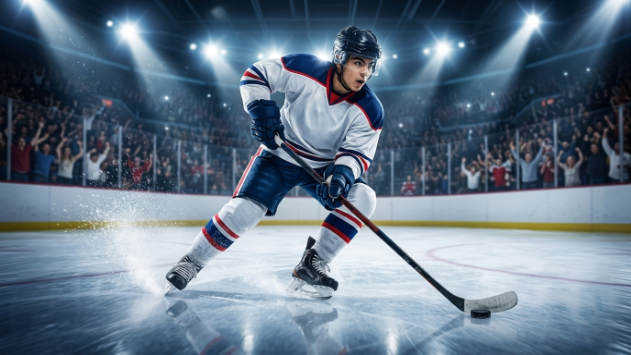
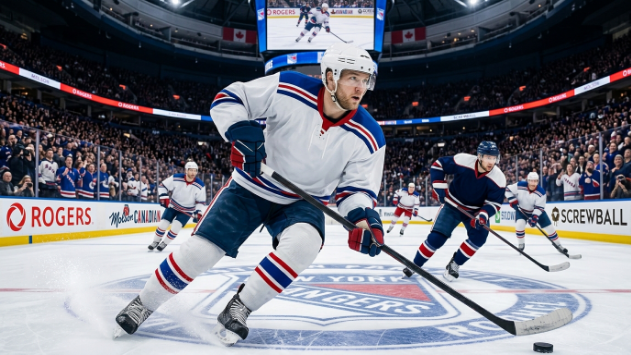
Every list of 10 Essential Hockey Skills Every Player Should Learn starts here and for good reason. Skating in ice hockey, or dynamic movement and footwork in field hockey, is the engine that powers everything else.
You could have the most powerful shot in your league, but if you can’t get to the right position in time, it won’t matter. Skating is where all other skills are either amplified or limited.
Field Hockey: Low-centre-of-gravity movement, quick directional changes, stick-side acceleration
Both: Balance, agility, and explosive first-step speed
Drill to Try:
Ice: Practice 5-cone agility circuits on ice, focusing on edge control and tight turns. Field: Agility ladder drills combined with quick stick touches to maintain low body position while moving at speed.
Skating is always Skill #1 in the 10 Essential Hockey Skills Every Player Should Learn it’s the platform every other skill is built on
2: Stickhandling / Puck or Ball Control
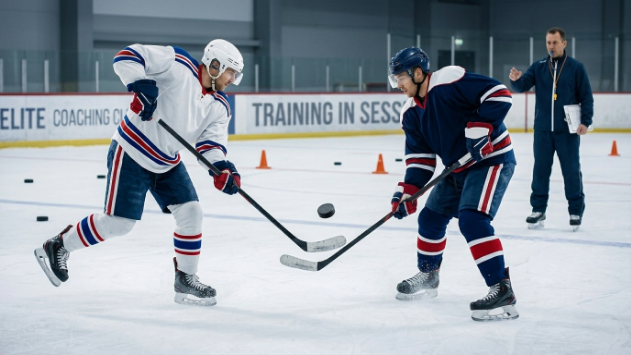
Ask any coach what separates confident players from hesitant ones and they’ll tell you: comfort on the puck (or ball). Stickhandling is how you keep possession under pressure, move past defenders, and set up the plays your team needs.
In ice hockey, stickhandling means smoothly moving the puck from forehand to backhand and controlling it while skating at full speed. In field hockey, it’s the Indian dribble and reverse-stick ball control that gives you space to work with.
Key Techniques:
Ice Hockey: Cupping the puck, forehand-to-backhand rolls, one-handed extensions to protect the puck
Field Hockey: Indian dribble (rapid side-to-side), reverse-stick control, first touch receiving
Both: Peripheral vision keeping your head up while your hands feel the puck/ball
Drill to Try:
Place 6–8 cones in a zigzag and stickhandle through at increasing speed. Challenge yourself by adding a tennis ball to bounce and catch while completing the drill this forces your eyes off the puck and develops true touch.
3: Passing The Skill That Makes Teams Win
You’ve heard it a thousand times: hockey is a team sport. And the glue of any team is accurate, well-timed passing. Among all the 10 Essential Hockey Skills Every Player Should Learn, passing is the one that makes your teammates better and that coaches always notice first.
A great passer doesn’t just move the puck or ball they move it to where their teammate is GOING to be, not where they are right now. That split-second anticipation is what separates functional passing from elite passing.
Field Hockey: Push pass (short distances), hit pass (long distances), lifted pass / aerial, reverse-stick pass
Both: One-touch passing under pressure, give-and-go combinations
Drill to Try:
2-player passing circuit stand 10m apart and complete 20 passes with your dominant side, then 20 with your non-dominant or reverse side. Add movement to both players in week 2 to simulate game conditions.
Passing is one of the 10 Essential Hockey Skills Every Player Should Learn that immediately makes your entire team better
4: Shooting Scoring Starts Here
Every player dreams about scoring. And while not every player needs to be a sniper, every player needs to be dangerous when the chance arrives. Shooting is at the heart of the 10 Essential Hockey Skills Every Player Should Learn because no matter your position, creating a threat on goal changes how opponents defend against you.
Field Hockey: Push shot, hit shot, drag flick (for penalty corners), reverse hit / tomahawk
The Secret Most Players Miss:
Shot accuracy beats shot power at almost every level below professional play. Focus on hitting specific spots in the net before you worry about adding power. A shot on target at 70% power scores more goals than a thunderball that misses the frame.
Drill to Try:
Set up targets (cones or tape markers) in the four corners of the net. Take 10 shots at each corner, rotating through all four. Track your accuracy percentage and aim to improve it 5% each week.
5: Defensive Positioning & Checking
Here’s the thing about defence that most beginners get wrong: it’s not about being big, physical, or aggressive. Great defensive hockey is about angles, timing, and reading the play before it happens.
And this is one of the 10 Essential Hockey Skills Every Player Should Learn that applies to EVERY position forwards included. The best forwards in the world are dangerous because they pressure the puck high and force turnovers. That’s defence as an attacking weapon.
Key Defensive Concepts:
Angling opponents away from dangerous zones (away from the middle, toward the boards or sideline)
Gap control maintaining the right distance from the puck carrier to react without overcommitting
Stick positioning keeping your stick active and in passing lanes without fouling
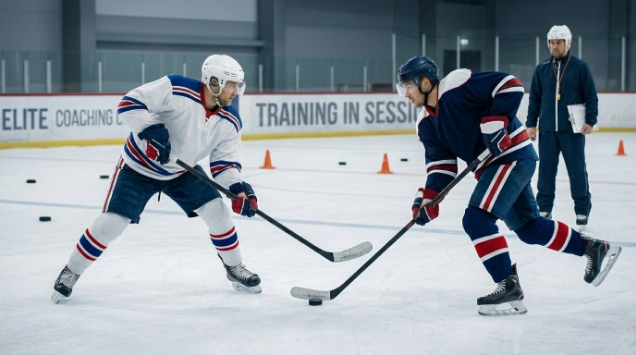
1-on-1 defensive mirror drill: one player attacks, one defends. The defender’s goal is NOT to take the puck only to angle the attacker toward the corner or sideline without being beaten. This teaches patience and angles simultaneously.
6: First Touch / Receiving Under Pressure
Your first touch sets the tone for everything that follows. A clean receive gives you time to look up, scan for teammates, and make your next move. A poor first touch puts you immediately under pressure and forces a hurried decision.
In field hockey, the first touch is so fundamental it earned its own ranking as the #1 skill at Hockey Performance Academy. For ice hockey, receiving passes cleanly especially while moving is equally critical.
How to Improve Your First Touch:
Soften your hands on receipt don’t fight the ball/puck, absorb it with slight give
Pre-scan before the ball arrives know where your next move will be BEFORE you receive
Practice receiving from multiple angles: in front, behind, left side, right side, while moving
Field Hockey: Practice hard-hand receives (redirecting into space) and soft-hand receives (controlling under pressure)
7: Hockey IQ The Skill You Can’t See
Of all the 10 Essential Hockey Skills Every Player Should Learn, this one doesn’t show up on any training drill card and yet coaches say it separates average players from exceptional ones more than any physical attribute.
Hockey IQ is your ability to read the game. To know where the play is going before it gets there. To position yourself in the right spot before the puck arrives. To make the simple, correct decision under pressure rather than the flashy, wrong one.
How to Build Hockey IQ:
Watch game film study how professional players position themselves OFF the puck, not just on it
Learn the systems your team plays so you know your role in each phase of play
After every training session or match, review 2–3 decisions you made what did you do, what would have been better?
Visualise game scenarios before training: ‘If the puck goes there, I go here’ mental rehearsal is real training
Hockey IQ the invisible skill is one of the 10 Essential Hockey Skills Every Player Should Learn that coaches value above almost everything else
8: Physical Fitness & Stamina
Hockey is played at relentless speed. A 60-minute ice hockey game or a 70-minute field hockey match demands sustained cardiovascular output, explosive bursts, and the mental sharpness to execute skills correctly when fatigued.
Physical fitness isn’t just a supporting quality in the 10 Essential Hockey Skills Every Player Should Learn it’s what allows all the other skills to be performed consistently from the first minute to the last.
Fitness Priorities for Hockey Players:
Aerobic base: Steady-state running or cycling 3–4x per week (30–45 minutes)
Anaerobic conditioning: Sprint intervals mimicking hockey shift lengths (30–45 seconds on, 60–90 seconds off)
Leg power: Squats, split squats, box jumps for explosive skating power
Core strength: Planks, rotational cable work, medicine ball throws for stable puck control and powerful shots
Recovery: 8 hours of sleep, hydration, and proper nutrition timing
9: Positional Awareness & Spacing
Ask a coach why a goal was conceded and nine times out of ten they’ll trace it back to poor positional awareness someone was in the wrong place at the wrong time, leaving a gap that the opposition exploited.
Positional awareness is one of the 10 Essential Hockey Skills Every Player Should Learn that evolves throughout your career. At beginner level, it’s about knowing where YOU should be. At intermediate, it’s knowing where everyone should be. At advanced, you’re anticipating movement before it happens.
Key Principles:
Always know where your nearest teammate and opponent are without the ball/puck
Create triangles: position yourself to give the puck carrier two clear passing options
When your team has possession, spread wide to stretch the defense
When your team is out of possession, compress and deny space through the middle
Positional awareness and spacing is one of the team-first 10 Essential Hockey Skills Every Player Should Learn great positioning makes the entire team better
10: Mental Toughness & Composure Under Pressure
The final skill in the 10 Essential Hockey Skills Every Player Should Learn is the one that ties all the others together: your mind.
Hockey is a game of momentum. Matches shift quickly. A bad goal, a defensive mistake, a missed open net these moments test your mental resilience more than any training session. The players who can reset quickly, stay focused, and perform their skills under pressure are the ones who make the biggest impact when it matters most.
How to Build Mental Toughness:
Pre-game routine: Consistent warm-up, breathing exercises, or visualisation before every game and practice
Process focus: Commit to executing the skill correctly (the process), not worrying about the outcome (the result)
Positive reset: Develop a specific physical trigger (fist clench, tap the boards, take a breath) to refocus after a mistake
Mindfulness training: 10 minutes daily of focused breathing improves concentration and reduces anxiety under pressure
Seek challenge: Play with and against players who are better than you it fast-tracks mental adaptation
Quick Reference: All 10 Essential Hockey Skills Every Player Should Learn
Skill
Type
Applies To
Beginner Priority
1. Skating / Movement
Physical/Technical
All positions
4+
2. Stickhandling
Technical
All positions
4+
3. Passing
Technical/Tactical
All positions
4+
4. Shooting
Technical
Forwards + All
3+
5. Defensive Positioning
Tactical
All positions
3+
6. First Touch / Receiving
Technical
All positions
5+
7. Hockey IQ
Mental/Tactical
All positions
2+
8. Fitness & Stamina
Physical
All positions
3+
9. Positional Awareness
Tactical
All positions
2+
10. Mental Toughness
Mental
All positions
2+
How to Practice All 10 Essential Hockey Skills Every Player Should Learn Sample Weekly Plan
Knowing the skills is half the battle. Here’s a simple framework to develop the 10 Essential Hockey Skills Every Player Should Learn across a structured week:
2-player passing circuits + receiving drills from multiple angles
Thursday
Active Recovery
Light movement + visualisation + video analysis
Friday
Shooting + Defensive Work
Net target accuracy drill + 1-on-1 angling defensive drill
Saturday
Game / Scrimmage
Apply all 10 skills in real game conditions
Sunday
Rest + Mental Work
Full rest + 10 min mindfulness or visualisation session
How Long Does It Take to Master the 10 Essential Hockey Skills Every Player Should Learn?
Honestly? It varies and anyone who gives you a fixed timeline is oversimplifying. But here’s a realistic guide:
Basic competency in skating, passing, and stickhandling: 3–6 months of consistent practice
Confident execution under light game pressure: 6–12 months
Skilled performance in competitive matches: 1–3 years of structured development
Mastery (near-automatic skill execution): This never fully stops even professionals work on these skills daily
The key is consistency over intensity. Practising the 10 Essential Hockey Skills Every Player Should Learn for 45 minutes four times a week will always outperform three-hour marathon sessions twice a month.
Frequently Asked Questions
What are the most important hockey skills for beginners?
The three most important skills to start with are skating (or footwork in field hockey), stickhandling, and basic passing. These three form the foundation of every other skill in the 10 Essential Hockey Skills Every Player Should Learn. Once these feel natural, you can build shooting, defence, and tactical awareness on top.
Can adults learn hockey skills from scratch?
Absolutely. Hockey is one of those sports where adult beginners can make rapid technical progress with structured practice. The 10 Essential Hockey Skills Every Player Should Learn apply at any age. Adults often develop tactical awareness (Hockey IQ, positional sense) faster than young players the physical skills just take more consistent repetition.
How do I improve my stickhandling at home?
You don’t need ice or a pitch for stickhandling practice. Use a smooth floor, a hockey ball or puck, and run through forehand-to-backhand drills with cones daily. Reaction balls (which bounce unpredictably) are excellent for developing soft hands. Even 15 minutes of home stickhandling per day adds up to 90 minutes per week significant skill improvement over a season.
Do I need to learn all 10 skills at the same time?
No, and trying to do so would overwhelm you. Pick your two weakest skills and focus on those for 4–6 weeks. Then reassess. The 10 Essential Hockey Skills Every Player Should Learn are all interconnected, so improving one (like first touch) will automatically benefit others (like passing and stickhandling). Focused development beats scattered effort every time.
How important is fitness for hockey skill development?
Extremely. Fitness determines whether you can execute your skills in the final minutes of a match with the same quality as the first. All of the 10 Essential Hockey Skills Every Player Should Learn degrade under fatigue your stickhandling gets sloppy, your shots lose accuracy, your decision-making slows. Building your aerobic and anaerobic fitness is an investment in the quality of every other skill you have.
Final Word: Start With One Skill, Improve Everything
If you’ve read this far, you already understand something most players take years to figure out: hockey excellence is built on deliberate skill development, not just playing more games.
The 10 Essential Hockey Skills Every Player Should Learn covered in this guide from skating and stickhandling to hockey IQ and mental toughness are not a checklist you complete once. They’re ongoing commitments that evolve as your game evolves.
Pick ONE skill from this list that you know needs work. Spend the next four weeks giving it specific, focused practice time. You’ll be surprised how quickly improvement in one area ripples across the rest of your game.
The 10 Essential Hockey Skills Every Player Should Learn aren’t about being perfect. They’re about being better than you were yesterday on every shift, in every game, in every season ahead of you.