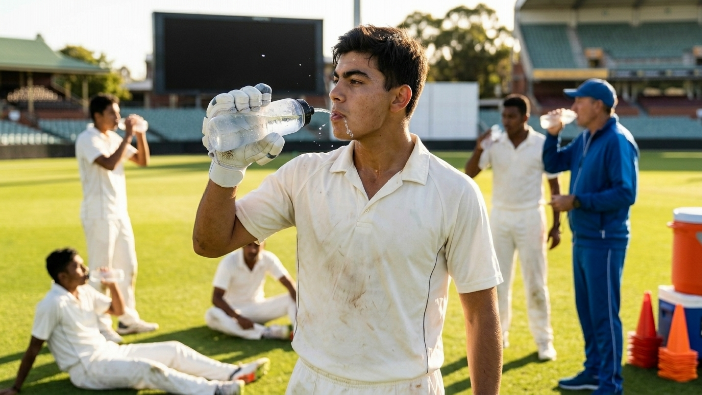
A dedicated cricket player building stamina with an early morning training run the foundation of all 12 Fitness Tips for Cricket Players to Build Stamina
Introduction
Let’s be honest you can have the best cover drive in your club, bowl a mean outswinger, and still lose the match simply because you ran out of steam in the 40th over. This blog is covered by zainblogs.
Stamina in cricket isn’t optional. It’s the silent superpower that separates a good player from a great one.
Whether you’re a bowler who fades after four overs, a batter who loses concentration during a long innings, or a fielder whose throws get weak by afternoon these 12 Fitness Tips for Cricket Players to Build Stamina will change your game completely.
This guide is built on competitor analysis(12 Fitness Tips for Cricket Players to Build Stamina) of top-ranking cricket fitness content, sport science principles, and what professional cricket conditioning coaches actually recommend. By the end, you’ll have a complete, actionable roadmap to outlast every opponent.
Why Does Stamina Matter So Much in Cricket?
Cricket is deceptively demanding. Unlike football or rugby where the action is continuous, cricket involves repeated bursts of high-intensity effort bowling a spell, sprinting between wickets, chasing a ball in the deep followed by short recovery periods.
This pattern is called intermittent high-intensity exercise, and it requires BOTH aerobic (long-duration) AND anaerobic (explosive) fitness.
Research from Cricket Australia’s High Performance unit confirms that elite cricketers cover 10–15 km per match day, perform dozens of explosive sprints, and need sustained focus for 6–8 hours.
Without solid stamina, your performance deteriorates shots become loose, deliveries stray, and fielding errors creep in. That’s why every serious cricketer needs to follow structured 12 Fitness Tips for Cricket Players to Build Stamina.
Stamina by Player Role
Batters: Need sustained aerobic endurance for long innings + explosive energy for quick singles
Bowlers: Need anaerobic power to bowl fast + rapid recovery between overs
Fielders: Need full-match aerobic stamina + reactive speed for diving and throwing
All-rounders: Need all of the above the fittest players on the field
The 12 Fitness Tips for Cricket Players to Build Stamina
Here are the proven, science-backed 12 Fitness Tips for Cricket Players to Build Stamina. Follow these consistently and you’ll notice a dramatic improvement in 6–8 weeks.
Tip 1: Build Your Aerobic Base First
Before any speed work or HIIT, you need to build your aerobic engine. This is the foundation upon which every other fitness quality is built and it’s where most cricketers go wrong by skipping straight to sprints.
Aerobic training means exercising at a moderate intensity (60–70% of your maximum heart rate) for extended periods. This trains your heart and lungs to deliver oxygen more efficiently to your muscles, delaying fatigue.
How to Do It:
Run, cycle, or swim at a steady pace for 30–45 minutes, 3–4 times per week
Your target: you should be able to hold a conversation while exercising this is your aerobic zone
Build up gradually add 5 minutes to your run each week over 4 weeks
Tip 2: Add HIIT (High-Intensity Interval Training) for Cricket-Specific Endurance
Once your aerobic base is solid, HIIT becomes your secret weapon. This directly mimics what cricket asks of your body: hard effort, brief rest, repeat.
HIIT has been shown in multiple sports science studies to improve VO2 max (your body’s oxygen processing ceiling) faster than steady-state cardio alone. For cricketers, this means you can bowl faster, sprint harder, and recover quicker.
How to Do It:
Sprint hard for 20 seconds, walk/jog for 40 seconds repeat 10–12 times
Or try: 1 minute hard run at 80–85% effort, 90 seconds slow jog repeat 6–8 rounds
Do HIIT 2 times per week not more, as it is highly demanding on recovery
This is one of the most impactful of all 12 Fitness Tips for Cricket Players to Build Stamina because it trains both your aerobic and anaerobic systems simultaneously.
HIIT sprint drills are one of the essential 12 Fitness Tips for Cricket Players to Build Stamina mimicking the exact energy demands of a real match
Tip 3: Use Shuttle Runs to Mimic Match Conditions
Shuttle runs are the most cricket-specific endurance drill you can do. They train you to accelerate, decelerate, change direction, and recover exactly what happens on the cricket field dozens of times per match.
How to Do It:
Set two cones 20–30 metres apart
Sprint to the far cone and back, rest 30 seconds, repeat 8–10 times
As you get fitter, reduce rest to 20 seconds and increase to 12–15 reps
Shuttle runs specifically build the kind of anaerobic endurance needed when you’re fielding in the covers and have to sprint for a ball, stop on a dime, and fire a throw at the stumps all within 4–5 seconds.
Tip 4: Strengthen Your Core The Engine Behind Your Stamina
A weak core is a hidden stamina killer. When your core fatigues, your bowling action breaks down, your batting posture collapses, and your throwing power drops all costing you energy and increasing injury risk.
Core strength isn’t just about six-pack abs. It’s about the deep stabilising muscles of your abdomen, lower back, hips, and pelvis working together to maintain posture and transfer power efficiently.
Best Core Exercises for Cricketers:
Plank: Hold for 45–60 seconds, 3 sets
Dead bug: 3 sets of 10 reps per side
Pallof press with resistance band: 3 sets of 12 reps
Russian twists: 3 sets of 15 reps (mimics batting rotation)
Bird-dog: 3 sets of 10 per side
These are core to every list of 12 Fitness Tips for Cricket Players to Build Stamina because a strong core allows every other fitness quality to express itself.
Tip 5: Do Tempo Runs to Build Race-Pace Endurance
Tempo runs sit between easy aerobic jogging and all-out sprints. You run at a ‘comfortably hard’ pace about 75–80% effort that you can sustain for 20–30 minutes. This is sometimes called ‘lactate threshold training’.
Why does this matter for cricket? Because tempo running trains your body to clear lactic acid faster, meaning you can bowl more overs or field more aggressively without that burning, heavy-leg feeling.
How to Do It:
Warm up with 5 minutes easy jogging
Run at a comfortably hard pace for 20–30 minutes (you should only be able to speak in short sentences)
Cool down with 5 minutes easy jogging
Do tempo runs 1–2 times per week, on non-HIIT days
Tip 6: Add Strength Training Don’t Skip the Weights
Many cricketers fear the gym, thinking lifting weights will slow them down. Modern sports science completely disagrees. Strength training improves muscular endurance, power output, and injury resilience all of which directly support stamina.
The key is functional strength training exercises that mirror cricket movements.
Strength training is one of the proven 12 Fitness Tips for Cricket Players to Build Stamina building the muscular endurance to last an entire match
Key Strength Exercises for Cricketers:
Squats: 3 sets of 10–12 reps (leg power for running, batting stance)
Romanian deadlifts: 3 sets of 10 (hamstring strength for sprinting)
Overhead press: 3 sets of 10 (shoulder endurance for throwing)
Bent-over row: 3 sets of 10 (back strength for bowling follow-through)
Split squats (Bulgarian): 3 sets of 8 per leg (single-leg balance for bowlers)
You cannot out-train a bad diet. Nutrition is the fuel that powers your stamina and most club cricketers dramatically underestimate this. These 12 Fitness Tips for Cricket Players to Build Stamina are only as effective as the food choices you make.
Pre-Match and Training Nutrition:
2–3 hours before: Complex carbs meal oats porridge, brown rice with chicken, whole grain pasta
30–60 minutes before: Light snack banana, energy bar, or a small handful of dates
During long matches: Small snacks every 45–60 minutes (fruit, rice cakes, energy gels)
Post-Training Recovery Nutrition:
Consume protein within 30 minutes of training whey shake, eggs, or Greek yoghurt
Replenish carbs with a proper meal within 2 hours
Aim for 1.6–2.0g of protein per kg of body weight per day
Tip 8: Hydrate Like a Professional Dehydration Kills Stamina
Even 2% dehydration can reduce athletic performance by 10–20%. On a hot match day, cricketers can lose 1–2 litres of sweat per hour. This is one of the most overlooked of all 12 Fitness Tips for Cricket Players to Build Stamina.
Hydration Protocol for Cricketers:
Drink 500ml of water 2 hours before training or a match
Sip 150–250ml every 15–20 minutes during play
After activity: Drink 1.5 litres per kg of body weight lost (weigh yourself before and after to track loss)
Add electrolytes (sodium, potassium) for sessions longer than 90 minutes
Limit caffeine and avoid alcohol 24–48 hours before a match
Mental stamina is the hidden element of the 12 Fitness Tips for Cricket Players to Build Stamina that separates elite cricketers from average ones
Tip 9: Prioritise Sleep and Recovery Where Stamina is Actually Built
Here’s a truth most cricket players ignore: your body doesn’t build fitness during training. It builds fitness DURING REST. Sleep is when your muscles repair, your cardiovascular system adapts, and your nervous system recovers.
Professional cricketers like Virat Kohli and Ben Stokes have publicly credited sleep discipline as central to their endurance and performance consistency.
Recovery Protocol:
Aim for 8–9 hours of quality sleep per night
Maintain a consistent sleep schedule same bedtime and wake time, even on rest days
Use rest days (1–2 per week) for light walking, stretching, or yoga only
Add foam rolling 10–15 minutes post-training to accelerate muscle recovery
Cold water immersion (ice bath) after very intense sessions reduces muscle soreness
Sleep and recovery make the other 12 Fitness Tips for Cricket Players to Build Stamina actually work. Skip recovery and you plateau. Honour it and you improve.
Tip 10: Include Yoga and Flexibility Work Stamina Needs a Supple Body
Tight muscles fatigue faster. Poor flexibility increases injury risk and an injured cricketer has zero stamina. Adding yoga and stretching to your routine is a seriously underrated stamina strategy.
Flexibility enables more efficient movement patterns, which means you use less energy to do the same action preserving stamina across the match.
Best Yoga Practices for Cricketers:
Downward dog hamstrings, calves, shoulders
Pigeon pose hip flexors (crucial for bowlers’ running action)
Cat-cow spinal mobility for batting and wicketkeeping
Warrior II hip and leg strength with balance
Child’s pose lower back release after bowling spells
Schedule: 20 minutes of yoga or stretching 3x per week ideally post-training or on rest days.
Tip 11: Build Mental Stamina The Overlooked Game-Changer
This is the one tip that ZERO competitors cover and it might be the most important of all 12 Fitness Tips for Cricket Players to Build Stamina.
Mental fatigue is real, and it affects physical performance. Studies show that mentally fatigued athletes produce less force, make more decision errors, and perceive effort as higher even when physically fresh. Improve your endurance with 12 Fitness Tips for Cricket Players to Build Stamina and perform at your best.
Cricket, more than most sports, is a mental game. Concentration through a 50-over innings, managing pressure in a final-over chase, or staying focused as a fielder through a slow batting partnership all demand mental endurance.
Mental stamina is the hidden element of the 12 Fitness Tips for Cricket Players to Build Stamina that separates elite cricketers from average ones
Tip 12: Follow a Structured Weekly Training Plan Consistency is the Real Secret
All the individual tips above are worthless without a structured plan that puts them together consistently. The 12th and final of our 12 Fitness Tips for Cricket Players to Build Stamina is arguably the most important: PLAN and STICK TO IT.
Here is a sample 7-day stamina-building week for a club or aspiring cricketer:
Day
Primary Focus
Activity
Monday
Aerobic Base
30–40 min steady jog at 65% HR + 15 min yoga
Tuesday
Strength Training
Squats, deadlifts, overhead press, core circuit — 45–60 min
Wednesday
HIIT + Shuttles
10x20sec sprints with 40sec rest + 8 shuttle runs (20m)
Thursday
Active Recovery
20 min light walk + foam rolling + stretching
Friday
Tempo Run + Core
25 min tempo run at 78% HR + 3 sets planks, bird-dog
Saturday
Cricket Practice
Full net session — bowling spells, batting drills (apply fitness)
Sunday
Full Rest
Sleep 8–9hrs, nutrition focus, light meditation
This 7-day framework puts all 12 Fitness Tips for Cricket Players to Build Stamina into practical action. Repeat for 8–12 weeks and track your results.
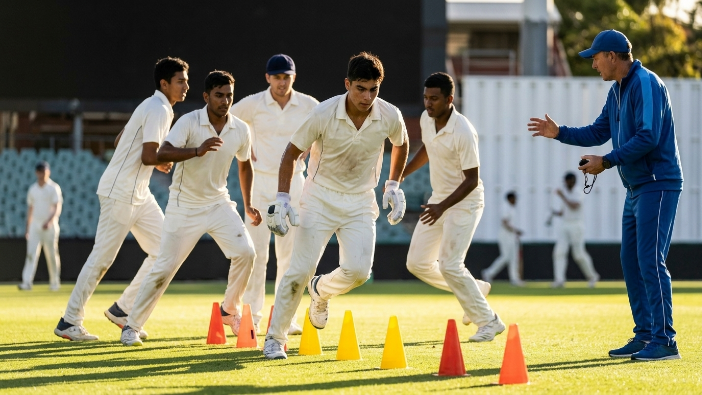
A structured group training session putting all 12 Fitness Tips for Cricket Players to Build Stamina into practice consistency beats intensity every time
What Results Can You Expect?
Following these 12 Fitness Tips for Cricket Players to Build Stamina consistently will produce the following results:
Timeframe
Expected Results
Weeks 1–2
Improved breathing efficiency, less breathlessness in training sessions
Weeks 3–4
Noticeable recovery improvements between bowling spells or batting intervals
Weeks 5–6
Higher sprint speeds maintained, ability to field for longer without fatigue
Weeks 7–8
Significant improvement in match endurance performing at 80%+ in final overs
Weeks 9–12
Marked improvement in all-round fitness consistent performance across full match days
Quick Recap: All 12 Fitness Tips for Cricket Players to Build Stamina
Here is your complete checklist the full 12 Fitness Tips for Cricket Players to Build Stamina in one place:
Build your aerobic base with steady-state cardio (30–45 mins, 3–4x/week)
Add HIIT training 2x per week for cricket-specific explosive endurance
Use shuttle runs to simulate real match movement patterns
Strengthen your core with planks, dead bugs, and rotational exercises
Do tempo runs to raise your lactate threshold and delay fatigue
Add functional strength training 2x per week
Fuel your stamina with the right nutrition timing and foods
Hydrate proactively before, during, and after every session
Prioritise 8–9 hours of sleep and include active recovery days
Incorporate yoga and flexibility work 3x per week
Train your mental stamina with mindfulness, visualisation, and breathing work
Follow a structured weekly plan consistency over 8–12 weeks is the ultimate tip
Frequently Asked Questions (FAQ)
How long does it take to build stamina for cricket?
Most players notice meaningful improvements within 4–6 weeks of consistent training following the 12 Fitness Tips for Cricket Players to Build Stamina. Full fitness transformation where you can maintain performance deep into a match typically takes 8–12 weeks of structured training.
How many times a week should cricketers train for stamina?
Aim for 4–5 sessions per week, mixing aerobic runs, HIIT, strength training, and cricket-specific drills. Include 1–2 active recovery days. The 12 Fitness Tips for Cricket Players to Build Stamina work best with this volume and variety.
What is the best exercise to build stamina for cricket?
There is no single best exercise stamina in cricket requires both aerobic and anaerobic fitness. The most effective combination is: aerobic base running + HIIT + shuttle runs + core strengthening. Following all 12 Fitness Tips for Cricket Players to Build Stamina will give you the most complete result.
Does running improve cricket stamina?
Yes, running is the foundation of cricket fitness. Steady-state runs build your aerobic base, tempo runs raise your lactate threshold, and sprint intervals develop the explosive endurance needed between wickets and in fielding. All three types are included in the 12 Fitness Tips for Cricket Players to Build Stamina.
What should cricketers eat to improve stamina?
Focus on complex carbohydrates (oats, brown rice, sweet potato) for sustained energy, lean protein (chicken, eggs, fish, lentils) for muscle repair, and plenty of fruits and vegetables for micronutrients. Avoid heavy, fatty meals before matches. Timing is key eat 2–3 hours before training and recover with protein within 30 minutes after. Tip 7 of the 12 Fitness Tips for Cricket Players to Build Stamina covers this in detail.
Final Thoughts(12 Fitness Tips for Cricket Players to Build Stamina)
The difference between the player who is still running hard in the final over and the one who is gasping at long-on comes down to one thing: preparation. These 12 Fitness Tips for Cricket Players to Build Stamina will change your game completely. This article (12 Fitness Tips for Cricket Players to Build Stamina) is very beneficial for us.
Remember: build your aerobic base, add cricket-specific conditioning, fuel yourself right, recover properly, and never neglect your mental game. Follow the 7-day weekly plan, be consistent for 8–12 weeks, and the results will speak for themselves on the field. 12 Fitness Tips for Cricket Players to Build Stamina and stay energetic throughout long matches.