A complete, up-to-date guide covering starter picks, type matchups, EV training, and competitive-level tactics organized by skill level so you always know what to learn next.
Every great Pokémon journey starts with the same first step: knowing what actually matters.
Most Pokémon tip lists fall into one of two traps. They’re either aimed at total beginners and stop at “pick a starter you like,” or they’re written for the competitive Smogon crowd and assume you already know what an EV spread is. This blog is covered by zainblogs. This guide is different. It walks through 20 Powerful Pokémon Tips Every Trainer Needs to Learn in order from the fundamentals every new trainer needs on day one, through team-building habits that separate a decent team from a great one, up to the competitive-level thinking that top players use in ranked battles and VGC tournaments.
What makes this list different from a random collection of trivia is the order. Each section builds on the one before it, so a tip about EV training in the intermediate section assumes you already understand the type chart from the foundational section. By the time you reach the advanced tips on Terastallization and speed tiers, you’ll have the groundwork to actually use that information instead of just reading past it. Learn official Pokémon battle basics and training advice on the Official Pokémon Support to improve your skills and understand core game mechanics.
How This Guide Is Organized
The 20 tips below are grouped into three tiers: foundational tips for a brand-new trainer, intermediate tips for someone who has finished a main story and wants a genuinely competent team, and advanced tips for trainers heading into ranked ladders or in-person tournament play. You don’t need to read it front to back in one sitting bookmark it and come back to the tier that matches where you are right now. 20 Powerful Pokémon Tips Every Trainer Needs to Learn for smarter battles.
Why Most Pokémon Tip Guides Fall Short
A lot of older guides were written for a single generation and never updated they miss mechanics like Terastallization, modern held-item metas, and the Fairy type entirely. Others jump straight into hardcore competitive jargon without explaining the basics first, assuming readers already know what an EV spread or a speed tier is. This guide is built to work across generations and skill levels, with clear reasoning behind every tip instead of just a list of commands to follow. That reasoning is the part most other guides skip, and it’s the part that actually sticks with you after you close the tab.
Foundational Tips Every New Trainer Should Master
These are the tips that make the single biggest difference in your first few hours with any Pokémon game. Get these right early and everything after them gets easier.
1. Learn the Type Chart Don’t Just Memorize It, Understand the Logic
Type matchups are the single most important system in Pokémon. Rather than rote-memorizing 18 types and their interactions, learn the logic behind them: most relationships follow real-world intuition (Water beats Fire, Grass absorbs Water), while a handful are counterintuitive (Electric does nothing to Ground, Ice actually beats Water despite melting logic suggesting otherwise). Keep a type chart bookmarked or as a phone wallpaper for your first playthrough you’ll stop needing it within a few hours. Master every challenge with 20 Powerful Pokémon Tips Every Trainer Needs to Learn.
It also helps to notice that dual-type Pokémon multiply these interactions rather than simply adding them together. A Water/Flying Pokémon isn’t just weak to Electric it’s four times weaker, because both of its types share that weakness. Spotting these double-weaknesses before a gym battle, rather than during it, is what separates a smooth run from a frustrating one. Win more battles using 20 Powerful Pokémon Tips Every Trainer Needs to Learn.
2. Choose Your Starter Based on Your Route, Not Just Looks
Your starter will front-load your team for the first several badges, so it’s worth 30 seconds of thought. If your region is Fire-type-heavy early on, a Grass starter will struggle through multiple gyms in a row. Check what your first two or three gyms specialize in before locking in your choice. Improve your strategy with 20 Powerful Pokémon Tips Every Trainer Needs to Learn.
This doesn’t mean picking a starter purely for stats and ignoring the one you actually like the games are long, and you’ll be looking at this Pokémon for dozens of hours. The goal is just to go in with your eyes open about the early trade-offs, rather than being surprised by them three gyms later. Level up faster with 20 Powerful Pokémon Tips Every Trainer Needs to Learn.
3. Build Type Diversity Into Your Team From the Start
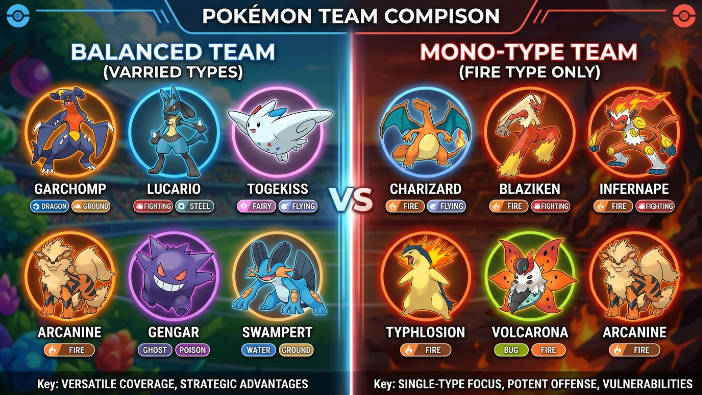
New trainers often end up with three or four Pokémon that share a common weakness for example, an all-Water-and-Electric core that gets swept by a single Grass-type. Aim for a team where no single type can threaten more than two of your six Pokémon at once. Build stronger teams with 20 Powerful Pokémon Tips Every Trainer Needs to Learn.
A simple habit that helps here: every time you’re about to add a new Pokémon to your permanent team, quickly check its type against the rest of your lineup. If three of your Pokémon already share the same weakness, look for a catch that patches that hole instead of one that repeats it. Become a better Trainer through 20 Powerful Pokémon Tips Every Trainer Needs to Learn.
4. Check Ability and Nature Before You Commit to a Pokémon
Nature quietly boosts one stat by 10% and reduces another by 10%. It sounds minor, but on a Pokémon built around Special Attack, a Nature that lowers Special Attack actively works against you. Most modern games let you check or even set Nature and Ability at capture use that information instead of ignoring it. Discover winning tactics in 20 Powerful Pokémon Tips Every Trainer Needs to Learn.
Abilities matter just as much, and they’re easy to overlook because they’re passive. Two Pokémon of the same species can play completely differently depending on their ability one might set up weather automatically, another might boost a stat the moment it’s hit. Always read the ability description at least once before deciding a Pokémon isn’t worth using. Boost your gameplay using 20 Powerful Pokémon Tips Every Trainer Needs to Learn.
5. Keep Your Team Leveled Together, Not Just Your Favorite
It’s tempting to let one strong Pokémon carry the team, but an overleveled solo carry leaves five underleveled teammates who get wiped out the moment a Gym Leader’s ace takes your carry down. Rotate battles so your whole team gains experience evenly. Learn expert techniques with 20 Powerful Pokémon Tips Every Trainer Needs to Learn.
A useful rule of thumb is to keep your whole active team within about three to five levels of each other. If one Pokémon starts pulling noticeably ahead, deliberately bench it for a route or two so the rest of the team can catch up. Make better battle decisions with 20 Powerful Pokémon Tips Every Trainer Needs to Learn.
6. Use In-Game Name and Appearance Clues to Guess Typing on the Fly
Many Pokémon names hint at their type a habit worth building because it speeds up real-time decisions in battle. Flame-colored, spiky, or aquatic designs are usually reliable visual cues too, even before you’ve memorized every entry in the regional Pokédex. Unlock your full potential through 20 Powerful Pokémon Tips Every Trainer Needs to Learn.
This tip pays off most in trainer battles, where an opponent’s Pokémon is announced by name before it appears. Being able to guess “that’s probably an Electric-type” from the name alone, and having your counter ready, saves you a turn compared to waiting to see the Pokémon and then reacting. Sharpen your skills with 20 Powerful Pokémon Tips Every Trainer Needs to Learn.
A type-diverse team (left) covers far more matchups than a mono-type team (right), even at lower average levels.
Comparison: Casual Approach vs. Optimized Approach
Here’s a quick side-by-side of habits that feel natural to new players versus the small adjustments that experienced trainers make instead.
Habit
Casual Approach
Optimized Approach
Starter choice
Pick based on looks alone
Pick based on early gym matchups too
Team building
Whoever you catch first
Deliberate type diversity across 6 slots
Held items
Left empty or ignored
Assigned based on each Pokémon’s role
Switching
Only when about to faint
Used proactively to bait or scout
EVs/IVs
Ignored entirely
Directed toward the Pokémon’s actual role
Learning method
Trial and error only
Trial and error plus watching high-level replays
Intermediate Tips to Build a Genuinely Battle-Ready Team
Once the basics feel automatic, these habits are what separate a team that survives the story mode from one that’s actually ready for online battles or tougher post-game content. Train your Pokémon more effectively with 20 Powerful Pokémon Tips Every Trainer Needs to Learn.
7. Understand EVs (Effort Values) Without Overcomplicating Them
Every Pokémon can gain up to 252 EVs in a single stat (510 total across all stats) simply by battling certain species or using vitamins and feathers. You don’t need a spreadsheet on your first run, but pointing EVs toward the stat your Pokémon actually uses Attack for a physical sweeper, Special Defense for a wall makes a noticeable difference by the time you hit the Elite Four. Gain a competitive edge with 20 Powerful Pokémon Tips Every Trainer Needs to Learn.
A good starting habit is picking one or two stats per Pokémon and committing to them, rather than spreading EVs thin across every stat. A focused spread almost always outperforms a diluted one, even at the same total EV count. Improve every match using 20 Powerful Pokémon Tips Every Trainer Needs to Learn.
8. Look Into Egg Moves for Coverage You Can’t Get Any Other Way
Breeding two compatible Pokémon can pass down moves that the offspring could never normally learn on its own. This is how many competitive staples get access to key coverage moves worth exploring even casually once you’re comfortable with basic breeding mechanics. Discover proven strategies in 20 Powerful Pokémon Tips Every Trainer Needs to Learn.
Start small: pick one Pokémon on your team that’s missing a single move to cover a common weakness, and look up whether an Egg Move fixes it. Doing this for even one team member teaches you the mechanic without needing to breed your whole roster. Play with confidence using 20 Powerful Pokémon Tips Every Trainer Needs to Learn.
9. Don’t Ignore Held Items
An empty item slot is a wasted advantage. Even a simple choice like a type-boosting item, a Leftovers-style recovery item, or a status-curing berry can change the outcome of a close battle. Held items are one of the most under-used tools by casual players. Strengthen your team with 20 Powerful Pokémon Tips Every Trainer Needs to Learn.
If you’re not sure where to start, give your bulkiest Pokémon a recovery item and your hardest hitter a damage-boosting item. That single change alone often noticeably extends how long your team survives a tough battle. Start winning consistently with 20 Powerful Pokémon Tips Every Trainer Needs to Learn.
10. Learn How Weather and Terrain Change the Math
Weather conditions like rain or sun, and terrain effects introduced in later generations, can boost or weaken entire move types for the whole battle. A Water-type move under rain hits noticeably harder building a team around a weather or terrain setter is a legitimate, powerful strategy once you understand the interaction.
Even without building a full weather team, it’s worth checking whether an opponent’s lead Pokémon can set weather, since that single detail can change how every other matchup in the battle plays out. 20 Powerful Pokémon Tips Every Trainer Needs to Learn to become a top Trainer.
11. Master Switch Timing Instead of Switching Randomly
Switching out isn’t just a panic button done well, it’s how you bait your opponent into a bad matchup, preserve a key Pokémon’s health, or scout what move they’re about to use. Switch with a plan, not just when a Pokémon is about to faint.
A simple upgrade here is switching one turn before you actually need to, rather than after your Pokémon has already taken serious damage. Proactive switching keeps your whole team healthier over the course of a long battle. Learn advanced tactics with 20 Powerful Pokémon Tips Every Trainer Needs to Learn.
12. Build a Defensive Core, Not Just an Offensive One
A team of six all-out attackers looks powerful but folds quickly to a single well-played defensive Pokémon. Pair your sweepers with at least one or two Pokémon that can reliably wall a common threat and buy your team time.
A defensive core doesn’t need flashy stats consistency matters more than raw power here. A Pokémon that can reliably take a hit and recover HP is often more valuable to your team than one more attacker. 20 Powerful Pokémon Tips Every Trainer Needs to Learn for consistent victories.
13. Use Tier Lists and Community Resources as a Starting Point, Not a Rulebook
Sites built around competitive analysis are genuinely useful for understanding what’s strong and why but blindly copying a top-tier team without understanding the reasoning behind it will leave you lost the moment your opponent does something the guide didn’t cover.
A better approach is reading a tier list entry, then asking yourself why that Pokémon is ranked where it is. That habit builds real understanding, which transfers to every future team you build copying a build without the reasoning doesn’t. Master the basics using 20 Powerful Pokémon Tips Every Trainer Needs to Learn.
Advanced Tips for Competitive and Endgame Play
These are the habits that show up once you’re battling online, entering ranked ladders, or preparing for VGC-style tournament play.
14. Understand Modern Battle Mechanics Like Terastallization and Mega Evolution
Newer battle mechanics can completely flip a matchup a Tera-typed Pokémon can suddenly resist an attack that should have been super effective. Knowing when your opponent is likely to use their one-time mechanic, and when to use your own, is a genuinely advanced skill that separates high-ladder players from everyone else.
A practical way to build this instinct is asking, before every ranked battle, “what’s the scariest thing this Pokémon could become if it uses its mechanic right now?” Planning for that worst case, rather than being surprised by it, is most of the skill. 20 Powerful Pokémon Tips Every Trainer Needs to Learn to train like a pro.
15. Learn Your Team’s Speed Tiers
Knowing exactly which of your Pokémon outspeeds which common threats and by how much lets you make split-second decisions about whether to attack, switch, or use a priority move. Competitive players often adjust EVs specifically to clear a speed benchmark by one point.
Keep a short mental (or written) list of the two or three most common threats in your current format and their exact speed stat. That small bit of memorization pays off constantly, because speed decides who moves first in the vast majority of exchanges. Discover effective battle plans with 20 Powerful Pokémon Tips Every Trainer Needs to Learn.
16. Practice Prediction Without Over-Predicting
Reading what your opponent is likely to do next is powerful, but over-predicting leads to risky plays that backfire. The strongest players default to the safe, obviously correct play unless they have a clear read, rather than gambling every turn.
A good gut-check: if your prediction is wrong, how much does it cost you? If a wrong guess loses the game outright, that’s a moment to play it safe instead save the bold predictions for turns where a miss is recoverable.
17. Build Your Team Around One Clear Win Condition
Every strong competitive team has a plan for how it actually wins the game a specific sweeper it’s trying to set up, or a stall plan it’s trying to execute. Build the other five team slots to support that plan instead of picking six good Pokémon with no shared strategy.
Before adding a new Pokémon to a competitive team, ask what it does for your win condition specifically clears a threat that stops it, sets up the conditions for it, or is the win condition itself. If the answer is “nothing,” it’s probably the wrong pick for that team.
18. Optimize IVs When It Actually Matters
Individual Values affect a Pokémon’s stats permanently. For casual play, this barely matters but for competitive teams, breeding or transferring for strong IVs (or using in-game tools that let you adjust them) closes the gap between a good Pokémon and a tournament-ready one.
Prioritize IVs in the stats your Pokémon’s role actually uses rather than chasing perfect IVs across the board a physical attacker gets far more value from strong Attack and Speed IVs than from a wasted point in Special Attack.
19. Trade and Transfer Strategically Instead of Randomly
Random trade features can be fun, but they’re rarely how serious trainers fill gaps in a team. Trading with a specific goal getting a version-exclusive evolution, a better Nature, or an Egg Move combination is a far more efficient use of your time.
Before trading, write down exactly what gap you’re trying to fill on your team. A targeted trade for that specific need will improve your team far more than several random trades that don’t address anything in particular.
20. Keep Learning by Watching Real Battles
Watching high-level replays or tournament VODs teaches pattern recognition faster than reading alone. Notice why a strong player chose to switch, sacrifice a Pokémon, or hold back a mechanic for later that decision-making is the actual skill this whole guide is trying to build.
Pick one replay a week and watch it twice: once for the outcome, and once specifically to narrate out loud why each player made the choice they did. That second pass is where the real learning happens. Explore detailed Pokémon types, moves, abilities, and battle strategies with the Bulbapedia Pokémon Encyclopedia for in-depth gameplay information and guides.
The gap between a casual team and a tournament-ready one is rarely about rare Pokémon it’s almost always about decision-making.
Common Mistakes That Hold Trainers Back
Even trainers who know most of the 20 tips above still fall into a handful of avoidable habits. Watch out for these:
Building a team entirely around Pokémon you think look strong, without checking actual stats or movepool.
Ignoring status conditions (like paralysis or burn) until they’ve already cost a battle.
Never checking a move’s accuracy stat before relying on it in a close fight.
Treating every battle the same way regardless of whether it’s a casual match or a ranked one.
Skipping post-game content that’s specifically designed to teach team-building fundamentals.
Assuming a Pokémon is bad because a tier list ranks it low, without checking whether it fits your specific team’s win condition.
Forgetting to update held items and movesets after leveling up or evolving a Pokémon.
Putting 20 Powerful Pokémon Tips Every Trainer Needs to Learn Into Practice
Reading through a list like this is only half the process. The trainers who actually improve are the ones who pick two or three tips from their current tier and apply them in their very next play session rather than trying to absorb all 20 at once. Start with the foundational tips if you’re new, revisit the intermediate section once your first playthrough is done, and save the advanced tips for when you’re actually preparing for ranked or tournament battles.
Frequently Asked Questions
Q1: What is the single most important tip for a brand-new Pokémon trainer?
Learning the type chart. Almost every other tip in this guide builds on understanding type matchups first.
Q2: Do I need to worry about EVs and IVs on my first playthrough?
Not really. They matter far more for competitive or post-game content. For a first run, focus on type balance and leveling your team evenly.
Q3: Which starter Pokémon is objectively the best?
There isn’t one it depends on your region’s early gyms and your own playstyle. Check what your first few gyms specialize in before deciding.
Q4: How many Pokémon should a beginner-friendly team have?
A full team of six, with at least four different types represented, gives you the flexibility to handle most Gym Leaders without needing to grind extra Pokémon.
Q5: Is switching Pokémon during battle considered a beginner or advanced skill?
It starts as a beginner skill (avoiding a bad matchup) and becomes an advanced one (baiting an opponent’s move) as you get more comfortable reading battles.
Q6: What’s the easiest way to learn modern mechanics like Terastallization?
Use it in casual battles first, against the CPU or in low-stakes online matches, before relying on it in a ranked or tournament setting.
Q7: Are tier lists worth following for a newer player?
Yes, as a reference point but understand why a Pokémon is ranked where it is rather than copying a team wholesale.
Q8: How long does it take to go from beginner to competitively viable?
There’s no fixed timeline, but trainers who work through 20 Powerful Pokémon Tips Every Trainer Needs to Learn in order fundamentals, then team-building habits, then advanced mechanics tend to reach a competitive-ready level far faster than those who jump straight into tournament play.
Conclusion
Becoming a genuinely strong Pokémon trainer isn’t about knowing one clever trick it’s about building good habits in order, from type matchups all the way up to competitive-level decision-making. That’s exactly what 20 Powerful Pokémon Tips Every Trainer Needs to Learn is meant to give you: a clear path, not just a scattered list. Work through these in order, revisit the ones that apply to your current stage, and your team and your win rate will reflect it.
Read 20 Powerful Pokémon Tips Every Trainer Needs to Learn to improve every battle. 20 Powerful Pokémon Tips Every Trainer Needs to Learn can sharpen your skills. Get ahead with 20 Powerful Pokémon Tips Every Trainer Needs to Learn today. 20 Powerful Pokémon Tips Every Trainer Needs to Learn for faster progress. Enjoy smarter gameplay with 20 Powerful Pokémon Tips Every Trainer Needs to Learn. 20 Powerful Pokémon Tips Every Trainer Needs to Learn for every skill level. Improve your winning chances with 20 Powerful Pokémon Tips Every Trainer Needs to Learn. 20 Powerful Pokémon Tips Every Trainer Needs to Learn for stronger strategies. Make every move count with 20 Powerful Pokémon Tips Every Trainer Needs to Learn.