The final whistle blows, the game ends, and most athletes do exactly the wrong thing next: they stop moving entirely and head straight for the car or the shower. This blog is covered by zainblogs. But what you do in the ten minutes after competition matters almost as much as your warm-up. This guide covers 12 Cool-Down Exercises After Sports for Fast Recovery, a routine designed specifically for athletes who want to bounce back faster, feel less sore the next day, and protect their body between games.
Whether you just finished a weekend league match or a full tournament day, the exercises, timing, and sport-specific adjustments below go further than the generic post-workout cooldown advice you’ll find elsewhere.
Most cooldown guides are written for gym workouts treadmill runs, weight sessions, group classes. Sport is different. You’ve been sprinting, cutting, jumping, and reacting for an hour or more, often on hard surfaces, often with contact. Your body needs a cooldown that matches that specific kind of fatigue, not a generic stretch routine borrowed from a strength-training article.
By the end of this guide, you’ll have a complete, timed post-game cool-down protocol, a sport-specific adjustment table, an explanation of what actually causes next-day soreness, and answers to the questions athletes search for most after stepping off the field.
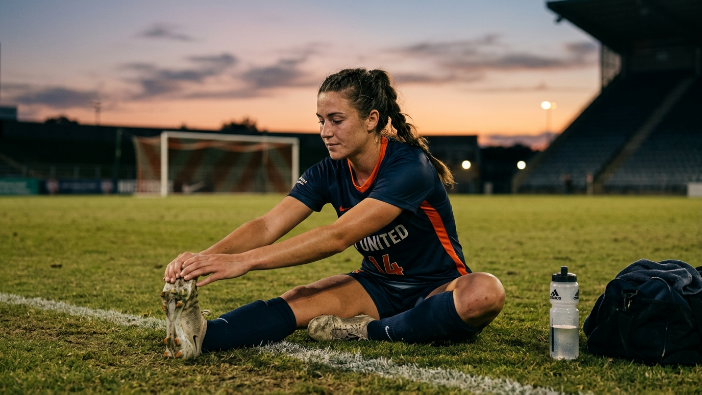
The minutes right after competition matter just as much as the warm-up before it.
Why Cooling Down After Sports Actually Matters
A cooldown isn’t just a formality before you head home. It supports several physiological processes that directly affect how you feel over the following 24 to 48 hours:
Gradually lowers heart rate and blood pressure instead of an abrupt stop
Helps prevent blood from pooling in the legs, which can cause dizziness or lightheadedness
Shifts the nervous system out of competition mode and into a calmer, recovery-focused state
Maintains and improves flexibility while muscles are still warm and pliable
Creates a mental transition point that helps you process the game and unwind
According to the American Heart Association, cooling down after activity gives the heart and blood vessels a chance to ease out of exertion gradually rather than being asked to shut down instantly.
This matters more in sport than in a controlled gym session, because competitive play rarely ends on your own terms. A game clock runs out, a match point is scored, and you’re often at or near peak exertion the moment it stops. A deliberate cooldown closes that gap safely instead of leaving your cardiovascular system to sort it out on its own.
Static vs. Dynamic Stretching After a Sport
Static stretching holding a position for 20 to 45 seconds is generally the better choice after activity, which is the opposite of what’s recommended before a game. Post-game, your muscles are already warm, making them far more receptive to a deeper, held stretch that helps restore length and range of motion.
A study published in the Journal of Human Kinetics found that a structured cooldown increased circulation and supported the removal of exercise byproducts from working muscles, which can help ease post-exercise soreness.
A common myth worth correcting: many people still believe stretching after sports flushes out lactic acid buildup and that this is what causes soreness the next day. In reality, lactic acid clears from the bloodstream within roughly an hour of finishing exercise. The soreness felt one or two days later delayed onset muscle soreness, or DOMS comes mainly from microscopic damage to muscle fibers during exertion, not from lingering lactic acid. Static stretching won’t eliminate DOMS entirely, but it supports circulation and flexibility, which can make the recovery window feel more comfortable.
A separate review in PMC (National Library of Medicine) similarly notes that stretching’s biggest post-exercise benefit is on flexibility and range of motion rather than a guaranteed reduction in soreness or injury risk.
How Long Should Your Cool-Down Be?
Cool-down length should scale with how intense and how long the activity was, similar to warm-up guidance but working in reverse:
Combat sports or heavy strength sessions: 12–15 minutes
A useful gut check: keep cooling down until your breathing has returned to a normal, conversational pace and your heart rate feels close to resting levels. If you’re still breathing hard after your stretching sequence, add a few more minutes of easy walking before you finish.
For more on structuring recovery around your training week, see our [INTERNAL LINK: Complete Guide to Post-Workout Recovery] .
The 10-Minute Post-Game Cool-Down Protocol
Here’s the differentiator most competing guides skip: an actual timed sequence rather than a random list of stretches to pick from.
Minutes 0–3: Light jog-to-walk transition to gradually lower heart rate
Minutes 7–9: Hip and joint decompression 90-90 stretch, child’s pose
Minutes 9–10: Neck and shoulder release, finishing with deep breathing
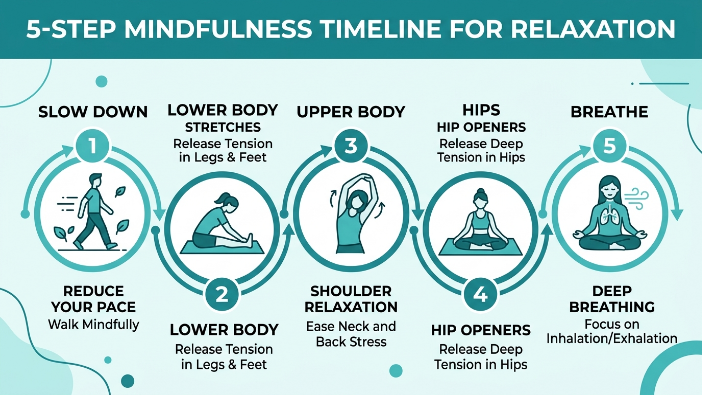
This structure moves from general de-intensification to targeted stretching to nervous-system calming mirroring what sports scientists recognize as an effective recovery sequence, rather than jumping straight into deep stretches while your heart rate is still elevated.
A timed 10-minute sequence beats a random list of stretches every time.
12 Cool-Down Exercises After Sports for Fast Recovery
Below are the 12 cool-down exercises after sports for fast recovery that make up the protocol above. Move through them in order, holding each static stretch without bouncing.
1. Light Jog-to-Walk Transition
Reps/Duration: 3–5 minutes. Gradually drops your heart rate instead of stopping cold, which helps prevent blood from pooling in your legs.
Form tip: Resist the urge to stop dead even 60 extra seconds of easy movement makes a noticeable difference.
2. Seated Forward Bend
Reps/Duration: Hold 30–45 seconds, 2 sets. Releases the hamstrings and lower back, both heavily loaded in almost every sport involving running or jumping.
Form tip: Keep a slight bend in your knees if your hamstrings are especially tight; never force straight legs.
3. Runner’s Lunge
Reps/Duration: 30 seconds per side. Targets the hip flexors and quads, which tighten quickly after sprinting, kicking, or cutting movements.
Form tip: Keep your back leg mostly straight and your front knee stacked over your ankle, not past your toes.
4. Standing Quadriceps Stretch
Reps/Duration: 20–30 seconds per side. Especially important after sports with repeated sprinting or jumping, like basketball or soccer.
Form tip: Hold your ankle rather than your foot, and keep your knees close together to isolate the stretch.
5. Calf Stretch (Wall Lean)
Reps/Duration: 20–30 seconds per side. Calves absorb enormous impact during running-based sports and tighten fast once you stop moving.
Form tip: Keep your back heel flat on the ground lifting it shifts the stretch away from the calf.
6. Spinal Twist
Reps/Duration: 20–30 seconds per side. Releases tension in the back and core from rotational movements common in throwing, swinging, and striking sports.
Form tip: Move slowly into the twist and avoid pulling with your arm; let your torso rotation do the work.
7. Child’s Pose
Reps/Duration: Hold 1–2 minutes. A gentle full-body release for the hips, back, and shoulders useful after nearly any sport.
Form tip: Let your hips sink back toward your heels rather than staying lifted, to deepen the release.
8. Chest Opener Stretch
Reps/Duration: 20–30 seconds. Counteracts the forward-hunched posture common in cycling, rowing, and racquet sports.
Form tip: Keep your shoulders down away from your ears as you open your arms.
9. Cat-Cow Stretch
Reps/Duration: 8–10 slow cycles. Restores spinal mobility after compressive movements like lifting, jumping, or repeated impact.
Form tip: Move slowly and match the motion to your breath inhale on cow, exhale on cat.
10. 90-90 Hip Stretch
Reps/Duration: 20–30 seconds per side. Releases deep hip rotators that work overtime in sports involving pivoting or changing direction.
Form tip: Keep your hips square to the floor rather than letting them rock side to side.
11. Neck and Shoulder Stretch
Reps/Duration: 15–20 seconds per side. Often skipped, but contact and racquet sports load the neck and shoulders more than people realize.
Form tip: Keep the stretch gentle the neck has a small range of motion and doesn’t need force.
12. Deep Breathing (Box Breathing)
Reps/Duration: 1–2 minutes. Shifts your nervous system out of ‘fight or flight’ mode and into recovery mode the final step that ties the whole routine together.
Form tip: Inhale for 4 counts, hold for 4, exhale for 4, hold for 4, and repeat the cycle.
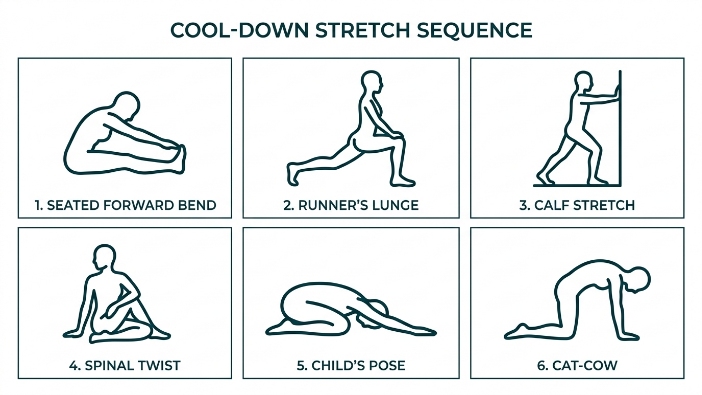
A quick visual reference for the core stretches in your cool-down sequence.
Sport-Specific Cool-Down Adjustments
Different sports load different muscle groups, so your cool-down should shift focus depending on what you just played rather than following one fixed routine for every activity.
Dynamic mobility, tension release in worked muscle groups
8–12 minutes
Cat-cow, chest opener, thread the needle, deep breathing
Combat & Martial Arts
Full-body tension release, joint decompression
12–15 minutes
Scorpion stretch, 90-90 stretch, shoulder stretch, deep breathing
Youth / Beginner Athletes
Gentle de-escalation, body awareness, recovery education
6–8 minutes
Gentle walk, seated forward bend, butterfly stretch, deep breathing
Browse cooldowns by activity in our [INTERNAL LINK: Sport-Specific Recovery Guides] hub.
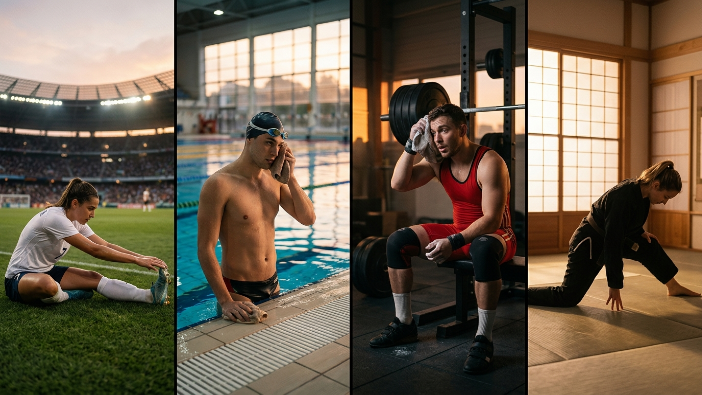
Cool-down focus shifts depending on which muscle groups your sport relies on most.
Common Cool-Down Mistakes That Slow Recovery
Stopping abruptly the moment the game ends instead of easing out gradually
Skipping stretching entirely and heading straight to the car or shower
Bouncing during static stretches instead of holding them steady
Using the same generic stretch routine regardless of which muscle groups were actually worked
Treating the cool-down as optional on days you’re short on time, when it takes only a few minutes
Most of these come down to treating the cool-down as an afterthought rather than the final phase of the session. Athletes who recover consistently well tend to protect those extra 10 minutes the same way they protect their warm-up time.
Struggling with recurring soreness or tightness? Our [INTERNAL LINK: Injury Prevention for Athletes] guide covers recovery-focused adjustments to your training week.
Cool-Down Considerations by Age and Experience Level
Beginners generally do best with a shorter, gentler sequence a slow walk and a few basic held stretches are enough to start building the habit without it feeling like extra homework after a tiring game.
Intermediate and advanced athletes can extend the static stretching portion and add more targeted work for whichever muscle groups took the heaviest load, since they’re more attuned to where they’re feeling tightness.
Athletes over 35 often benefit from a few extra minutes in the cool-down to support joint recovery, since connective tissue naturally becomes less elastic with age. Youth athletes, meanwhile, typically need less intensive stretching but benefit from the routine itself building the habit early pays off well into their athletic careers.
New to structured training? Start with our [INTERNAL LINK: Beginner’s Guide to Sports Conditioning] before layering in advanced recovery work.
Building a Recovery Routine That Actually Sticks
Knowing which stretches to do matters less than actually doing them consistently. Most athletes cool down properly during structured practice but skip it after casual games or tournaments, which is exactly when the accumulated fatigue of multiple matches in a day makes recovery most important.
A few small habits make the routine easier to keep. Pack a water bottle and a small snack for right after the final whistle, since your cool-down works better when your body isn’t also managing dehydration or low blood sugar. Treat the routine as part of the game itself rather than an optional extra pairing it with something automatic, like walking back to your bag or car, helps it become a habit rather than a decision you have to make each time.
Sleep also plays an outsized role in how quickly you bounce back. A solid cool-down supports the first hour of recovery, but the muscle repair that follows DOMS-inducing exercise happens largely during deep sleep in the days after. Pairing a good cool-down with consistent sleep and adequate protein intake will do more for how you feel two days later than the stretching routine alone.
20 unique benefit
Here are 20 unique benefit-focused lines for “12 Cool-Down Exercises After Sports for Fast Recovery”:
12 Cool-Down Exercises After Sports for Fast Recovery help reduce muscle soreness and stiffness.
12 Cool-Down Exercises After Sports for Fast Recovery improve blood circulation after intense activity.
12 Cool-Down Exercises After Sports for Fast Recovery lower the risk of muscle cramps.
12 Cool-Down Exercises After Sports for Fast Recovery increase flexibility for better movement.
12 Cool-Down Exercises After Sports for Fast Recovery help your heart rate return to normal gradually.
12 Cool-Down Exercises After Sports for Fast Recovery support faster muscle repair and recovery.
12 Cool-Down Exercises After Sports for Fast Recovery reduce post-workout fatigue and discomfort.
12 Cool-Down Exercises After Sports for Fast Recovery improve joint mobility after exercise.
12 Cool-Down Exercises After Sports for Fast Recovery help prevent muscle tightness.
12 Cool-Down Exercises After Sports for Fast Recovery promote relaxation for both body and mind.
12 Cool-Down Exercises After Sports for Fast Recovery prepare your body for the next training session.
12 Cool-Down Exercises After Sports for Fast Recovery help improve overall athletic performance.
12 Cool-Down Exercises After Sports for Fast Recovery reduce the chance of sports-related injuries.
12 Cool-Down Exercises After Sports for Fast Recovery improve recovery without special equipment.
12 Cool-Down Exercises After Sports for Fast Recovery help maintain healthy muscle function.
12 Cool-Down Exercises After Sports for Fast Recovery boost flexibility while easing muscle tension.
12 Cool-Down Exercises After Sports for Fast Recovery encourage better posture and body balance.
12 Cool-Down Exercises After Sports for Fast Recovery support long-term fitness and endurance.
12 Cool-Down Exercises After Sports for Fast Recovery help you recover comfortably after every game.
12 Cool-Down Exercises After Sports for Fast Recovery keep your body ready for your next sports challenge.
Frequently Asked Questions
What are the best 12 cool-down exercises after sports for fast recovery?
A well-rounded sequence covers gradual heart-rate reduction, static stretching, and breathing: a light jog-to-walk transition, seated forward bend, runner’s lunge, standing quad stretch, calf stretch, spinal twist, child’s pose, chest opener, cat-cow, 90-90 hip stretch, neck and shoulder stretch, and deep breathing. Together, these 12 cool-down exercises after sports for fast recovery take about 10 minutes and help your body transition out of competition mode smoothly.
How long should a cool-down be after playing sports?
Most athletes benefit from 8 to 15 minutes, depending on sport intensity and duration. Endurance events often need closer to 15 minutes, while shorter recreational games can be adequately covered in 8 to 10 minutes.
Does cooling down actually reduce muscle soreness?
Research is mixed on whether cooldowns directly prevent next-day soreness, but they reliably help lower heart rate gradually, reduce dizziness risk, and improve flexibility all of which support a smoother overall recovery.
Can you skip a cool-down after a low-intensity game?
For light, low-intensity activity, a separate structured cool-down is less critical. For anything moderate to vigorous most competitive sports a few minutes of gradual de-intensification is still worth the time.
Is static stretching after sports better than dynamic stretching?
Yes, generally. Static stretching is best saved for after activity, when muscles are already warm and more receptive to holding a lengthened position, unlike before a game when dynamic movement is preferred.
Is lactic acid really what causes muscle soreness after sports?
Not exactly. Lactic acid clears from the muscles within about an hour of finishing exercise. The soreness felt a day or two later, known as DOMS, is now understood to come mainly from microscopic muscle fiber damage rather than lactic acid buildup.
Do younger athletes need a different cool-down than adults?
Youth athletes generally do well with a shorter, gentler cool-down focused on calming down and light stretching, while adults especially those over 35 often benefit from a few extra minutes to support joint recovery.
Quick answers to the questions athletes ask most about cooling down.
Final Takeaway
A proper cool-down isn’t dead time after the real work is done it’s the bridge between competition and recovery. Follow the 12 cool-down exercises after sports for fast recovery outlined here, adjust the focus based on your sport, and you’ll likely notice less stiffness, better next-day mobility, and a smoother return to training.