Have you ever watched two athletes with identical physical ability perform completely differently under pressure? One rises to the occasion; the other falls apart. This blog is covered by zainblogs. The difference rarely comes down to muscle. It comes down to mindset. If you want to know the 10 Ways to Develop a Winning Mindset in Sports, you’re in the right place and science is firmly on your side.
A landmark 2019 review of Olympic athletes ranked mental toughness as the single most important psychological factor separating winners from the rest. Yet over 62% of coaches say their greatest challenge is developing mental toughness in their athletes. The gap between knowing this and acting on it is exactly what this guide closes. Unlock your true potential with 10 Ways to Develop a Winning Mindset in Sports and transform your focus, confidence, and performance like a champion.
In the sections below, you’ll get 10 evidence-backed, practitioner-approved strategies that any athlete beginner, amateur, or advanced can start applying today. No fluff, no motivational clichés just a real roadmap built from sports psychology research and the habits of elite performers. 10 Ways to Develop a Winning Mindset in Sports help athletes develop resilience and recover quickly from failures.
What Is a Winning Mindset in Sports And Why Does It Matter?
A winning mindset isn’t arrogance and it isn’t blind positivity. According to sports psychologist Carol Dweck‘s foundational research, a winning mindset is fundamentally a growth mindset the belief that abilities, skills, and mental toughness can be developed through effort, strategy, and coaching. 10 Ways to Develop a Winning Mindset in Sports focus on staying present and concentrating on performance instead of outcomes.
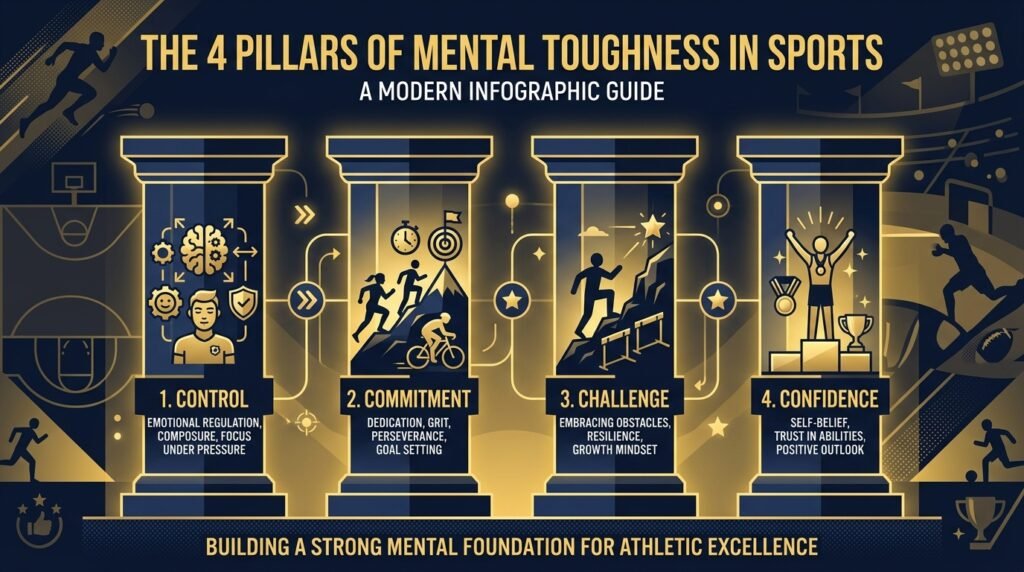
Athletes with a winning mindset share four psychological pillars, first identified by researchers Lee Crust and Peter Clough:
Control believing you govern your actions and emotions under pressure
Commitment staying dedicated to goals when motivation fades
Challenge seeing obstacles as opportunities rather than threats
Confidence maintaining self-belief even through setbacks
Master the 4 Pillars of Mental Toughness: Control, Commitment, Challenge, and Confidence.
The 10 Ways to Develop a Winning Mindset in Sports
Let’s break down each strategy. These aren’t abstract ideas each one includes a science-backed explanation and an action step you can implement this week.
1. Embrace a Growth Mindset Every Single Day
The foundation of the 10 Ways to Develop a Winning Mindset in Sports is this: you must believe that your abilities are not fixed. Research by Carol Dweck demonstrates that athletes with a growth mindset consistently outperform those with a fixed mindset not because they’re more talented, but because they keep getting better.
When a coach gives you critical feedback, a growth mindset hears “here’s how to improve.” A fixed mindset hears “I’m not good enough.” That internal interpretation shapes everything: your training effort, your resilience after losses, and your ceiling as an athlete. 10 Ways to Develop a Winning Mindset in Sports encourage surrounding yourself with supportive coaches, teammates, and mentors.
Most athletes obsess over winning the scoreboard, the medal, the ranking. But elite sports psychology teaches a different approach: fall in love with the process. Among the core 10 Ways to Develop a Winning Mindset in Sports, goal-setting done right is one of the most impactful yet most misunderstood. 10 Ways to Develop a Winning Mindset in Sports promote mental toughness, determination, and confidence under pressure.
Process goals are things fully within your control: ‘I will maintain defensive footwork for the entire first set.’ Outcome goals (‘I will win this match’) involve too many variables you can’t control the opponent, the weather, the referee. When your confidence depends only on outcomes, one bad result can collapse your entire mindset.
The SMART Goal Framework for Athletes
Specific ‘Improve sprint start reaction time by 0.1 seconds’
Measurable track it weekly with a stopwatch
Achievable within your current capability range
Relevant directly tied to your sport demands
Time-bound ‘within the next 4 weeks’
3. Master Pre-Performance Routines
When pressure peaks, your brain needs a script. That’s exactly what a pre-performance routine provides. Research consistently shows that structured pre-competition routines reduce anxiety by giving the nervous system a familiar, controllable sequence before high-stakes moments.
Legendary athletes from tennis player Rafael Nadal to basketball icon LeBron James are famous for their pre-game rituals. These aren’t superstitions. They’re psychological anchors. Among the 10 Ways to Develop a Winning Mindset in Sports, developing a personalized routine is one you can build starting today.
Sample 5-Minute Pre-Competition Routine
2 minutes: diaphragmatic breathing (4 counts in, 6 counts out)
1 minute: positive self-talk mantra (‘I have prepared for this. I am ready.’)
1 minute: mental rehearsal of your opening actions
30 seconds: physical cue (fist pump, shoulder roll, specific stretch)
30 seconds: focus on the first ‘controllable’ of the competition
4. Use Visualization and Mental Rehearsal
Champions win twicefirst in their minds, then on the field.
Visualization is one of the most scientifically proven tools in sports psychology. When you mentally rehearse a skill a free throw, a sprint start, a golf swing your brain activates the same neural pathways as actual physical execution. This is why 10 Ways to Develop a Winning Mindset in Sports always includes mental rehearsal at or near the top of the list.
Effective visualization isn’t just “see yourself winning.” Research from sports psychology experts emphasizes that the most powerful form includes:
Realistic sensory detail hear the crowd, feel the surface beneath you
First-person perspective see through your own eyes, not from the stands
Adversity rehearsal visualize a mistake, then rehearse your reset
Short and focused sessions 2 to 3 minutes is enough; don’t daydream
What you say to yourself in the middle of competition can lift you or bury you. Self-talk is not about pretending everything is perfect. It’s about consciously choosing internal language that keeps you focused, confident, and moving forward. Productive self-talk is one of the most researched and validated among the 10 Ways to Develop a Winning Mindset in Sports.
Research links positive self-talk to improved performance, better stress response, and greater consistency. The famous “catch it, name it, replace it” technique works like this:
Catch it: Notice the negative thought (‘I always mess up under pressure’)
Name it: Label it without judgment (‘There’s that self-doubt again’)
Replace it: Substitute with a focused cue (‘Next ball. My footwork. Breathe.’)
Examples of Productive Athletic Self-Talk
Replace ‘I can’t do this’ → ‘I’ve trained for this’
Replace ‘I’m terrible today’ → ‘What’s my next controllable action?’
Replace ‘Everyone’s watching me fail’ → ‘Focus on the process, not the crowd’
6. Build Resilience by Reframing Failure
Every elite athlete has a story of failure often many of them. What separates them is not that they fail less; it’s that they reframe failure differently. This cognitive skill sits at the heart of any authentic 10 Ways to Develop a Winning Mindset in Sports system.
The Hintsa Performance coaching model, used with Formula 1 champions and Olympic medalists, teaches that coping well even when things aren’t going well is an essential ingredient of a winning mindset. The goal isn’t to eliminate setbacks. It’s to shrink your recovery time from them.
3-Step Failure Reframe Process
Step 1 Acknowledge: ‘That didn’t go as planned, and it’s okay to feel that.’
Step 2 Extract: ‘What one thing can I learn or adjust from this?’
Step 3 Reset: ‘What’s my next action?’ Then take it.
7. Control What You Can Release What You Can’t
One of the most liberating mental shifts any athlete can make is drawing a clear line between what is within their control and what isn’t. Anxiety spikes when athletes spend mental energy trying to control uncontrollable things: the referee’s call, the opponent’s tactics, the weather, or the crowd.
Sports psychologists, including those at the Center for Sport Psychology at CBI (Pittsburgh), consistently identify this as a foundational skill. Among the 10 Ways to Develop a Winning Mindset in Sports, the control-focus distinction might produce the most immediate anxiety reduction.
The Two-Column Exercise
Draw two columns before your next competition:
WITHIN MY CONTROL: my effort, my preparation, my attitude, my response to adversity
OUTSIDE MY CONTROL: opponent performance, officiating, crowd reaction, weather
Commit to investing 100% of your mental energy only in column one.
8. Use Breathing Techniques to Regulate Pressure
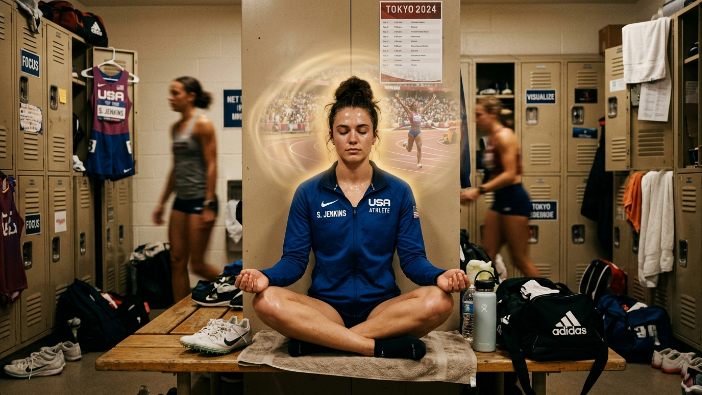
Mastering control starts with breaththis athlete uses box breathing to calm the mind, sharpen focus, and step into the game with confidence and clarity.
Breathing is the fastest physiological tool you have for regulating your nervous system under pressure. When anxiety spikes, breathing becomes rapid and shallow signaling ‘danger’ to your brain and increasing muscle tension, reduced decision-making speed, and tunnel vision.
Diaphragmatic breathing with extended exhales activates the parasympathetic nervous system (rest and recovery mode), and research confirms this is one of the most accessible and powerful of the 10 Ways to Develop a Winning Mindset in Sports that every athlete regardless of sport can use.
Proven Breathing Techniques for Athletes
Box Breathing (4-4-4-4): Inhale 4 counts → Hold 4 → Exhale 4 → Hold 4. Used by Navy SEALs and Olympic athletes.
2-1-4-1 Pattern: Fast reset technique for between points or plays.
9. Build a Strong Support System and Coaching Relationship
Mental toughness does not develop in isolation. Research consistently emphasizes the role of coaches, mentors, and teammates in creating the psychological environment where winning mindsets grow. Among the 10 Ways to Develop a Winning Mindset in Sports, this is the one most often overlooked in solo-focused training plans.
10. Practice Mindfulness to Sharpen In-Competition Focus
Mindset before movement peace, focus, and clarity build champions.
The final piece of the 10 Ways to Develop a Winning Mindset in Sports is mindfulness the practice of present-moment awareness without judgment. In sports, mindfulness training directly develops your ability to block distractions, stay ‘in the zone,’ and quickly return to focus after disruptions.
Mindfulness is not meditation as a lifestyle choice. For athletes, it’s a performance tool. Several elite programs, including those at the NBA, Premier League clubs, and Olympic training centers, now integrate mindfulness training into regular practice schedules.
Three Mindfulness Drills for Athletes
Sensory Anchoring: During a break in play, name 3 things you can physically feel right now (feet on ground, grip, breathing). This snaps focus back to the present.
The 10-Second Reset: After any mistake, take 10 seconds. Breathe. Identify your next action. Execute. No rumination.
Body Scan Pre-Sleep: A 5-minute scan from head to toe identifying tension helps recovery and builds body awareness critical for next-day performance.
Quick-Reference: 10 Ways to Develop a Winning Mindset in Sports
#
Strategy
Key Benefit
Time to Impact
1
Embrace Growth Mindset
Builds continuous improvement cycle
Immediate shift, 4–8 wk compounding
2
Process Goal Setting
Reduces outcome anxiety
1–2 weeks
3
Pre-Performance Routines
Controls pre-competition anxiety
2–4 weeks of consistency
4
Visualization / Mental Rehearsal
Reinforces neural pathways
2–6 weeks
5
Positive Self-Talk
Boosts confidence under pressure
1–3 weeks
6
Reframing Failure
Accelerates recovery from setbacks
Ongoing; faster over time
7
Control Focus
Reduces anxiety immediately
Immediate
8
Breathing Techniques
Regulates nervous system
Immediate; automatic in 4+ weeks
9
Support System / Coaching
Creates development environment
Medium-term (months)
10
Mindfulness Practice
Sharpens in-competition focus
6–8 weeks of daily practice
Going Deeper: What Elite Athletes Do Differently
Applying the 10 Ways to Develop a Winning Mindset in Sports is a starting point. What separates good athletes from great ones is how consistently and intelligently they apply these strategies across an entire career.
They Train Mental Skills Like Physical Skills
Elite athletes treat mindset training as non-negotiable as conditioning. They schedule visualization sessions, self-talk audits, and mindfulness practice the same way they schedule sprint training. Mental skills grow through deliberate, planned, repeated practice not by accident.
They Work With Sports Psychologists
Organizations like the Center for Sport and Performance Psychology at CBI offer personalized mental toughness training rooted in cognitive-behavioral techniques. Working with a licensed sport psychologist provides accountability, precision, and customization that self-directed practice alone cannot replicate.
They Track Their Mental Game
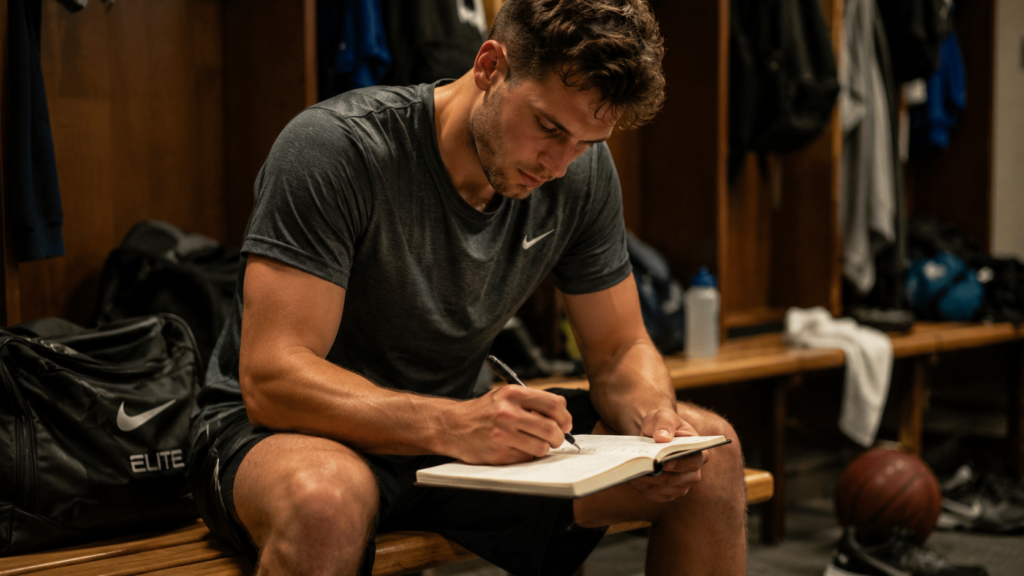
Elite athletes journal. They review not just physical performance but emotional patterns, focus quality, and response to adversity. Over time, this self-awareness data is one of the most powerful competitive tools available.
Reflect, record, and rise every session builds a stronger mind and a better performance.
Related Topics Worth Exploring
The 10 Ways to Develop a Winning Mindset in Sports intersects with a wider ecosystem of mental performance topics. Here are related areas worth exploring as you advance:
Sports psychology techniques for competition anxiety
Mental toughness training programs for youth athletes
Growth mindset exercises for coaches
How to build resilience in team sports environments
Peak performance mindset for endurance athletes
Overcoming performance anxiety in high-stakes competition
Q: What does it mean to have a winning mindset in sports?
A: A winning mindset in sports means consistently choosing focus, resilience, and growth-oriented responses over anxiety, blame, or fixed thinking especially under competitive pressure. It’s not about always winning; it’s about maximizing your performance potential and bouncing back effectively from setbacks.
Q: Can a winning mindset be developed, or is it something you’re born with?
A: Research consistently shows that mental toughness and winning mindset are trainable skills, not fixed personality traits. Carol Dweck’s growth mindset research and decades of sports psychology evidence confirm that deliberate mental skills training visualization, goal-setting, self-talk, mindfulness produces measurable improvements in any athlete’s mental game.
Q: How long does it take to develop a winning mindset in sports?
A: Some strategies like breathing techniques and control-focus awareness produce immediate benefits. Others, like mindfulness practice and growth mindset habits, typically show significant results after 4–8 weeks of consistent daily practice. Full mental toughness development is a career-long process that compounds over time.
Q: What is the difference between mental toughness and a winning mindset?
A: Mental toughness refers specifically to the psychological capacity to perform consistently under pressure and adversity. A winning mindset is broader it includes mental toughness but also encompasses goal-setting philosophy, growth orientation, support systems, and daily mental habits. You need mental toughness to execute a winning mindset in competition.
Q: How do elite athletes stay mentally strong during losing streaks?
A: Elite athletes use structured reframing techniques (extract one learning, identify the next controllable action), maintain pre-performance routines to keep their emotional baseline stable, rely heavily on their support systems for perspective, and use journaling to separate factual analysis from emotional reaction during poor performance periods.
Final Thoughts: Start Your Mindset Training Today
The 10 Ways to Develop a Winning Mindset in Sports are not a passive reading list they’re a performance training system. Every elite athlete who has ever dominated their sport has, consciously or not, developed most of these mental habits. The difference between knowing them and doing them is where your competitive edge lives. 10 Ways to Develop a Winning Mindset in Sports emphasize the importance of discipline and commitment to training routines. 10 Ways to Develop a Winning Mindset in Sports teach athletes to learn from mistakes rather than being discouraged by them.
You don’t have to implement all 10 at once. Pick one strategy from this guide start with growth mindset journaling or pre-competition breathing practice it for two weeks, then add the next. Mental skills compound exactly the way physical fitness does: slowly at first, then dramatically. The 10 Ways to Develop a Winning Mindset in Sports are available to every athlete willing to take them seriously. 10 Ways to Develop a Winning Mindset in Sports highlight the value of visualization and imagining success before competitions.
10 Ways to Develop a Winning Mindset in Sports starts with setting clear goals that keep you focused and motivated every day. 10 Ways to Develop a Winning Mindset in Sports include maintaining a positive attitude even when facing challenges and setbacks. 10 Ways to Develop a Winning Mindset in Sports encourage athletes to build self-confidence through consistent practice and preparation. Choose differently, starting today. This article (10 Ways to Develop a Winning Mindset in Sports) is very helpful.