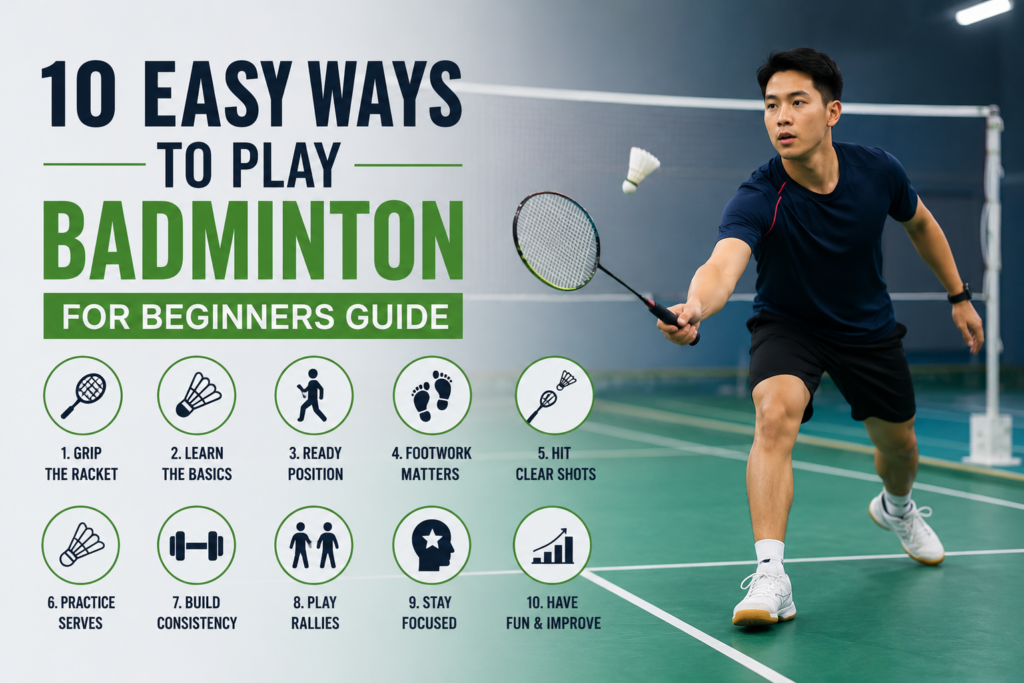
Begin your badminton journey with the right stance and confidence.
Picking up a racket for the first time can feel intimidating, especially when you watch fast-paced rallies on TV and wonder how anyone reacts that quickly. This blog is covered by zainblogs. The truth is, badminton is one of the easiest racket sports to start playing casually, and you don’t need years of training to enjoy your first real rally. This 10 Easy Ways to Play Badminton for Beginners Guide breaks the sport down into simple, practical steps so you can go from holding a racket for the first time to playing confident matches with friends.
Unlike complicated technical manuals, this 10 Easy Ways to Play Badminton for Beginners Guide focuses on what actually matters for beginners: the right grip, basic footwork, a reliable serve, core shots, and a simple practice routine you can follow without a coach. Whether you’re picking up badminton for fitness, fun, or to join friends at the local court, these ten steps will get you rallying with confidence in a matter of weeks.
By the end of this guide, you’ll understand not just the rules but exactly how to practice, what mistakes to avoid, and how to structure your first few weeks on the court. Let’s walk through the 10 Easy Ways to Play Badminton for Beginners Guide, one step at a time.
Quick Overview: The 10 Easy Ways to Play Badminton for Beginners
Understand the Basic Rules and Scoring
Get the Right Equipment
Learn the Correct Grip
Master Basic Footwork
Learn the Underhand Serve
Practice the Core Shots
Build a Simple Practice Routine
Play Regularly With a Partner or Against a Wall
Learn Basic Strategy and Court Positioning
Warm Up, Stretch, and Avoid Common Beginner Mistakes
Why Badminton Is One of the Best Sports for Beginners
Badminton is fast to learn because the fundamentals grip, footwork, and a basic serve can realistically be picked up within your first couple of sessions. It’s also incredibly accessible: all you need is a racket, a shuttlecock, and a bit of open space, whether that’s a proper court, a driveway, or a park lawn. Unlike sports that demand significant strength or size, badminton rewards reflexes, timing, and consistency, which means beginners of almost any age or fitness level can start enjoying real rallies quickly.
This 10 Easy Ways to Play Badminton for Beginners Guide is designed around that accessibility. Instead of overwhelming you with every possible shot and rule on day one, it breaks the learning process into ten manageable steps that build on each other naturally.
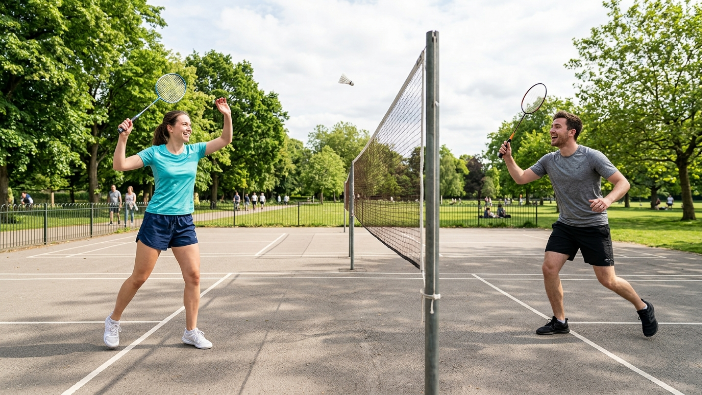
Badminton’s simple equipment and fast learning curve make it one of the easiest racket sports for beginners to pick up.
The 10 Easy Ways to Play Badminton for Beginners
1. Understand the Basic Rules and Scoring
Before you even pick up a racket, it helps to understand how a game actually works. A standard badminton match is played to 21 points across a best-of-three format, and a point is scored on every single serve, regardless of who served this is different from older scoring systems and trips up a lot of newcomers. The shuttle must land inside the court boundaries, and if it touches the net, the floor outside the lines, or is hit twice by the same player, it counts as a fault.
Understanding scoring early is one of the simplest entries in this 10 Easy Ways to Play Badminton for Beginners Guide, because it lets you actually keep score and play a real game from your very first session instead of just rallying aimlessly.
Key rules to remember: – Matches are played to 21 points (win by 2, capped at 30). – Players switch sides after each game, and mid-game once a team reaches 11 points in the deciding game. – Serves must be hit below the server’s waist and travel diagonally into the correct service box.
2. Get the Right Equipment
You don’t need expensive gear to start playing badminton in fact, one of the sport’s biggest advantages is how little equipment it requires. A lightweight beginner racket with a larger head (for more forgiveness on off-center hits), a few nylon or feather shuttlecocks, and a pair of non-marking court shoes are really all you need.
Getting your equipment right early is a practical step in this 10 Easy Ways to Play Badminton for Beginners Guide, because a racket that’s too heavy or shoes with poor grip can slow your progress and increase your risk of injury.
Beginner equipment checklist: – Lightweight racket (80–90 grams) with a larger head for control – Nylon shuttlecocks for practice (more durable than feather ones) – Non-marking indoor court shoes with good lateral support – Comfortable, breathable sportswear
A common question when following this 10 Easy Ways to Play Badminton for Beginners Guide is whether to buy expensive gear upfront. The honest answer is no a mid-range beginner racket in the $15–$30 range performs perfectly well for your first year of play, and you can always upgrade once you understand your own playing style and preferences. Start your badminton journey with 10 Easy Ways to Play Badminton for Beginners Guide.
3. Learn the Correct Grip
Grip is the foundation of every shot you’ll ever hit, which is why nearly every coach starts here. The two essential grips for beginners are the forehand grip (hold the racket like you’re shaking someone’s hand) and the backhand grip (rotate your thumb slightly so it rests behind the flat side of the handle). Advanced players also use bevel and panhandle grips, but as a beginner, mastering the forehand and backhand grip covers the vast majority of shots you’ll need.
Practicing your grip is one of the most overlooked entries in any 10 Easy Ways to Play Badminton for Beginners Guide, mainly because it doesn’t require a court you can practice switching between grips at home while watching TV.
Quick grip drill: Hold your racket loosely and switch between forehand and backhand grip 20 times without looking down at your hand. Repeat daily until it becomes automatic.
4. Master Basic Footwork
Good footwork matters more than raw power in badminton, especially for beginners. The two most important movement patterns are the 2-step (a quick right-left movement to reach a nearby shuttle) and the split step (a small hop just before your opponent hits, which keeps you balanced and ready to move in any direction).
Footwork is consistently one of the most underrated steps in this 10 Easy Ways to Play Badminton for Beginners Guide, because players who move well look and play like far more experienced athletes, even with basic shot technique. Improve every match through 10 Easy Ways to Play Badminton for Beginners Guide.
Simple footwork drill: Place five shuttlecocks randomly around the court, then practice moving quickly to “pick up” each one and return to the center, focusing on balance rather than speed.
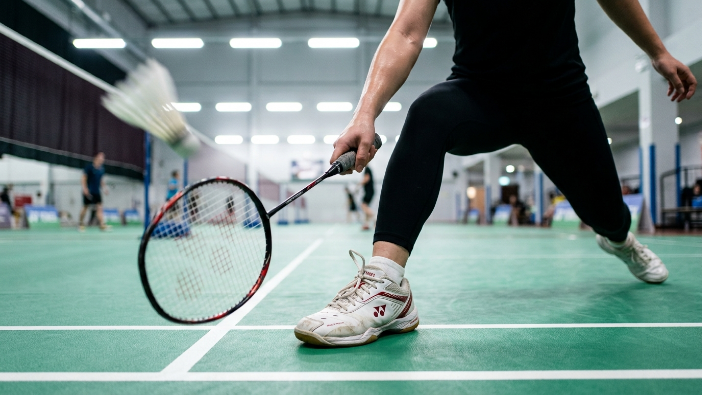
Good footwork, like the lunge and split step, matters more than raw power for beginner players.
5. Learn the Underhand Serve
The serve starts every single rally, so it’s worth mastering early. The underhand serve hitting the shuttle upward from below your waist is the standard, legal serve for beginners and is far more consistent than trying to smash a serve like a tennis ball. Stand close to the service line, hold the shuttle at waist height, and swing gently upward and diagonally into the correct service box.
Serving reliably is one of the fastest ways to start enjoying real games, which is why it holds a central place in this 10 Easy Ways to Play Badminton for Beginners Guide a consistent serve means fewer stalled rallies and more actual play. Play smarter with 10 Easy Ways to Play Badminton for Beginners Guide.
Serve practice target: Try serving 30–50 times into the correct diagonal box each session. Focus on consistency over power for the first few weeks.
6. Practice the Core Shots
Once your grip, footwork, and serve are solid, it’s time to build your shot vocabulary. Beginners should focus on five core shots:
Clear: A high shot that pushes your opponent to the back of the court.
Drop: A soft shot that barely clears the net, forcing your opponent forward.
Drive: A fast, flat shot that travels quickly across the net at mid-height.
Smash: A powerful downward shot used to end a rally quickly.
Net shot (lift/kill): Close-to-net shots used either to reset the rally (lift) or finish it (kill).
Learning these five shots is arguably the most important section of this 10 Easy Ways to Play Badminton for Beginners Guide, since combining them is what actually turns a casual rally into a real, strategic game. Learn the right techniques with 10 Easy Ways to Play Badminton for Beginners Guide.
Practice tip: Rally against a wall or with a partner using only clears and drops for your first few sessions save the smash for once your control is solid. Many beginners following this 10 Easy Ways to Play Badminton for Beginners Guide find that spending an extra week on clears and drops before introducing smashes pays off with far more consistent rallies later on.
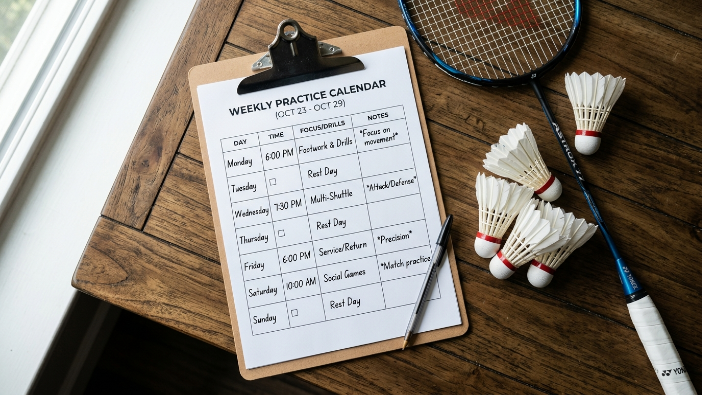
7. Build a Simple Practice Routine
Random practice sessions get you only so far. A simple, repeatable routine even just 3–4 sessions a week of 30–45 minutes builds skill far faster than occasional, unstructured play. A basic weekly structure might rotate between grip and footwork drills, serve practice, shot repetition against a wall or partner, and light match play. Develop better footwork with 10 Easy Ways to Play Badminton for Beginners Guide.
Structuring your practice is what separates casual players from confident ones, and it’s a core pillar of this 10 Easy Ways to Play Badminton for Beginners Guide because consistency, not talent, is what drives real improvement in the first month. Boost your confidence using 10 Easy Ways to Play Badminton for Beginners Guide.
Sample weekly structure: – 2 sessions focused on grip, footwork, and serve drills – 1–2 sessions focused on core shots (clear, drop, drive, smash) – 1 session of light match play to apply what you’ve practiced
8. Play Regularly With a Partner or Against a Wall
Drills build technique, but nothing replaces actual play for developing timing and reflexes. If you don’t have a regular partner, rallying against a wall is a surprisingly effective substitute it forces quick reactions and consistent shot placement. If you do have a partner, casual half-court rallies are ideal for beginners since they reduce the court size and let you focus on control rather than covering large distances.
This step in the 10 Easy Ways to Play Badminton for Beginners Guide is where all your drilled skills start to feel natural, since real rallies force you to react instinctively instead of thinking through each shot. Follow 10 Easy Ways to Play Badminton for Beginners Guide for quick improvement.
Beginner rally goal: Aim to sustain a 10-shot rally using only clears and drives before introducing drops and smashes into live play.
9. Learn Basic Strategy and Court Positioning
Once you can sustain a rally, basic strategy starts to matter. In singles, the goal is to move your opponent around the court pushing them deep with clears, then short with drops while returning to a central “base” position after every shot. In doubles, positioning shifts between a front-back formation (attacking) and a side-by-side formation (defensive), depending on whether your team has the shuttle advantage.
Understanding positioning is a more advanced but essential part of this 10 Easy Ways to Play Badminton for Beginners Guide, since even beginners who know basic strategy will consistently beat opponents with similar shot skills but no game plan. Train like a beginner with 10 Easy Ways to Play Badminton for Beginners Guide.
Simple strategy rule: After every shot, return to the center of your court this single habit improves coverage more than almost any other tactical adjustment for beginners.
Beyond returning to base, beginners benefit from thinking one shot ahead rather than reacting purely on instinct. For example, a well-placed drop shot tends to draw your opponent forward, which sets up an easy opening for a clear to the back court on your next exchange. This kind of simple two-shot thinking without needing to plan an entire rally is usually enough to start beating opponents who rely purely on hard hitting without a plan. Watching a few professional or intermediate matches, even casually on video, can also help you recognize these patterns faster than reading about them alone.
10. Warm Up, Stretch, and Avoid Common Beginner Mistakes
Badminton involves quick lunges, sudden direction changes, and overhead swings, all of which put strain on shoulders, knees, and ankles if you skip a proper warm-up. Spend 5–10 minutes on light cardio and dynamic stretches (leg swings, arm circles, lunges) before every session, and don’t skip a short cool-down afterward. Enjoy learning with 10 Easy Ways to Play Badminton for Beginners Guide.
Rounding out this 10 Easy Ways to Play Badminton for Beginners Guide, avoiding common beginner mistakes will save you weeks of frustration:
Gripping the racket too tightly this reduces wrist flexibility and increases injury risk.
Chasing power before control a soft, accurate shot beats a hard, wild one every time.
Ignoring footwork beginners often stand flat-footed, arriving late to every shot.
Skipping the serve rules illegal serves (above the waist, incorrect box) are among the most common beginner faults.
Not returning to base position leaving one side of the court open after every shot.
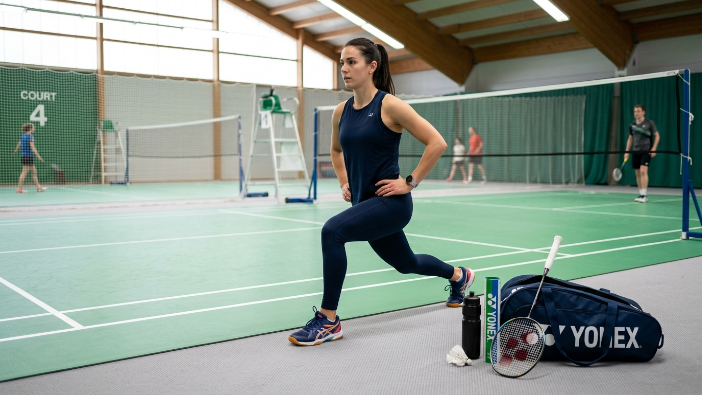
A short warm-up routine before every session helps beginners avoid common badminton injuries.
Singles vs Doubles: Which Should Beginners Start With?
One question that comes up constantly when people follow this 10 Easy Ways to Play Badminton for Beginners Guide is whether to start with singles or doubles matches. Both have value, but they teach slightly different skills. Build strong badminton skills using 10 Easy Ways to Play Badminton for Beginners Guide.
Singles forces you to cover the entire court alone, which accelerates footwork and stamina development faster than doubles. Rallies also tend to be longer, since there’s more open space to exploit with clears and drops, giving beginners more repetitions of core shots per match. The downside is that singles can be physically demanding for complete beginners, especially in the first few weeks.
Doubles, on the other hand, is more forgiving on stamina since you only cover half the court, and it introduces useful concepts like communication, formation switching, and reading a partner’s position. Many coaches recommend beginners start with casual doubles for fun and confidence-building, then transition to singles once footwork and shot control are more developed usually around week three or four of consistent practice.
Whichever format you start with, the fundamentals in this 10 Easy Ways to Play Badminton for Beginners Guide grip, footwork, serve, and core shots remain exactly the same. The format just changes how those skills get applied on court. Practice smarter with 10 Easy Ways to Play Badminton for Beginners Guide.
Tracking Your Progress as a Beginner
Without a coach tracking your development, it helps to build simple habits for measuring improvement. A few beginner-friendly options:
Keep a practice journal. Note which drills you did, how many successful serves or rallies you managed, and what felt difficult patterns emerge quickly over a few weeks.
Record short video clips. Filming your grip, footwork, or serve on a phone and comparing it to instructional videos is one of the fastest ways to spot technical errors you can’t feel yourself.
Set small weekly targets. For example, “sustain a 15-shot rally” or “land 8 out of 10 serves in the correct box” small, measurable goals keep motivation high.
Play with slightly better opponents. Playing people marginally more skilled than you exposes gaps in your game faster than always playing beginners at your own level.
Tracking progress this way turns the steps in this 10 Easy Ways to Play Badminton for Beginners Guide into a feedback loop rather than a one-time checklist, which is what actually drives steady, visible improvement over your first two to three months of play.
Beginner vs Intermediate vs Advanced: What Changes
Not every step in this 10 Easy Ways to Play Badminton for Beginners Guide needs to be mastered at once your focus should shift as your skill level grows:
Beginner (weeks 1–4): Focus on grip, footwork, the underhand serve, and clears/drops. Play casual half-court rallies to build consistency.
Intermediate (months 2–4): Add smashes, drive shots, and basic doubles formations. Start playing full-court singles and scored matches regularly.
Advanced (month 5+): Refine footwork speed, add serve variations (flick, low serve), and study opponent patterns to improve shot selection and court strategy.
Progressing through these stages honestly rather than rushing to smashes before your footwork and control are solid is what makes this 10 Easy Ways to Play Badminton for Beginners Guide effective for long-term improvement, not just a quick first session.
Comparison Table: The 10 Easy Ways at a Glance
Step
Focus Area
Time to Learn
1. Rules & Scoring
Knowledge
1 session
2. Equipment
Preparation
1 session
3. Grip
Technique
1–2 weeks
4. Footwork
Movement
2–3 weeks
5. Underhand Serve
Technique
1–2 weeks
6. Core Shots
Technique
3–4 weeks
7. Practice Routine
Structure
Ongoing
8. Regular Play
Application
Ongoing
9. Strategy & Positioning
Tactics
4–6 weeks
10. Warm-Up & Mistake Avoidance
Safety
Ongoing
Sample 4-Week Practice Schedule for Beginners
Week
Focus
Sample Sessions
Week 1
Grip, footwork basics, underhand serve
4 sessions, 30 minutes each
Week 2
Clears, drops, half-court rallies
4 sessions, 40 minutes each
Week 3
Drives, smashes, full-court singles
4 sessions, 45 minutes each
Week 4
Strategy, doubles basics, scored matches
4 sessions, 45–60 minutes each
This schedule mirrors the structure behind this 10 Easy Ways to Play Badminton for Beginners Guide, moving from fundamentals in week one to real, strategic play by week four.
A structured 4-week schedule helps beginners progress from basic drills to full scored matches.
Fitness and Health Benefits of Playing Badminton
Beyond the fun of rallying with friends, badminton delivers genuine fitness benefits that make it worth sticking with. It’s a high-intensity interval activity by nature short bursts of sprinting and lunging followed by brief recovery which makes it excellent for cardiovascular fitness and calorie burn, typically 400–500 calories per hour for casual singles play. The constant direction changes also improve agility, reaction time, and joint stability, particularly in the ankles and knees.
Beyond the physical side, badminton sharpens hand-eye coordination and mental focus, since tracking a shuttle traveling at high speed forces rapid decision-making. For many beginners following this 10 Easy Ways to Play Badminton for Beginners Guide, the combination of fitness, fun, and social play is what keeps them coming back long after the first few sessions.
Common Mistakes Beginners Make (and How to Fix Them)
Even with the right steps in place, a few recurring mistakes slow down beginner progress:
Skipping structured practice entirely. Casual play alone builds bad habits faster than it builds good ones mix in focused drills.
Copying advanced players too early. Trying to smash like a professional before your footwork and control are solid usually leads to inconsistent, wild shots.
Ignoring the non-racket hand and balance. Your free arm plays a real role in balance during lunges and overhead shots don’t let it hang uselessly.
Overthinking instead of reacting. Badminton moves fast; beginners who hesitate mid-rally are usually late to every shot. Trust your drilled footwork.
Not resting between sessions. Badminton’s quick, repetitive movements can lead to overuse injuries (especially in the shoulder and knees) without adequate recovery days.
Avoiding these pitfalls is just as valuable as following the positive steps in this 10 Easy Ways to Play Badminton for Beginners Guide, since bad habits formed early are often harder to unlearn than new skills are to build.
Learn faster with 10 Easy Ways to Play Badminton for Beginners Guide. Master the basics using 10 Easy Ways to Play Badminton for Beginners Guide. Improve your skills through 10 Easy Ways to Play Badminton for Beginners Guide. Start playing confidently with 10 Easy Ways to Play Badminton for Beginners Guide. Discover simple techniques in 10 Easy Ways to Play Badminton for Beginners Guide.
Frequently Asked Questions
1. How long does it take a beginner to learn badminton?
Most beginners can learn the core basics grip, footwork, serve, and simple shots within 3–4 weeks of regular practice, and can comfortably play scored matches with friends by the end of that first month.
2. What is the easiest shot for a beginner to learn first?
The underhand serve and the overhead clear are usually the easiest shots to learn first, since they involve simple, repeatable motions that don’t require precise timing like a smash or a delicate net shot.
3. Do I need a coach to follow this guide?
No. While a coach accelerates progress, this 10 Easy Ways to Play Badminton for Beginners Guide is designed so you can learn the fundamentals through self-practice, wall rallies, and casual games with friends or family.
4. How many times a week should a beginner practice badminton?
Three to four sessions per week of 30–45 minutes is ideal for beginners enough to build consistency and muscle memory without risking burnout or overuse injuries.
5. What equipment do I really need to start?
At minimum, a lightweight beginner racket, a few shuttlecocks, and non-marking court shoes are enough to get started you don’t need premium gear to follow these 10 easy ways to play badminton as a beginner.
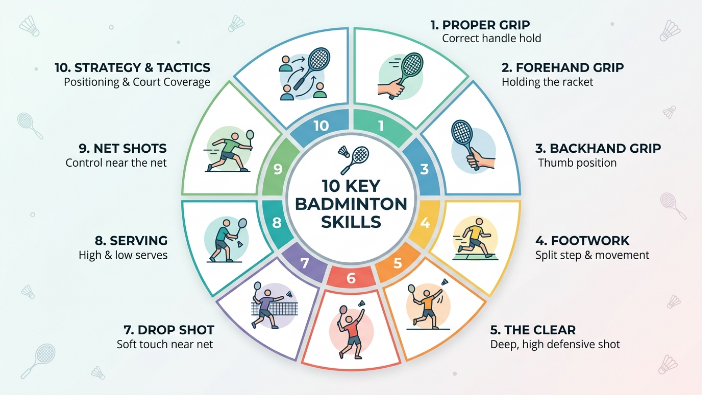
The 10 easy steps beginners can follow, from basic rules to match-ready strategy.
Final Verdict
Learning badminton doesn’t require expensive coaching or years of practice it requires a clear, structured approach. This 10 Easy Ways to Play Badminton for Beginners Guide walks you through exactly that: understanding the rules, getting simple equipment, mastering grip and footwork, learning a reliable serve, building your core shots, and finally applying everything through regular, structured play.
Start with the first two or three steps this week, stay consistent with practice, and don’t rush toward smashes and advanced strategy before your fundamentals are solid. Within a month of following these ten steps, you’ll go from someone who’s never held a racket to a player who can serve, rally, and enjoy a full scored match with confidence.
Badminton rewards patience far more than raw athleticism, and that’s precisely why this 10 Easy Ways to Play Badminton for Beginners Guide is built around gradual, layered skill-building rather than quick shortcuts. Every advanced player you’ll ever watch on TV started exactly where you are now fumbling their grip, missing serves, and slowly building the muscle memory that eventually looks effortless. Give yourself permission to be a beginner for a few weeks, trust the process outlined here, and focus on small, consistent wins rather than instant mastery.
The court is waiting, the equipment list is short, and every one of the ten steps above is something you can start practicing today even if that just means switching between forehand and backhand grip while you watch TV tonight. Pick up a racket, find a wall or a willing friend, and start turning this guide into real, on-court progress.